Katie Strang asked the only question that still mattered a month after Matthew Mayich hit the turf at Sun Angel Stadium, and Greg Powers treated it like a schedule conflict.
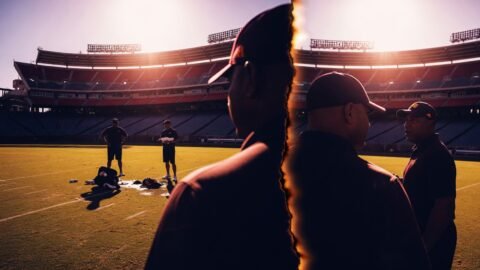
A 21-year-old defenseman from Ontario, eight days into Arizona after transferring in, collapsed near the end of a roughly 45-minute outdoor session on Aug. 20. Temperatures sat in the mid-to-high 80s with humidity around 50 percent and almost no wind. A former Green Beret named Tim Ziesel, who held no university contract for the three-day event, ran calisthenics, sprints, bear crawls, and a medicine-ball relay while Powers and his staff watched. Tempe Fire got the heat-emergency call at 8:31 a.m. Mayich remains on life support. His family’s attorney says there is no realistic path to recovery. ASU’s internal review interviewed about 20 people, assigned no responsibility, and floated a blue-ribbon panel instead of naming failures already on the books. Powers is still the head coach. The season opens Oct. 2-3 at Lindenwood.
That is the ledger Strang walked into on NCHC media day.
Accountability Became a One-Word Dodge
Powers opened with a prepared line about a “tremendous university support system” for Mayich, his family, and the rest of the roster, then said rink work “is what is helping us most.” After that he shut the door. Strang did not. She asked why answering hockey questions felt more urgent than the circumstances that left one of his players on life support. Powers replied, “Again, just not able to answer questions about it in any way.” A communications staffer tried to redirect. Strang held the floor for one more: past players had told her accountability sat at the center of his philosophy. How had he modeled it for this team over the past month?
“In a lot of ways,” Powers said.
“Can you expand on that?”
“No, not today.”
Powers is operating under an active campus police probe and a university review. Fair. The family attorney has already framed a potential wrongful-death path. Also fair. None of that required him to pretend the guiding principle past players associated with him somehow evaporates the moment the cameras are on. “In a lot of ways” is the linguistic equivalent of a shrug. The tape of that exchange will outlive any press-release language about thoughts and prayers.
The Athletic’s earlier reporting laid out the culture that produced the workout in the first place. After a 14-21-1 season that finished last in the NCHC and missed the conference tournament entirely, Powers told a 247Sports podcast the group lacked buy-in and identity and called it soft. Ten players hit the transfer portal. Eighteen newcomers arrived for 2026-27, Mayich among them. The toughness posture that followed, according to that reporting, included locker-room postings and language that treated softness as a moral failure. Ziesel’s session fit the brand: cadence, repeating commands, penalty sprints for lagging. Powers had told the team the day before it would be team-building with physical activity built in and to hydrate and eat well. He did not, per the university timeline, submit Ziesel’s actual training plan for review by ASU strength and conditioning staff. When asked this week about current routines, Powers said, “I don’t run workouts,” and pointed at the strength coach operating business as usual.
That sentence is the whole mechanism. The head coach who spent more than a decade building the only Division I program ASU has ever known, who signed a five-year extension through 2030 last November, claims he does not run the workouts that define the physical standard he demands. The review found the staff sought permission for Ziesel to speak but never cleared the training design. No one is on leave. Practices continue.
The Season Cannot Outrun the File
College hockey’s first official activity window opened Aug. 20. ASU used it for an outdoor session in desert heat with an outside consultant who left before the collapse. The family attorney called the university’s September report “more advocacy than fact-finding” and noted it ignored existing policy violations rather than inventing new ones. Powers remains the public face because the athletic department has decided continuity outweighs the optics of a player still on life support while the coach talks about identity and buy-in.
Strang’s questions were not theater. By the time an investigative reporter goes public like that, the quieter channels have usually failed. She has done this work across baseball, hockey, and high-profile institutional failures. The exchange became contentious because Powers used the investigation as a blanket over every question about his own modeling of the standard he sold players for years. NCHC staff tried to steer back to the season. The season is the least interesting part of this story until someone explains how a program that just lost ten players to the portal and imported eighteen new ones plans to sell parents on safety when the coach will not expand on accountability the month after a heat-stroke emergency.
Mayich arrived Aug. 12, passed a physical, completed three prior voluntary sessions, and was down inside an hour on day one of formal activity. The university review assigned no blame. Powers answered “in a lot of ways” and then “no, not today.” Mullett Arena cost $137 million. The program’s ceiling was supposed to match the building. Right now the only number that matters is the one still sitting in a hospital bed while the head coach prepares for Lindenwood.
The rink will open on schedule. The questions Strang asked will not close with it.