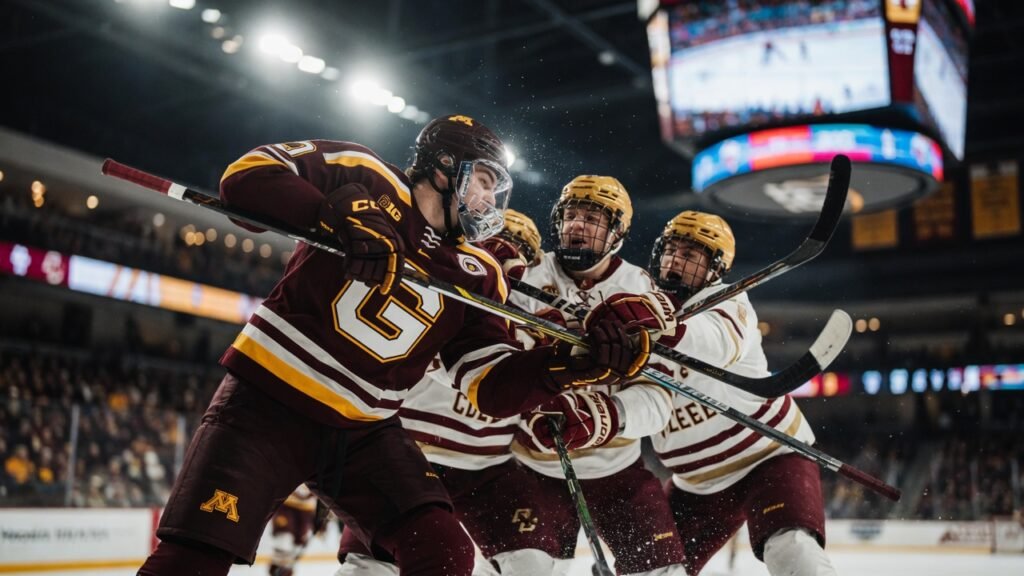
College hockey just walked the NCAA into a corner, took the eligibility hammer out of its hand, and rewrote the rule before August even got here. I am still not over how close this came to gutting every roster that matters.
The original 5-in-5 model the Division I Cabinet advanced in the spring was clean on a whiteboard and catastrophic in a locker room. Start the five-year clock the academic year after expected high school graduation or the athlete’s 19th birthday, whichever hit first, and you were handing the average men’s DI hockey freshman a short leash with a smile. That average age at enrollment sits at 20.3. Of the 509 freshmen in a recent season, 80 percent were already 20 or 21 when the season started. Ninety-nine percent of first-year players came out of junior leagues. Only 16 percent of DI men’s goaltenders were even on campus by 19. The plan did not simplify hockey. It would have turned the USHL, NAHL, BCHL, and CHL path into a three-year degree with extra steps.
All 63 DI men’s hockey coaches voted against it. Then the cavalry arrived. NHL Deputy Commissioner Bill Daly went public before Game 1 of the Stanley Cup Final: “We’re not in favor of the change, and we’ve made the NCAA aware of it. We and a number of other hockey organizations throughout North America — the three junior leagues in Canada, the USHL, USA Hockey, the college coaches’ association — all have raised concerns.” Gary Bettman was blunter about the philosophy: “I hope that a one-size-fitting-all solution, which disadvantages some sports over others, isn’t the way they go because I think that would be unfair to us.”
Hockey East commissioner Steve Metcalf later described the rescue with zero corporate varnish. “Quite frankly, people couldn’t believe what we’d done. A week prior, people were saying we were dead and buried. We were cooked.”
They were not cooked. The Cabinet flipped.
The Clock Moved Because Junior Hockey Is the Product
On June 5 the Cabinet adopted the hockey-backed trigger. On June 23 it unanimously approved the modified age-based model. The five-year window still exists. The clock now starts at initial full-time college enrollment or the academic year following the 19th birthday, whichever comes first. Effective date: August 1, 2026. Current athletes with remaining eligibility and 2026-27 first-time enrollees get the better of the old or new rules. Fall 2027 and beyond live under the new model only. The old men’s hockey 21-year-old delayed-enrollment rule is gone.
That is not a participation trophy. That is the difference between a 20-year-old freshman keeping four years or landing with three, and between a high-school graduate who takes one junior season retaining all five. The people pushing the high-school-graduation trigger treated junior hockey like a loophole that needed closing. It is the entire feeder system. USHL alumni accounted for 244 of the 437 players in the 2026 NCAA Tournament field. More than 195 USHL alums were on NHL Opening Night rosters in 2024-25. CHL alumni filled roughly half the league on Opening Night 2025-26, with 59 of 61 clubs carrying at least one. You do not “streamline” that into a high-school conveyor belt because some other sports wanted fewer waivers and cleaner litigation numbers.
Division I Cabinet chair Josh Whitman sold the final version as rules that are “simpler to administer and easier to predict for roster management decisions.” True enough. Simpler than the war crime against the salary-cap-adjacent roster math they almost inflicted on a sport that develops later on purpose.
Metcalf, speaking for the whole ice hockey community after the counter-proposal landed, said they were “grateful to the NCAA Division I Cabinet for their willingness to consider and support our counter-proposal on age eligibility.” Grateful is the polite version. The real version is that the NCAA got told, by every coach and the NHL itself, that one-size-fits-all was about to nerf the only pipeline that actually works here, and then the Cabinet blinked.
Minnesota High-School Commits Are Already the Next Brawl
I know what the traditional media take will be. Some suit will lead with “statistically speaking, uniformity reduces risk,” pour a glass of Skip energy, and move on. Cool. Meanwhile the first Minnesota high-school commitments under the new rules are already lighting up the recruiting fairness fights, and that is exactly where this story goes next. Hockey kept the junior path intact. Now every coach, every parent, and every 18-year-old commit gets to argue about who actually benefits from the five-year window and when the clock should feel fair.
A kid who leaves high school around 18 can still play one junior season and keep the full five. Spend two years after 19 and you enroll with three left. That math is the whole sport. The original proposal was going to pretend football’s development calendar should run the show for a sport where the dawg in a 20-year-old USHL captain is the feature, not a bug.
Other sports that develop straight from high school get the clean PowerPoint they wanted. Hockey just proved that when your ecosystem includes the NHL, USA Hockey, the CHL, the USHL, and 63 coaches who refuse to eat the L, the NCAA’s uniformity speech lasts about six weeks. The 5-in-5 window is still coming. Redshirts as we knew them are mostly dead. Litigation reduction was always the quiet motive. College hockey’s ceiling, though, still lives and dies with late-blooming juniors who need that extra year or two before they can hang at the DI level. That path survived a near-death experience in May and June.
The Minnesota commits are only the opening round of the fairness argument. The actual scoreboard is whether every other sport that needs 19- and 20-year-old development finally learns how to lobby like this, or whether hockey remains the only one that refused to get nerfed while the Cabinet chased a single rulebook.