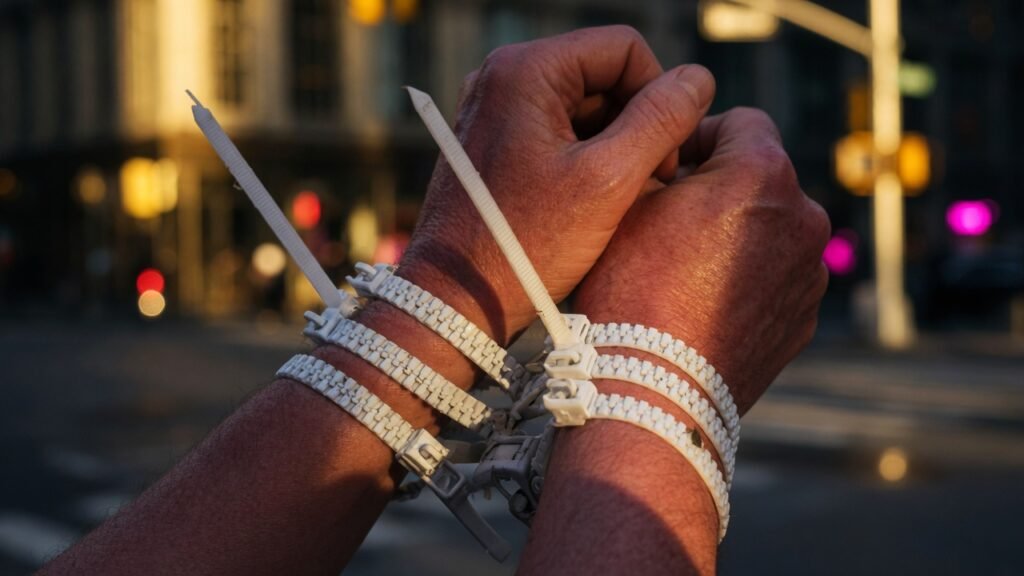
The zip ties went on Susan Sarandon like the last beat of a scene she had already decided to play. AFP cameras caught the Thelma & Louise star getting cuffed on a midtown Manhattan street Thursday as Benjamin Netanyahu prepared to address the United Nations, and a few feet away Hacks star Hannah Einbinder got walked toward a police bus yelling, “Free Palestine! Get Netanyahu out of New York!”
Look, I get it. Celebrity civil-disobedience arrests are a known product line now. You sit in the roadway, you ignore the dispersal order, you collect the photo, you drop the statement. Jewish Voice for Peace organized the sit-in a few blocks south of the UN. Protesters blocked the intersection of First Avenue and East 39th with banners reading “Stop Arming Israel” and “End the Genocide.” The NYPD called it an unscheduled demonstration, issued warnings through Community Affairs, and took into custody the people who stayed. Multiple outlets put the number over 100. Council members, a congressional candidate, Chelsea Manning, comedian Caleb Hearon. Same choreography, different marquee names.
Now, you might be thinking this column is about to litigate the entire Middle East from a sports-and-culture desk. Stay with me. The foreign policy is the backdrop. The Hollywood part is the script problem.
They Already Ran the Cost-Benefit in Public
Sarandon walked into this with her eyes open and her residual checks already on notice. At the Venice Film Festival earlier this month she told journalists, “I’ve still had movies taken away recently because there are agencies that are telling people not to hire me still. But that’s the power structure.” She added that she’d found her people and she was okay. That is not a person discovering consequences on a Thursday in September. That is a person who has been living inside them.
Einbinder has been even blunter. At Cannes she said of actors who speak on Palestine, “I think what they know is what I know, which is that the cost of not speaking is higher,” and then the line that should be taped above every studio development whiteboard in town: “I am under no impression that my small career could ever measure up in comparison to even one human life. It’s an obligation and I will always do it.”
Massive shock: two working actresses priced a Hollywood career against a human-life ledger and chose the ledger. Stunning and brave only if you still believe the industry’s preferred myth, which is that political speech carries no employment weather and everyone is free to say whatever they want between hair-and-makeup and the premiere after-party. Sarandon’s Venice answer is the weather report. Agencies still whispering. Projects still vanishing. The power structure still doing what power structures do when a hire becomes a headache.
The arrest, according to the NYPD’s own framing, was for remaining in a blocked intersection after warnings. Traffic obstruction. Zip ties. Buses. Released later the same day. The legal story is small and boring on purpose. The cultural story is the one they keep writing out loud: speech has a price tag in this business, and they decided the price of silence was higher.
The Cuff Photo Is Not the Story. The Hire Ban Is.
Inside the General Assembly, dozens of envoys walked out as Netanyahu began. He clocked it and offered the room an exit ramp with a sneer: “If there are any other moral cowards who haven’t yet left this hall, please do so now. Thank you very much.” Outside, the chant was the inverse of that line: “Netanyahu, you can’t hide! We charge you with genocide.” Two stages, same day, same man, different audience contracts.
After her release, Einbinder posted the statement that actually matters more than the cuff photo. If the pictures drew attention to anything, she wrote, let it be “the devastating genocidal war Israel is waging against the people of Palestine and Southern Lebanon,” the daily crimes that “garner almost no international press coverage,” and the fact that “the U.S. government has the power to bring an end to all of this killing, pillaging and land theft, yet instead it chooses to welcome the butcher of Gaza with open arms.” She called the free roam of that architect through American cities “an indictment of BOTH REPUBLICANS AND DEMOCRATS.” Then the kicker: “Let us not mistake the spectacle for the story: Genocide is the headline, and it is time for it to end.”
That last sentence is the only piece of media criticism in the whole pile worth keeping. The spectacle is the zip ties, the celebrity names, the bus, the smiling stills. The story, as she frames it, is the war. Hollywood’s version of the same mistake runs the other direction. The industry treats the speech as the spectacle and the quiet blacklist as the non-story. Projects get “taken away.” Nobody issues a press release about the taking. Sarandon has to say it at a festival Q&A for the mechanism to become visible.
I am allergic to committee scripts and to executives who think audiences are goldfish. I am equally allergic to a town that congratulates itself for courage in the abstract and then runs a soft employment filter on the concrete. You do not have to share Sarandon’s politics, or Einbinder’s, or Jewish Voice for Peace’s banners, to notice the double standard in the hiring pipeline. Causes that photograph well at the right galas become brand assets. Causes that trigger the wrong donors become career contaminants. The writing of that system is lazy. Flat. No third act. Just a closed door and a vague “scheduling.”
Councilwoman Alexa Avilés, led away the same afternoon, put the municipal version on the record: “We’re standing against war. Stop the genocide. U.S. dollars for health care, for housing, for education. Not for bombing children. We say no to Netanyahu. No war criminals in New York City.” Local elected officials can say that and still have a job description the next morning. A mid-tier film actress says a softer version and starts losing movies. That gap is the column.
Oh no… anyway. The sit-in ended the way sit-ins end. Over a hundred people in custody, per NYPD figures reported across outlets. Names released. Statements posted. Netanyahu finished his speech. The intersection reopened. Nobody in a development office is going to log “arrested at UN protest” as a skill on a casting breakdown tomorrow. They will log the quieter thing Sarandon already named: do not hire.
The second act of this particular Hollywood story has been sagging for years because the industry introduced a love interest called “values” that serves zero narrative function when the budget spreadsheet arrives. Die Hard works because the hero’s principles cost him something visible in every sequence. The studio version of principle costs nothing until someone like Sarandon or Einbinder forces the cost onto the call sheet. Then the town acts surprised that the receipt exists.
Sarandon smiled in the cuffs. Einbinder yelled the slogan and later wrote the longer indictment. They treated the career as fungible. The agencies, if her Venice account holds, treated the speech as contagious. You can argue the protest tactics, the slogans, the foreign policy, the moral math, until the buses fill again. The part that belongs in a pop-culture column is simpler and uglier. Two actresses keep saying the blacklist impulse never left. Thursday’s zip ties were just the version you could photograph.