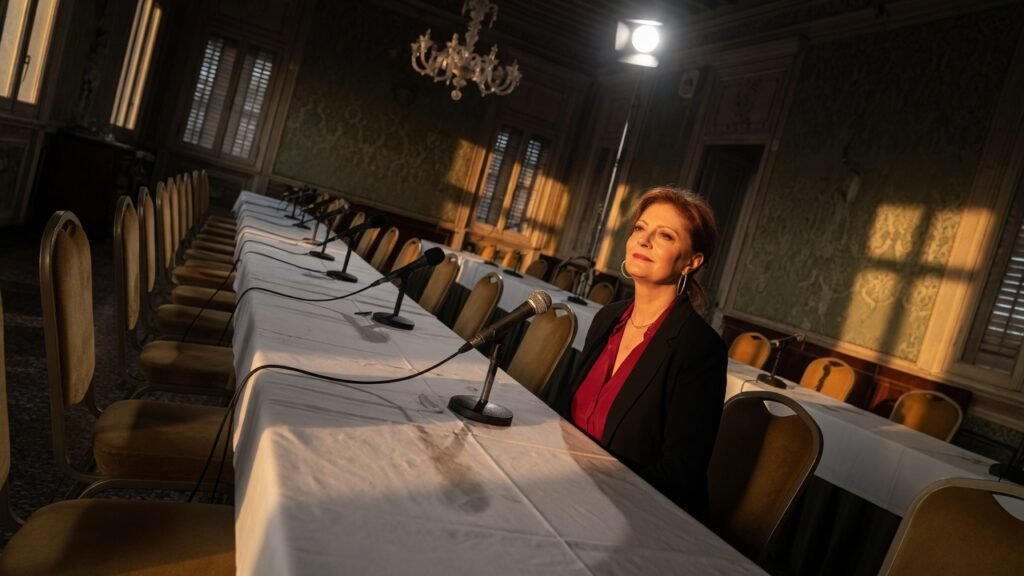
Susan Sarandon is 79 years old, sitting in a Venice press conference for a film drawn from Bernardo Bertolucci’s final screenplay, and she is still naming jobs she does not get.
“I’ve still had movies taken away recently because there are agencies that are telling people not to hire me still,” she said on September 6 while promoting The Echo Chamber. Present tense. Recently. Not a memoir of 2023. A working actress describing a live veto.
The room answered with roughly twenty seconds of applause. Then she kept going. The public narrative around Palestine and U.S. politics had “completely changed,” she argued. The power structure inside her own industry had not. “There are still positions in my industry that are held by Zionists who have not relaxed their feelings towards me,” Sarandon said. “But I found my family, I found my people and I’m OK.”
That is the split she keeps drawing: audiences and international crews on one side, the American hiring machinery on the other. The split is older than this festival.
Four Days From Rally Stage to Agency Exit
On November 17, 2023, Sarandon spoke at a pro-Palestinian ceasefire rally in New York’s Union Square. The line that detonated her standing came fast: “There are a lot of people afraid of being Jewish at this time, and are getting a taste of what it feels like to be a Muslim in this country, so often subjected to violence.” Four days later, United Talent Agency confirmed it was no longer representing her. She had been a UTA client since 2014. The agency offered no elaborate public brief; the timing did the talking. Sources said staff were hurt. By early December she posted an apology for the phrasing.
The drop was never subtle. What followed is harder to audit. In a November 2024 interview with The Times of London she described pulled projects and the sense she had been turned into a cautionary example. At a February 2026 press conference around the International Goya Award she said major Hollywood films and television had become effectively closed, so she moved toward England and Italy, including a play at the Old Vic. In May 2026 at Cannes, jury member Paul Laverty publicly grouped her with Javier Bardem and Mark Ruffalo and criticized Hollywood for blacklisting artists over opposition to the war in Gaza. Solidarity from a screenwriter is not a contract. It is a temperature check.
No outlet in the record has independently confirmed a specific recent title “taken away.” That absence matters. Sarandon’s claim is first-person and repeated. The formal, signed industry blacklist of mid-century lore has not been produced. What has been produced is a pattern: agency severance, a European work pivot, directors warned off her, and her own decision to keep saying the quiet mechanism out loud on festival carpets.
The Director Who Ignored the Warning
The Echo Chamber is the proof of concept she keeps pointing at. Italian director Andrea Pallaoro shot it in Italy and Belgium. Alicia Vikander and Luca Marinelli co-star. It is one of 21 films competing for Venice’s Golden Lion. Sarandon thanked Pallaoro in the room for casting her anyway. “I thank Andrea for that, because he doesn’t listen to the warnings,” she said.
Warnings. Plural. From whom, she did not itemize on the microphone. The implication is agency-to-production pressure, the soft no that never has to become a leaked email. European independent film can absorb that risk. A studio comedy with a nine-figure P&A line usually will not. That is not mysticism. That is how risk committees behave when a name carries political static in the domestic market that still writes the biggest checks.
Sarandon has an Oscar for Dead Man Walking and five career nominations. She is not a fringe character actor inventing a conspiracy to explain a dry spell. She is also not immune to the ordinary economics of age and taste. Both can be true at once. The industry has always been expert at laundering a political punishment inside a commercial rationale until the two become impossible to separate. Her version of the story insists the political piece is still doing real work. The unconfirmed piece is the body count of scripts. The confirmed piece is UTA in 2023, the geographic shift in her résumé, Laverty’s Cannes broadside, and a Venice director who had to be told, and refused.
Public opinion has moved. Polling since the start of the Gaza war has shown softening U.S. support for Israel and rising sympathy for Palestinians, a shift Reuters noted without hanging a single tidy percentage on it. Festivals have become stages for the argument. Venice itself saw activist pressure around a Palestinian flag. Sarandon reads that weather change as validation. She also reads the remaining studio and agency resistance as proof the old gatekeepers have not conceded the point.
Selective Consequences Are Still Consequences
Hollywood’s free-speech culture has always been a curated list. Stars have spent decades issuing takes on elections, wars, police, and presidents with uneven professional cost. The Gaza ceasefire lane has carried a sharper tariff for some names than others. Sarandon’s original rally language was clumsy and landed as a minimization of Jewish fear at a moment of genuine terror; she apologized for the phrasing and did not walk back the ceasefire demand. The industry’s response treated the episode as disqualifying in the domestic mainstream. Whether that response was moral clarity, donor pressure, internal staff revolt, market fear, or some blend depends on who you ask. Sarandon’s answer is structural and blunt. She keeps using the word Zionists for the positions she says still block her. That framing will strike many listeners as reductive or worse; it is also the framing she chose on the record, twice in the span of this cycle.
What she is really selling in Venice is endurance. “I found my family, I found my people and I’m OK.” The sentence is both defiance and a business plan. Work the rooms that will have her. Say the line the American agencies still flinch at. Collect the applause that lasts twenty seconds and the co-stars who show up anyway.
The Echo Chamber will live or die on Pallaoro’s craft and Bertolucci’s leftover pages, not on a press-conference monologue. Sarandon’s larger project is the monologue. Three years after the UTA exit she is still forcing the industry to hear the cost she attributes to it. Some of that cost is documented. Some of it remains her word against a town that prefers not to leave fingerprints. Both facts travel with her to the next festival.
She is not waiting for the town to relax. She is working around it in Italian light, with a director who declined the warning, at an age when most careers have already accepted the quiet.
VERDICT: BELIEVE THE PATTERN, AUDIT THE COUNT — 7.5/10. A three-year consequence trail with a confirmed agency drop, a European pivot, and still-unverified recent losses she refuses to stop naming.