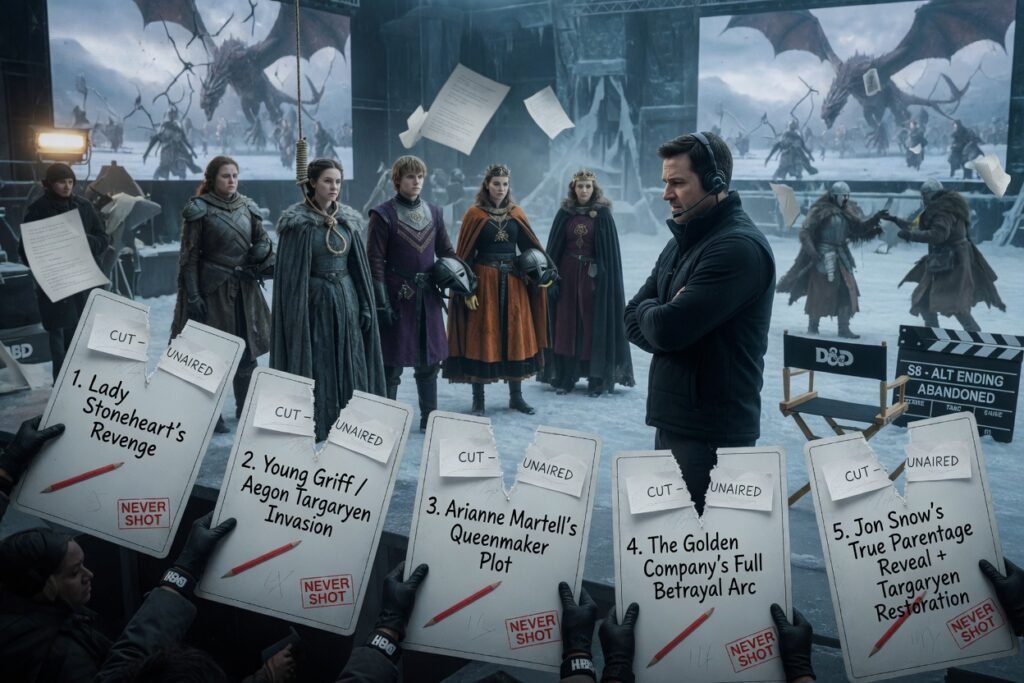
Alright, let’s talk about the Iron Throne, shall we? Not the glorified lawn ornament HBO spent eight seasons hauling around, but the narrative edifice built by George R.R. Martin. Because for all the spectacle, all the dragons, and all the “cultural phenomenon” headlines, the *Game of Thrones* adaptation ultimately became a cautionary tale in what happens when you gut the very soul out of a fantasy epic.
Look, I get it. Adapting a sprawling, multi-POV, intricate fantasy series like *A Song of Ice and Fire* is a Herculean task. Peter Jackson had to make tough calls with *Lord of the Rings*, and those were relatively straightforward good-vs-evil narratives. Westeros? That’s a whole different beast, drenched in grey morality, ancient magic, and prophecies that twist like a barbed wire fence. But there’s a Grand Canyon-sized chasm between trimming the fat and filleting the entire damn carcass until you’re left with bones and gristle. And that’s what happened, particularly in the back half of the show, as the creatives seemed to develop a physical allergy to anything that smacked of “too much fantasy” or “too many moving parts.”
The result? A simplified, often nonsensical, express-lane rush to an ending that, for many of us who actually read the books, felt like a betrayal not just of the characters, but of the very *world* Martin meticulously crafted. It’s a massive shock, I know, but sometimes, executives who think audiences are goldfish actually make bad narrative choices. So, let’s pour one out for the incredible plotlines from *A Song of Ice and Fire* that HBO, in its infinite wisdom, decided we didn’t need. These aren’t just deleted scenes; they’re the foundations that would have held up a far more compelling, coherent, and utterly devastating endgame.
### Euron Greyjoy: From Eldritch Horror to Discount Jack Sparrow
Remember show-Euron? The swaggering, quippy pirate with the bad pickup lines and a knack for showing up exactly when the plot needed a convenient villain? Yeah. Now forget him. Because book-Euron “Crow’s Eye” Greyjoy is a different beast entirely. He’s not just fierce; he’s *terrifying*. A sorcerer, a madman, a collector of dark artifacts, a man who has sailed to the smoking ruins of Valyria and returned, claiming he’s walked with warlocks and demons. He wears an eyepatch, not for pirate aesthetic, but because the eye beneath is, by all accounts, something utterly unnatural and horrific.
His grand entrance at the Kingsmoot isn’t just about claiming the Salt Throne; it’s about magic. He brings a dragon horn, “Dragonbinder,” which supposedly binds dragons to its owner – a direct, terrifying threat to Daenerys. But it gets darker. Euron’s ambitions aren’t merely political; they’re cosmic. He’s less a pirate king and more a Lovecraftian elder god in waiting, hinted at in visions as an Eldritch Kraken sitting on the Iron Throne, summoning horrors from the deep, potentially to unmake the world. He traffics in blood magic, dark rituals, and whispers of forgotten gods.
Cutting this version of Euron wasn’t just a character change; it was a fundamental shift in the *type* of threat Westeros faced. It stripped the world of its inherent, ancient magic, reducing the cosmic battle between ice and fire to a mundane political squabble. The showrunners seemed to prefer a more grounded, gritty drama, but in doing so, they neutered the very fantastical elements that made the “Song of Ice and Fire” truly epic. They turned a chilling, potentially world-ending antagonist into a forgettable Saturday morning cartoon villain. “We wanted to keep it about the human characters,” D.B. Weiss once said, discussing the show’s focus. A *stunning and brave* declaration, but in practice, it meant excising the very forces that shaped those human characters and their world, leaving them adrift in a less magical, less dangerous Westeros.
### Young Griff and the Targaryen Pretender
This is perhaps the most glaring omission for anyone who understands the political chess game Martin was playing. Introduced in *A Dance With Dragons*, Young Griff is a young man traveling with an exiled knight, Jon Connington. Connington was a close friend and confidante of Rhaegar Targaryen, exiled after failing to defeat Robert’s Rebellion. Here’s the kicker: Connington eventually reveals that Young Griff is none other than Aegon Targaryen, Rhaegar’s son, supposedly murdered as a baby during the Sack of King’s Landing. Connington claims he swapped Aegon with another babe, spirited him away, and has been raising him to reclaim his birthright.
Now, whether Young Griff is truly Aegon or a well-coached imposter is the brilliant, delicious mystery. But his existence introduces a massive, undeniable wrench into the succession. Suddenly, Daenerys isn’t the *sole* Targaryen claimant. Jon Snow isn’t the *only* hidden heir. You have a third player, potentially with a legitimate claim, backed by Westerosi exiles and, crucially, a fully formed army (the Golden Company, which in the books lands with Aegon, not Cersei).
The show, by erasing Aegon, simplified the entire endgame into Daenerys vs. Cersei, with Jon as the reluctant hero. It removed the nuance, the moral ambiguity, and the terrifying possibility that the true heir might be a charismatic, foreign-raised boy with his own agenda. This would have forced Daenerys to confront not just a usurper queen, but a rival claimant to *her own family’s throne*, making her descent into tyranny far more complex and tragic, and Jon’s allegiance far more agonizing. Instead, we got a streamlined narrative that felt less like complex geopolitics and more like a straightforward “good queen vs. bad queen” setup. Oh no… anyway.
### The Valonqar Prophecy: Cersei’s True Doom
For casual show viewers, the flashback to young Cersei visiting Maggy the Frog in Season 4 was a cool bit of foreshadowing: “gold shall be their crowns and gold their shrouds.” It predicted her children’s deaths, which came to pass. But in the books, Maggy’s prophecy doesn’t end there. She tells Cersei: “And when your tears have drowned you, the valonqar shall wrap his hands about your pale white throat and choke the life from you.” *Valonqar* is High Valyrian for “little brother.”
This isn’t just a throwaway line; it’s the driving force behind Cersei’s paranoia and hatred for Tyrion. While she despises Jaime too, she’s obsessed with the idea that Tyrion, her *younger* brother, will be her undoing. This prophecy gives her character a deep, psychological motivation for her cruelty and her desperate attempts to control her fate. It makes her eventual demise, by whatever hand, resonant with a sense of tragic irony.
By omitting the valonqar prophecy, the show robbed Cersei’s character arc of its full tragic weight. Her death with Jaime in the crypts of the Red Keep felt less like a fulfillment of a cursed destiny and more like an anticlimactic consequence of falling rubble. The prophecy would have added a layer of inescapable doom, a self-fulfilling prophecy brought about by her own actions fueled by fear. It’s the kind of subtle, character-driven detail that elevates fantasy, and its absence left Cersei’s final moments feeling oddly hollow, unearned by the narrative threads that *should* have been there.
### Lady Stoneheart: The Zombie Avenger
This is the one that still makes book readers clench their fists. After the Red Wedding, Catelyn Stark’s body is thrown into the river. Later, she’s found by the Brotherhood Without Banners, and Thoros of Myr, against his better judgment, resurrects her. But she’s not the Catelyn we knew. She’s Lady Stoneheart: a silent, vengeful, terrifying zombie. Her wounds are still visible, her voice is a rasp, and her heart is consumed by a singular desire for vengeance against anyone involved in the Red Wedding. She takes over the Brotherhood, hanging Freys and Lannisters without mercy.
The show *had* the Brotherhood. It *had* Thoros of Myr and Beric Dondarrion. The setup was all there. Yet, they decided against bringing Catelyn back. Why? Perhaps “too much magic.” Perhaps “too depressing.” But Lady Stoneheart is a critical narrative device. She embodies the dark side of resurrection, the cost of bringing someone back from the dead. She’s a constant, visceral reminder of the brutality of war and the corrosive nature of vengeance. Her presence would have dramatically altered the Brotherhood’s arc, provided a terrifying mirror to Jon Snow’s own resurrection, and complicated the moral landscape of the North.
“The show was ahead of me, and I was going very slow,” George R.R. Martin admitted in 2019, reflecting on the show’s divergence. “The major points of the ending will be things that I told them five or six years ago. But there may be changes, and there will be a lot added.” Lady Stoneheart was clearly one of the “changes” that was removed, a *stunning and brave* decision that arguably diminished the grim reality of Westeros. It was a choice that stripped away a powerful, horrifying symbol of the unyielding cycle of hatred and revenge that permeates the books.
### Victarion Greyjoy: The Kraken’s Fury and Fire
You thought Euron was the only interesting Greyjoy uncle? Oh, you sweet summer child. Victarion Greyjoy, the younger brother of Balon and Euron, is a brute of a man, a fearsome warrior, and commander of the Iron Fleet. After Euron claims the Salt Throne, Victarion, disgusted by his brother’s sorcery and treachery, sets sail with the Iron Fleet for Meereen. His mission? To woo Daenerys, marry her, and bring her dragons back to Westeros for *himself*. And he’s not going empty-handed. He also possesses a dragon horn, gifted by Euron, which he intends to use.
Victarion’s journey is a massive, epic sea voyage filled with storms, encounters with various cultures, and the escalating use of blood magic by a red priest who accompanies him. He’s a deeply flawed, often simple-minded character, but his journey would have added a monumental naval conflict to the Mereenese knot, introduced another compelling (if misguided) suitor for Daenerys, and showcased more of the world’s magic and geopolitical maneuvering.
By cutting Victarion, the show drastically simplified Daenerys’s storyline in Essos, removing a powerful rival and a source of incredible tension. It reduced the Iron Islands to a narrative footnote, only relevant for Euron’s cartoon villainy. The potential for an epic naval battle, the complexity of another claimant trying to secure dragons, and the sheer scope of a journey across the world were all sacrificed on the altar of “streamlining.” It’s the kind of omission that makes you wonder if the showrunners just got tired of building out the world and decided to draw straight lines to the finish.
### The Roguish Take: The Cost of Simplification
These aren’t just footnotes. These five plotlines — the terrifying, magical Euron; the politically explosive Young Griff; the fated Cersei with her valonqar; the vengeful, undead Catelyn; and the seafaring, dragon-seeking Victarion — are critical threads in the tapestry of *A Song of Ice and Fire*. They are what made the books rich, unpredictable, and deeply, often uncomfortably, human in their complexity. They introduced more magic, more political intrigue, more moral quandaries, and more genuine surprises.
The show, particularly in its later seasons, systematically removed these elements, seemingly in an effort to accelerate towards an ending they had been given by Martin, but without the intricate scaffolding he was still building. They traded depth for speed, nuance for directness, and the fantastical for the merely dramatic. The result was a narrative that became increasingly predictable, less impactful, and ultimately, less satisfying.
When you strip away the Valyrian prophecies, the dark sorcery, the rival Targaryens, and the resurrected avengers, what you’re left with is a political drama *with dragons* instead of a true fantasy epic. It’s a stunning and brave decision to take one of the most beloved fantasy series of all time and decide that the *fantasy* elements were the “fat” to be trimmed. But as anyone who’s ever tried to build a compelling story knows, sometimes the “fat” is where the flavor is. And without it, all you’re left with is a bland, undercooked meal that leaves you hungry for what could have been.