The women’s college hockey transfer portal did not ease off when the 15-day window slammed shut. It just changed shape. From March 23 to April 6 the NCAA ran a compressed post-championship cycle for the 2026-27 rosters, and the tracker numbers still sit at roughly 124 entrants. That matches the 121 from the prior cycle and sits well below the 159 that flooded the board in 2024 when extra COVID years still distorted the market. The frenzy is quieter now. It is also more surgical.
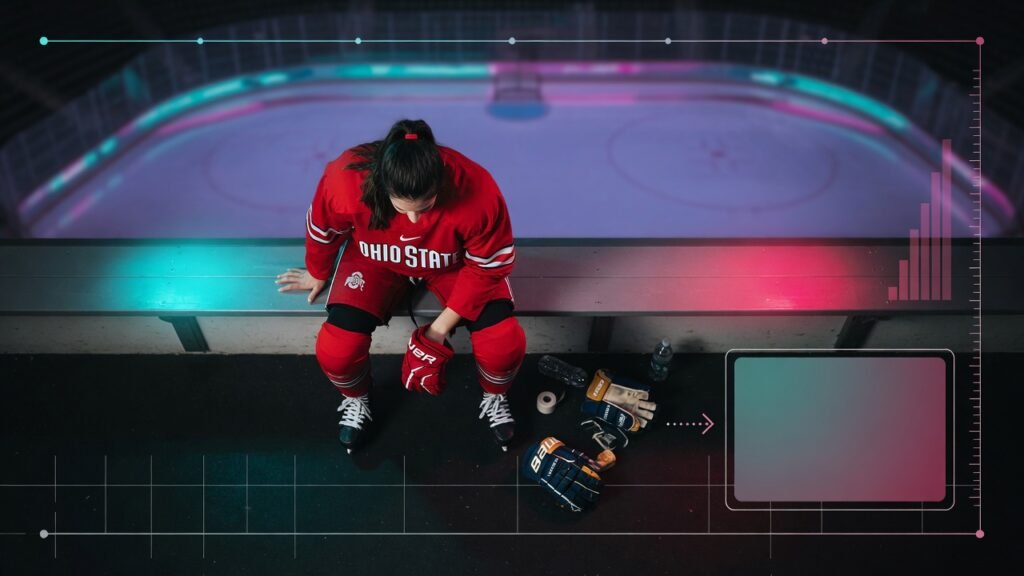
Ohio State and Minnesota treated the window like a scouting combine with real roster consequences. The Buckeyes pulled forward Rylee Bartz out of St. Thomas after she led that program with 17 goals and 30 points in 36 games, then layered in defender Ellah Hause (5 goals, 11 assists in the same span) and defender Sydney Sawyer from Colgate. That is not random volume. That is a program that already feeds the PWHL and still treats the portal as a finishing school for contenders. Minnesota answered with Finnish Olympian Julia Schalin (9 goals, 22 assists after a 14-18 freshman year) and UConn’s Ashley Allard, who just posted career highs of 10 goals and 18 assists while helping win a Hockey East tournament. Coach Greg “Boom” May put the Allard addition in plain terms on the official release: “Ashley is a strong center wi” — the rest of the line got cut in transit, but the intent landed. The Gophers also slid defender Lauren Goldsworthy over from Minnesota State. When two WCHA heavyweights move this deliberately in the same two-week window, the national title bracket feels the shift before September 18 even arrives.
Saint Anselm’s Exodus Is the Real Structural Story
The loudest single-school number is not a power-conference haul. Saint Anselm dumped 18 players into the portal after announcing the athletics reclassification to Division III for 2027-28. The team still plays DI this coming season, then joins the Little East. Eighteen departures from one NEWHA roster rewires the entire lower half of the map. St. Cloud State sent nine, St. Lawrence eight, Lindenwood and Mercyhurst six each. Meanwhile several Ivies — Harvard, Princeton, Dartmouth, Cornell — posted zero entrants. Stability still exists. It just lives in specific zip codes.
Position breakdown tracks the usual scarcity. Forwards dominate the list. Freshmen make up about 39 percent of the pool, sophomores 33 percent, juniors 22 percent. Only 6 percent are seniors, mostly limited-play goalies hunting one last runway. Roughly 47 percent of the 2026 class had already locked new DI homes by early summer; another 7 percent dropped to DIII and 9 percent headed to USports, the Canadian route that keeps rising for players who want closer to home. More than 30 percent were still uncommitted when the last major tracker snapshot hit. That uncommitted block is where late-summer roster finalizations still move needles.
Clarkson stacked Isa Goettl (Bemidji State) and Jessie Pellerin (Providence) up front plus defender Sydney Lamb from St. Cloud. Northeastern flipped Minnesota-Duluth pieces Kamdyn Davis and Grace Sadura. Robert Morris stayed active. St. Thomas itself flipped the script and became a net adder with five portal arrivals after losing Bartz and Hause. The market is not one-way traffic from mid-majors to blue bloods. It is a series of calculated swaps.
Selective Silence Still Beats Panic Buying
Minnesota-Duluth lost bodies to Northeastern, Boston University, Dartmouth and Bemidji, yet coach Schuler declined major portal shopping for 2026-27. The stated reason was roster strength and selective matching. That choice matters. In a 124-player market where only about 24 percent grade out as true impact or starting-caliber pieces, restraint is a strategy. Programs that treat every open scholarship like an emergency end up with chemistry problems in October. Programs that wait for the right fit keep their identity intact.
Hometown data reinforces the geography of the sport. About 64 percent of entrants are American, Minnesota leading the way, followed by Massachusetts. Roughly 31 percent are Canadian, Ontario heavy. Only a handful of true internationals appear — Schalin’s Finnish passport is the high-profile exception. The portal is still largely a North American internal market, not a global free-for-all.
I keep coming back to the mechanism. A single 15-day window after the national championship forces decisions under real time pressure. Graduate transfers can still move later, but the undergraduate bulk of the class is locked into that March-April sprint. Ohio State and Minnesota used it to retool without blowing up their cores. Saint Anselm’s reclassification forced a mass exit that no amount of recruiting can immediately replace. The teams that win the 2026-27 race will be the ones that treated those 15 days like a draft, not a clearance sale. Opening weekend is September 18. The portal numbers already tell you which benches got heavier and which ones got lighter. The ice will settle the rest.