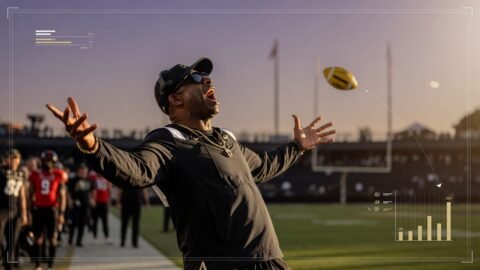
The celebration happened while Dante Moore was still on the ground. That is the entire story USC tried to manage with a one-game suspension, and the numbers around it do not bail them out.
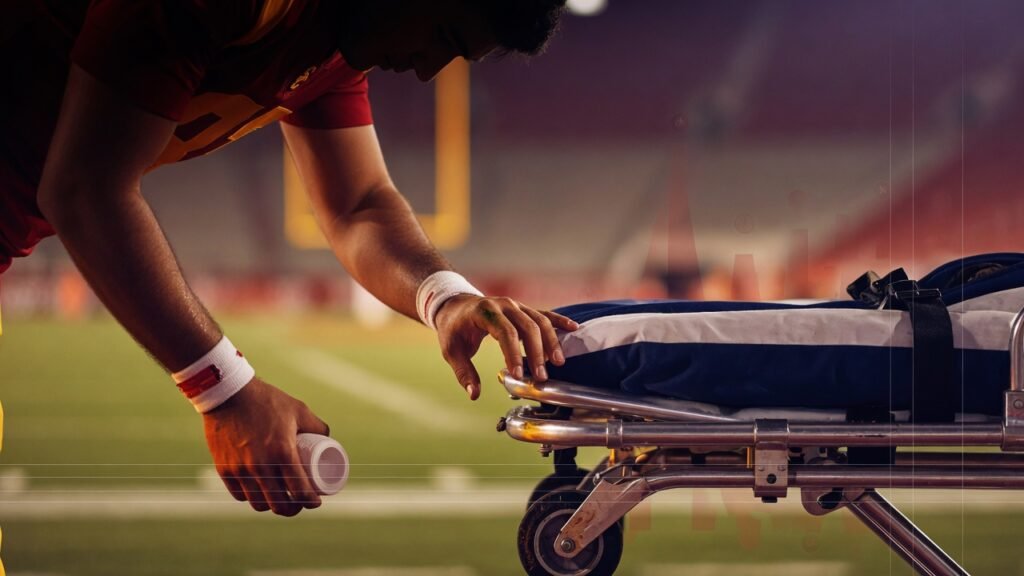
On Saturday at the Coliseum, with about 10:05 left in the second quarter of Oregon’s 41-27 win, Moore scrambled for a first down and began to slide. USC linebacker Desman Stephens II still delivered the hit—shoulder and forearm into the head and helmet area after Moore had given himself up. Moore’s head snapped back into the turf. He stayed motionless while medical staff worked on him for several minutes. Officials ejected Stephens for targeting on review. NBC rules official Terry McAulay called it textbook. Both sidelines drew unsportsmanlike conduct. Moore left on a backboard with a neck brace, went by ambulance to Los Angeles General, and was later diagnosed with a concussion. He had movement in all extremities. That was the medical update. Everything else was choice.
Stephens smiled, ran around, and dapped teammates while Moore received treatment. He was still on the USC sideline in the second half after the ejection. Oregon’s energy flipped. Backup Dylan Raiola entered and threw for 289 yards and two touchdowns on 19-of-25. Moore had been 8-of-10 for 77 yards with 10 rushing before the hit. Oregon still controlled the game. The result was never the issue.
The Targeting Rule Gave USC Cover and They Used It
The 2026 experimental targeting framework is the mechanism here. First offense of the season carries ejection from that game only—no automatic next-game suspension. Second offense costs the first half of the following game. Third is a full game. Stephens was already gone for the rest of Saturday. USC’s Sunday announcement added one game, the Oct. 3 home date against Washington, “as a result of his conduct.” That is a team decision layered on top of a rule that no longer forces the carryover. It is also the floor of what a program can do when the optics are this bad.
Lincoln Riley’s statement landed in the expected register: “Desman’s actions in last night’s game are unacceptable and are not reflective of USC Football nor of his personal character. He understands his mistake, accepts the consequences of his actions and will learn from this. The entire Trojan Family wishes Dante a full recovery, and we send our best regards to him and his family.” Riley also said he did not see the celebration. That line matters more than the apology template. The head coach either missed the most visible moment of the afternoon or chose not to own it in real time. Dan Lanning did not hedge. “It was a disgusting play,” the Oregon coach said postgame. “The energy changed. A lot of guys on the sideline, they were emotional in that moment, including myself.” Lanning later added that Oregon’s guys respect the game and that he would not expect to see that from his players or coaches, while still noting Riley checked on Moore afterward.
Stephens issued his own statement: “Seeing a player injured like that is incredibly serious, and my reaction in the moments afterward was completely inappropriate and inexcusable. Regardless of what was going through my mind at the time, there is no justification for smiling or celebrating while another player receives medical attention. I take full responsibility for my actions.” The words are correct. The timing is after the backlash had already formed.
One Game Does Not Match the Image
Stephens recorded 19 tackles through his first five contests (12 solo, 1.5 TFL, 0.5 sacks). He is a productive piece, not a fringe special-teamer. That is why the suspension length becomes a culture signal instead of a roster footnote. A one-game internal ban for the celebration after a targeting hit that put a quarterback on a stretcher and into concussion protocol reads as damage control calibrated to the new rule, not accountability calibrated to the moment. The melee was the predictable byproduct of players watching a teammate lie still while the opposing linebacker celebrated. Unsportsmanlike flags on both sides do not erase that sequence.
Moore flew back to Eugene with the team and entered concussion protocol. He is expected back at some point this season. Oregon has a bye before UCLA on Oct. 10. USC plays Washington without Stephens and then continues. The experimental targeting change was sold as a way to keep first offenses from stacking automatic absences. In practice it also created space for programs to set their own floor. USC set that floor at one game and called it learning.
The hit was late and illegal under the rule that exists. The smile while Moore was motionless is what turned a foul into a program question. One game answers the minimum requirement of looking responsive. It does not answer the image that traveled farther than the final score.