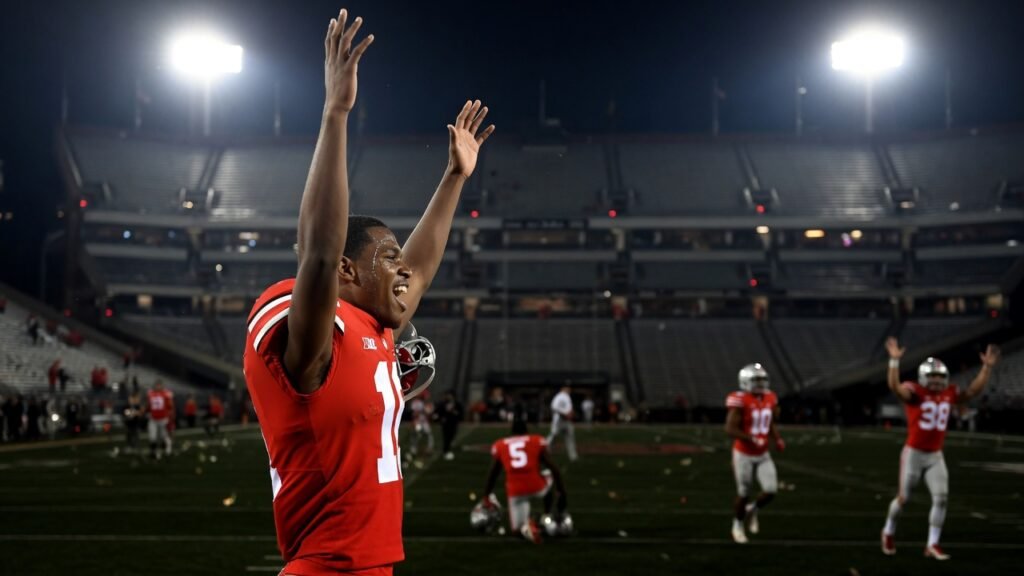
Jeremiah Smith just completed the Ohio State receiving triple crown on a Saturday night in Iowa City, and the debate about the best wide receiver in college football history just got rewritten in real time. Eleven catches. Two hundred six yards. Two touchdowns. The receptions record. The touchdown record. The yards record he already owned. All of it in his 34th career game.
I rank these guys the way other people rank album runs. Volume. Efficiency. Big-moment gravity. Longevity compressed into too few seasons. Smith checks every box at a pace that feels unfair. Ohio State left Kinnick with a 31-14 win and a 4-1 record. Smith left with every major Buckeye receiving mark that has ever mattered.
The Records Fell Like Dominoes
Start with the career ledger after the Iowa game: 207 receptions, 3,381 yards, 36 touchdowns. That is 16.3 yards per catch across a national title as a freshman, a unanimous All-American sophomore year, and five games of absolute destruction as a junior. This season alone he sits at 44 catches for 823 yards and nine scores. He leads the entire FBS in both yards and touchdowns. Four games of 150-plus already. Back-to-back 200-yard games, the first Buckeye ever to pull that off and only the second player in Big Ten history.
The Iowa night itself was pure theater. He tied Chris Olave’s touchdown mark late in the second quarter, then broke it in the third on a 57-yard play-action strike where Julian Sayin stepped up and Smith simply outran the safety after breaking a diving tackle. He struck the Heisman pose again. Earlier he had ripped a 54-yarder through triple coverage. The previous week against Illinois he posted career highs of 12 catches, 217 yards and four touchdowns. The week before that he claimed the yards record against Kent State.
After that Kent State game Smith said the quiet part out loud about how he approaches the jersey. “They always say leave the jersey better than you found it,” he said. “And that’s what I’m trying to do.” He also admitted the records were never the daily obsession. “I don’t really think too much about records and stuff like that, but the opportunity presented itself, and I just took full advantage of it.” That is the entire scouting report in two sentences. Talent plus indifference to the noise equals this.
Ryan Day has watched every rep. “It’s hard to put anybody above him,” Day said after the yards record fell. “Thirty-three games to break the all-time leading receiving record at Ohio State. I think that speaks more than anything to just him, his mindset, his discipline, what he does every day.” Day is not wrong. The speed of the climb is the argument.
The Counter Cases Collapse Under the Pace
The strongest pushback comes from people who lived through Marvin Harrison Jr. in the same scarlet and gray, or who still treat Randy Moss at Marshall as untouchable folklore, or who point to Larry Fitzgerald’s volume years. Those names earned their statues. Harrison Jr. was a technician who now sits tied with Smith at 15 career 100-yard games for the program mark. Moss warped defenses in a different conference and era. Fitzgerald produced at a ridiculous clip.
None of them vacuumed up an entire program’s record book this early while leading the country as a junior and projecting as a top-five pick, often the first overall in 2027 mocks. Smith already owns the freshman marks from the title run. He is four touchdowns from Braylon Edwards’ Big Ten career record of 39. Teammate Brandon Inniss put it flat after the yards record: “He’s like no receiver I’ve ever seen in my life. I’m just proud of him.” The production backs the hyperbole.
Ohio State reasserted itself with the Iowa win while other early high-fliers dropped. Smith is the reason the ceiling stays championship-level. He is the early Heisman favorite for a reason. Every defensive coordinator left on the schedule has to invent a new plan for No. 4, and most of those plans will fail for long stretches.
The remaining question is not whether the records will keep falling. At this clip the Big Ten touchdown mark is gone before the leaves finish changing. The real stake is whether any defense in the sport can keep him under 150 yards for four full quarters when the games start deciding seeds. That answer arrives soon enough, and the ledger already says the odds are long.