The jury needed less time to convict Duane “Keffe D” Davis than the closing arguments took to finish. Thirty years of fog. Roughly three hours of clarity. That is the cleanest sentence you can write about the first person ever held legally accountable for Tupac Shakur’s murder, and it still feels like it understates the whiplash.
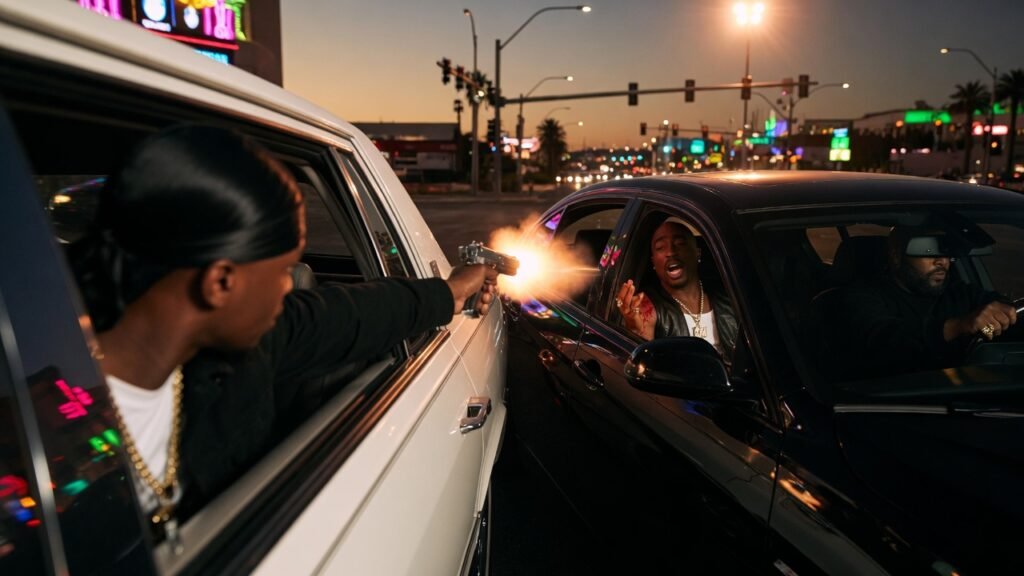
For three decades the killing lived in the American imagination as unfinished scripture. Government plots. East Coast–West Coast war as cosmic drama. Missing tapes. Shadowy power brokers. The actual night of September 7, 1996, kept shrinking under the weight of the myth: a lobby fight at the MGM Grand after Tyson–Seldon, a white Cadillac at Flamingo and Koval, four bullets into a 25-year-old passenger in a black BMW, six days on life support, death at University Medical Center. Simple gang retaliation for the beating of Orlando “Baby Lane” Anderson got rewritten into a national ghost story because the country could not stand the idea that its most electric young rapper died over a medallion and a nephew’s pride.
Then Davis, 63, spent years turning himself into the primary source. Nearly eight hours of his own recorded statements played for the jury. A 2019 memoir, *Compton Street Legend*, that placed him in the car and framed the killing as warranted. Interviews, documentaries, the whole true-crime industrial complex. He sold proximity. Prosecutors simply asked the room to believe the salesman.
He Wrote the Case File Himself
Chief Deputy District Attorney Binu Palal did not need poetry. He needed Davis’s own mouth. “For nearly 18 years, Duane Davis has told the police, television producers, books, YouTube interviewers, anybody that will listen, that he was responsible for the murder of Tupac Shakur,” Palal told the jury. “Tell him you hear him and find him guilty.” Another line landed harder because it was structural: “The one thing [Davis] never says from 1998 to 2023 is, ‘I wasn’t there.’”
That is the cultural hinge. The defense, led by Michael Sanft, leaned into the only available counter: their client is a liar who published for fame and money, the statements are inconsistent fiction, Compton policing was rotten, no murder weapon, no DNA, no fingerprints, and maybe he was not even in Nevada. Sanft floated absence as strategy. The state answered with the man’s continuous narrative of presence. Palal’s framing stayed brutal and plain: “Duane Davis did not pull the trigger. But what he did do was plan the retaliation for the beating of his nephew.” Gun obtained. White Cadillac. Shot-caller seat. Revenge executed. “This was a case about gang retaliation and revenge.” “Duane Davis, in the culture of gangs, could not let that stand.”
The jury of twelve, the youngest of them 21 and born nearly a decade after Shakur died, took the recordings, the MGM surveillance of the lobby assault, the circumstantial gang map, and the absence of any sustained “I wasn’t there,” and they were done before lunch felt late. Unanimous first-degree murder with use of a deadly weapon. Anderson, the suspected shooter and Davis’s nephew, died in 1998 without ever being charged. Other alleged occupants of the Cadillac are gone. Davis is the only one the system ever put in a box. He stood impassive for the verdict, then raised a fist on the way out and asked for an appeal. Held without bail. Sentencing October 13. Life without parole is on the table.
The Shakur family statement was short and human. “The family of Tupac Amaru Shakur is elated and relieved by today’s verdict,” it read. “We would like to thank the jury for thoughtfully fulfilling their duty and carefully listening to all the evidence.” Sekyiwa “Set” Shakur cried quietly. Hands clasped. On the other side of the room Davis’s son held a hand to his face. Geography did its own quiet work: the downtown Las Vegas courthouse sits less than seven miles from the intersection and less than two from the hospital. The verdict arrived two weeks before the thirtieth anniversary of the death. Symmetry is not justice, but it is not nothing.
The Myth Wanted a Better Villain
Here is the part the conspiracy economy will not metabolize cleanly. A huge slice of the audience that kept Tupac’s murder alive as content wanted Suge Knight’s silence broken on the stand, or Sean “Diddy” Combs dragged into the narrative, or some larger apparatus exposed. Both men were named on a state witness list. Neither testified. The story the jury accepted is smaller and meaner: South Side Compton Crips shot-caller answers a public beating with a drive-by. No Illuminati. No master tape of the century. Just retaliation logic that has destroyed more young Black men than any single rival label ever did.
That smallness is why the three-hour deliberation matters more than the thirty-year wait. Cold-case romance thrives on complexity. This trial thrived on a man who could not stop narrating himself into the crime for leverage, for status, for book sales. When Palal said selling the memoir amounted to “profiting off a murder,” he was describing the entire late-stage true-crime marketplace that made Davis a recurring character instead of a suspect. The same culture that turned Shakur’s death into endless docuseries and message-board scripture gave the prosecution its cleanest exhibits. Davis became legible the moment he decided the legend was a revenue stream.
I keep coming back to the age gap in the jury box. A 21-year-old deciding the fate of a 1996 killing has no living memory of the Death Row peak, the “Hit ’Em Up” temperature, or the way Shakur’s voice felt like a live wire in real time. What that juror has is the afterlife: the T-shirts, the hologram tours, the academic papers, the endless “who killed Tupac” content farms. The conviction does not restore the 25-year-old who died of respiratory failure and cardiac arrest after surgeons removed a lung. It does something colder and more useful. It collapses the profitable fog. It says the most documented version of the night, the one the alleged shot-caller kept repeating until the state finally treated it as evidence, is the version that counts in a courtroom seven miles from the intersection.
Appeals will come. Davis already signaled as much. The absence of physical evidence will be litigated again. People who needed a grand conspiracy will call the whole thing incomplete. Fine. Let them. The record now contains a unanimous finding that the man who spent years describing how the gun moved through that Cadillac was legally responsible for the murder he kept describing. The fist in the air on the way out of court was pure performance. The three hours of deliberation were the opposite. They were the sound of a story finally being forced to sit still.
The country spent a generation treating Tupac’s death like a prestige mystery. A Las Vegas jury treated it like a man who would not stop talking. That is the only ending that was ever going to survive contact with twelve citizens and a stack of his own tapes. Everything else was merchandise.
VERDICT: SIT WITH THE THREE HOURS. Score: 9/10 for a culture that finally let the smallest true version of the night outweigh the largest profitable ones.