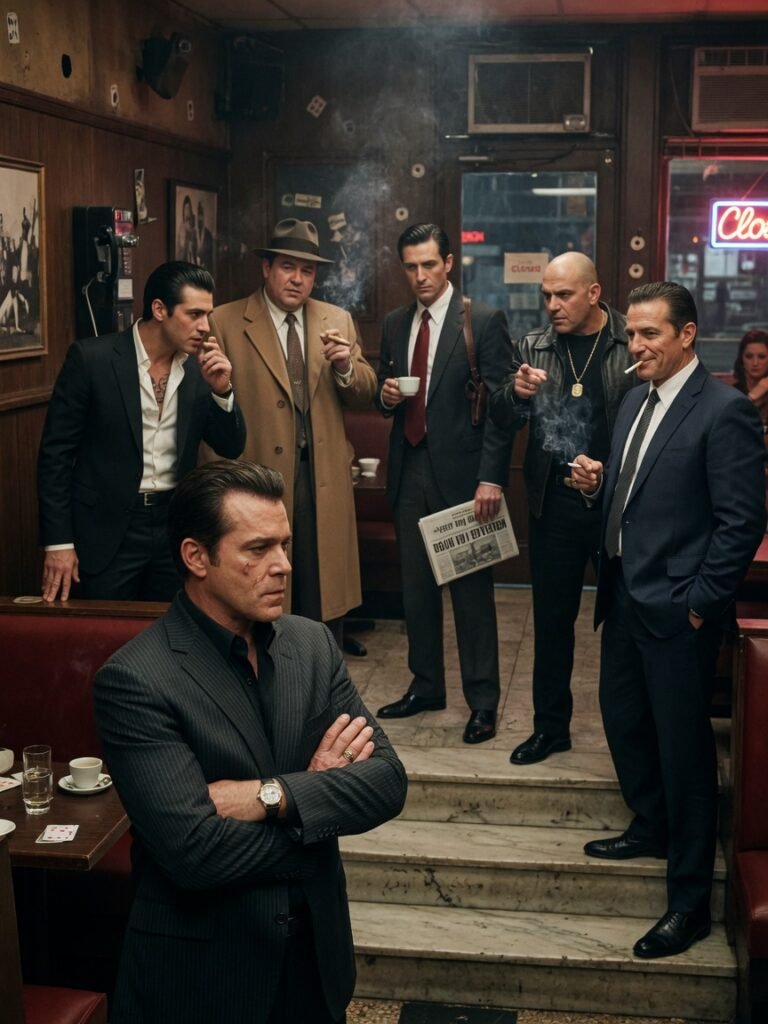
Alright, let’s talk about the gangster movie. Not the sepia-toned nostalgia trips where everyone wears fedoras and calls each other “see?” every third word, but the actual, honest-to-god, consequence-laden cinematic explorations of men (and sometimes women) who live by a different code. The kind of films that understand that the glamour is a thin veneer over a cesspool of violence, betrayal, and inevitable ruin.
The genre, much like a good mob boss, has had to evolve. The days of simple good-fella glorification are largely behind us, thank God. Now, the best of the best dive deep into the psychology, the systemic rot, and the crushing weight of a life spent outside the law. So, when I see a list purporting to celebrate the “6 Best Gangster Movies Released Since 2000,” my antennae go up faster than a wiretap on a payphone. Because this isn’t just about throwing a few well-known titles onto a page; it’s about understanding what makes the new breed of crime cinema tick.
The primary source starts with *Road to Perdition* at number six. Look, I get it. Sam Mendes’ 2002 film has a moody beauty, a perpetually rain-slicked aesthetic that’s as oppressive as a Chicago winter. Tom Hanks, bless his perpetually decent heart, steps out of his comfort zone to play Michael Sullivan, an enforcer on the run with his son. And Paul Newman? His final film performance, a masterclass in quiet menace. The film absolutely nails the “human cost” angle, emphasizing the father-son bond over gratuitous violence.
But here’s the rub: while *Road to Perdition* is a *good* film, a *beautifully shot* film that snagged an Oscar for cinematography, calling it one of the *best gangster movies* of the last two decades feels like saying a meticulously crafted short story is one of the best novels. It’s too restrained, too elegiac, too… safe. It’s a tragedy, yes, but it lacks the visceral punch, the sprawling ambition, or the narrative complexity that defines the truly great gangster epics. It’s a gorgeous lament, not a roaring bonfire. It’s a character study first, a gangster film second, and that’s perfectly fine, but for “best of the genre”? We need more teeth.
Then comes *Gangs of New York* at number five. Martin Scorsese. Daniel Day-Lewis. Leonardo DiCaprio. On paper, it sounds like a contender for the greatest film ever made. In practice? It’s a bloated, uneven mess that occasionally sputters to life thanks to Day-Lewis’s sheer, unadulterated brilliance. The primary source praises its “epic historical drama” and “richly developed characters,” but let’s be brutally honest: this film has more fat than a Christmas goose.
Scorsese, a man who practically invented the modern gangster film, seemed to get lost in the historical minutiae of the Five Points. DiCaprio’s Amsterdam Vallon is a forgettable protagonist, his revenge arc feeling less like a Shakespearean tragedy and more like a checklist. The pacing is atrocious, particularly in the second act where the narrative meanders aimlessly, introducing plot points that serve little purpose beyond extending the runtime. Remember when Bill the Butcher takes Amsterdam under his wing, unaware of his true identity? It’s a classic setup, but the payoff is diluted by a convoluted plot that tries to cram too much history into too little narrative cohesion. It’s a film that *looks* epic, but its storytelling backbone is surprisingly weak. Even Day-Lewis, who delivers one of the most iconic villain performances of all time, can’t elevate the whole thing to “best” status. It’s a swing and a miss for Scorsese, despite the individual moments of genius.
So, if those are the starting points, where do we go from here? The gangster genre, post-2000, isn’t just about the Italian-American mob anymore. It’s about cartels, international crime syndicates, and the quiet, insidious violence that permeates society. It’s about examining the *system* of crime, not just the flamboyant individuals.
Here’s my take, the *actual* six best gangster films since 2000 that truly pushed the genre forward, ranked from good to utterly essential:
**6. *A History of Violence* (2005)**
David Cronenberg, the master of body horror, proved he could dissect the American psyche with a scalpel just as effectively. Tom Stall (Viggo Mortensen) lives a quiet life in small-town Indiana until his past as a ruthless hitman, Joey Cusack, comes back to haunt him. This film isn’t about the glamour of the mob; it’s about the inescapable nature of violence and how it poisons everything it touches, including family. The screenplay is a masterclass in tension and subversion. It asks: can a leopard change its spots? And the answer, delivered through brutal, sudden bursts of violence, is a resounding, chilling “no.” The film’s quiet desperation and explosive confrontations are far more impactful than any grand Scorsese-esque tableau. It’s a stark, minimalist gangster film that rips the romanticism right out of the equation.
**5. *Eastern Promises* (2007)**
Another Cronenberg entry, and another Viggo Mortensen tour de force. This film plunges headfirst into the brutal, ritualistic world of the Russian Vory v Zakone in London. Mortensen plays Nikolai Luzhin, a driver for a powerful crime family, who is far more complex than he initially appears. This isn’t just about “bad guys” doing bad things; it’s an ethnographic study of a hidden society, complete with its own tattoos, codes, and savage justice. The infamous bathhouse fight scene, where a naked Mortensen fends off two assassins, is one of the most raw, unflinching depictions of violence ever put to screen. It’s terrifying because it feels so real, so devoid of cinematic flourish. As Mortensen himself said, discussing the film’s authenticity, **”The research was really fascinating. I spent a lot of time with people who had been involved in that world, and they were very generous with their stories and insights.”** That dedication shows in every brutal frame, creating a world that feels lived-in and utterly chilling. It’s a truly *foreign* gangster film in the best possible way, expanding the genre beyond its traditional American roots.
**4. *American Gangster* (2007)**
Okay, the primary source mentioned this one as “dominating the competition,” and for once, I largely agree. Ridley Scott’s *American Gangster* is a compelling, sprawling epic based on the true story of Frank Lucas (Denzel Washington), a Harlem drug lord who cut out the middleman and imported heroin directly from Southeast Asia. What makes this film stand out isn’t just the star power (Washington and Russell Crowe are magnetic) but its dual narrative. We follow Lucas’s rise and eventual fall alongside the relentless pursuit by Richie Roberts (Crowe), an honest cop in a corrupt system.
The film excels because it doesn’t glorify Lucas entirely. It shows his cunning, his ruthlessness, and his warped sense of family loyalty, but it also highlights the devastating impact of his trade. Washington’s portrayal of Lucas is nuanced, showcasing both his charm and his chilling pragmatism. “My man, my man,” you hear him say, but you know that charm can turn to cold blood in a heartbeat. The screenplay, by Steven Zaillian, takes a complex true story and distills it into a digestible, thrilling narrative without sacrificing the moral ambiguity. It’s a classic cat-and-mouse game, but one grounded in the grim realities of 1970s urban decay and systemic corruption.
**3. *Sicario* (2015)**
Now we’re getting into the truly modern definition of “gangster.” Forget the fedoras; we’re talking about the drug cartels, the true transnational crime syndicates of our era. Denis Villeneuve’s *Sicario* isn’t just a crime thriller; it’s a horror film about the breakdown of morality on the U.S.-Mexico border. Emily Blunt plays Kate Macer, an idealistic FBI agent who is thrown into a black ops world where the lines between good and evil are not just blurred, but actively erased.
The “gangsters” here are not just the cartel bosses but the shadowy government agents who operate with impunity, using brutal tactics to fight an unwinnable war. The film’s sound design, cinematography, and Jóhann Jóhannsson’s haunting score create an atmosphere of suffocating dread. The second act, particularly the convoy scene on the highway, is a masterclass in building tension without a single line of dialogue. It’s a film that argues the fight against modern organized crime is so ugly, so morally compromising, that it turns everyone involved into a monster. As Benicio del Toro’s Alejandro says, with chilling resignation, **”You are not a wolf, and this is a land of wolves now.”** That line perfectly encapsulates the film’s brutal vision of a world where savagery is the only currency.
**2. *The Departed* (2006)**
Yes, the source mentioned it as a dominant film, and it absolutely is. Martin Scorsese finally got his Best Director Oscar for this one, and it’s a massive shock that it wasn’t for *Goodfellas* or *Raging Bull*… oh no, anyway. *The Departed* is a remake of the Hong Kong classic *Infernal Affairs*, and while it’s not Scorsese’s most *original* work, it’s arguably his most *perfectly executed* in the post-2000 era.
It’s a relentless, high-stakes game of cat and mouse between an undercover cop (Leonardo DiCaprio) in the Irish mob and a mole (Matt Damon) in the Massachusetts State Police. The narrative tension is almost unbearable, constantly shifting loyalties and ratcheting up the paranoia. Jack Nicholson’s Frank Costello is a force of nature, a monstrous, charismatic villain who chews scenery and spits out chaos. The dialogue crackles, the violence is sudden and brutal, and the stakes never feel anything less than life and death. The film’s brilliant use of parallel narratives, constantly cross-cutting between the two moles, keeps the audience on the edge of their seat, desperate to know who will be exposed first. It’s a masterclass in pacing, character development, and genre filmmaking, proving that even a remake, in the right hands, can become a modern classic.
**1. *The Irishman* (2019)**
And here we are. Scorsese, again. But this isn’t the flashy, propulsive energy of *Goodfellas* or the historical sprawl of *Gangs of New York*. This is the elegiac, haunting, and ultimately devastating swan song of the American gangster. *The Irishman* is a three-and-a-half-hour meditation on memory, regret, and the slow, agonizing decay of a life lived in violence.
Frank Sheeran (Robert De Niro) recounts his life as a hitman for the Bufalino crime family and his association with Jimmy Hoffa (Al Pacino). The de-aging technology was a point of contention for some, but it quickly fades into the background as the film delves into the profound sadness and loneliness of these men. There’s no glamour here, only the grim reality of old age, isolation, and the weight of unforgivable sins. As Scorsese himself reflected on the film’s themes, **”The characters are dealing with the consequences of their choices, the loneliness of their old age, and the ultimate reckoning.”** This film isn’t about glorifying the past; it’s about reckoning with it. The third act, particularly Sheeran’s quiet, devastating final years, is a gut punch. It’s a story about what happens when everyone you’ve ever known, everyone you’ve ever loved, is gone, and all you’re left with are the ghosts of your past. It’s a truly stunning and brave exploration of a genre often accused of romanticizing its subjects, instead offering a brutal, unvarnished look at the ultimate price. It’s not just the best gangster movie since 2000; it’s one of the best films, period.
So, there you have it. The gangster genre isn’t just alive; it’s evolving, digging deeper, and asking harder questions. It’s about the cost, the system, and the crushing weight of a life of crime. And if you’re still looking for fedoras and “see?” at every turn, you’re missing the point.