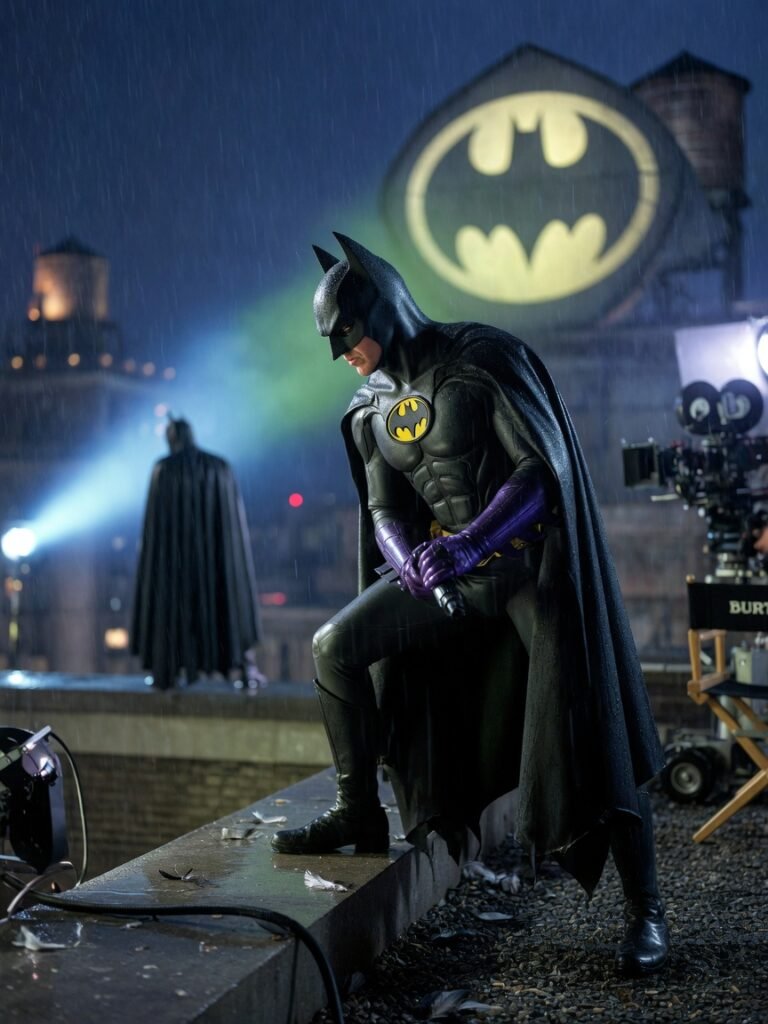
Alright, let’s settle this once and for all, shall we? Every so often, a film gets crowned “the greatest” by popular decree, and for a while, we all just nod along, because challenging consensus is apparently more exhausting than watching another committee-written superhero origin story. For years now, the reigning champ in the “Best Superhero Movie Ever Made” bracket has been Christopher Nolan’s *The Dark Knight*. And look, I get it. It’s a phenomenal film. A genuinely taut, morally complex crime drama that just *happens* to have a guy dressed as a bat and a clown. Heath Ledger’s Joker is iconic, a performance that redefined villainy on screen, and the film’s grimy, grounded aesthetic ripped the genre out of its primary-colored infancy. It deserves every single accolade it’s received.
But here’s the thing about “greatest ever”: it’s a title that demands brutal, uncompromising scrutiny. And when you put *The Dark Knight* under the microscope next to its predecessor, Sam Raimi’s *Spider-Man 2* (2004), a very different picture emerges. Because while Nolan gave us an undeniable masterpiece of filmmaking, Raimi delivered something far more profound, far more *superhero*, and yes, far more enduring. He gave us the definitive hero’s journey, the one that, for my money, still swings highest.
Now, you might be thinking, “The Rogue’s lost his mind. *Spider-Man 2*? Really?” Stay with me here. *The Dark Knight* is arguably a better *film*, a more technically audacious and thematically dense piece of cinema. But is it the *best superhero movie*? That’s where the distinction matters. A superhero movie, at its core, needs to be about the *hero*. It needs to explore the burden of power, the cost of responsibility, and the profoundly human struggle beneath the mask. And on that front, *Spider-Man 2* runs circles around *The Dark Knight*.
Bruce Wayne, as brilliant as Christian Bale plays him, is almost a force of nature. He’s a stoic, driven billionaire with an unwavering moral compass (mostly). His struggles are external: how to fight crime, how to deal with an unhinged Joker, how to inspire a city. Peter Parker, on the other hand, is a living, breathing, profoundly messed-up human being. He’s late on rent, he’s failing classes, his Aunt May is about to lose her house, and the love of his life is slipping away. Oh, and he also has to stop a multi-limbed supervillain from destroying the city.
Alvin Sargent’s script for *Spider-Man 2* isn’t just about Peter Parker fighting crime; it’s about Peter Parker fighting *himself*. It’s about the crushing weight of “with great power comes great responsibility” when that responsibility means sacrificing everything that makes your life worth living. We see him lose his powers because his subconscious is *done* with the burden. He wants to be Peter Parker, not Spider-Man. That’s a struggle that resonates with every single person who’s ever felt overwhelmed by their obligations. Bruce Wayne never truly questions *being* Batman; he questions *how* to be Batman. Peter questions if he *can* be Spider-Man at all. That’s a fundamentally more compelling internal conflict.
As Tobey Maguire himself put it, discussing his character: “The thing that resonated with me was Peter Parker’s humanity, his struggles, his everyday problems. That’s what makes him so relatable.” That’s the core of it. We root for Peter because he’s us, just with spider-powers. We understand the agony of choosing between saving the world and having a life. Nolan’s Batman is an ideal; Raimi’s Spider-Man is an everyman pushed to his breaking point.
And let’s talk villains. Heath Ledger’s Joker is a force of chaos, an agent of anarchy, a philosophical opponent to Batman’s order. He’s magnificent. But Doctor Otto Octavius, played by the incomparable Alfred Molina, is something else entirely. He’s a tragic figure, a brilliant scientist whose noble intentions are corrupted by a horrific accident and sentient mechanical arms. His journey is one of hubris, loss, and ultimately, redemption. We don’t just fear Doc Ock; we pity him. We understand him.
Alfred Molina himself understood this nuance, stating, “I wanted to make him as human as possible. I didn’t want him to be just a cartoon villain.” And they nailed it. Doc Ock isn’t just a foil; he’s a dark mirror to Peter. Both are brilliant scientists, both want to use their gifts for the good of humanity, both face immense personal loss. The difference is Peter chooses self-sacrifice, while Octavius succumbs to his grief and ego. When Doc Ock finally breaks free of the arms’ influence and sacrifices himself to save the city, it’s not just a plot point; it’s an emotional gut punch that lands because the film has painstakingly built his humanity. You don’t get that kind of arc from the Joker, who’s a force of nature, not a person.
The supporting cast in *Spider-Man 2* isn’t just window dressing; they’re integral to Peter’s journey. Aunt May (Rosemary Harris) is the emotional core of the film, delivering that powerful “There’s a hero in all of us” speech that grounds the entire movie in its themes of heroism and sacrifice. Mary Jane Watson (Kirsten Dunst) isn’t just a damsel in distress; she’s a woman with her own ambitions, who loves Peter but can’t wait around for him to get his act together. Their relationship is messy, real, and heartbreaking, because Peter’s commitment to Spider-Man constantly jeopardizes it. The film makes us *feel* the cost of his choices, not just see them.
And the action sequences? My God, the action. The train fight sequence alone is a masterclass in staging, pacing, and emotional stakes. It’s not just about two super-powered individuals duking it out; it’s about Spider-Man pushing himself to his absolute physical and mental limit to save a train full of innocent people. When the passengers carry his unconscious body and defy Doc Ock, it’s a moment of collective heroism, a testament to Spider-Man’s inspirational power. It’s earned. It feels real. It’s exhilarating and emotionally resonant in a way that many modern CGI slugfests, which often feel like watching two action figures collide in a blender, simply aren’t. This isn’t just CGI spectacle; it’s a visual metaphor for the hero’s burden and the community he protects.
Sam Raimi, a director who truly understands the heart of a hero, always emphasized this balance. “The character is about responsibility and the great power, but it’s also about the human condition. It’s about being a teenager, being in love, struggling with life,” he said in an interview during the film’s release. This holistic approach, where the superheroics are inextricably linked to the personal drama, is what elevates *Spider-Man 2*. It doesn’t just show us a hero; it shows us what it *costs* to be one, what it *feels* like to be one.
Look, *The Dark Knight* is an incredible film. A genuine achievement in cinema. But it’s a crime drama that uses superhero iconography. *Spider-Man 2* is a superhero film, through and through, that also happens to be a deeply moving, emotionally complex character study. It understands the genre, embraces its inherent optimism, and grounds it in a relatable, painful reality. It’s funny, it’s heartbreaking, it’s thrilling, and it makes you believe in heroes not because they’re dark and edgy, but because they’re just like us, trying to do the right thing when everything is falling apart. That’s a story that will always resonate, long after the gritty reboots and “darker, grittier” takes have faded into the background.
So, while the academy might be tripping over itself to crown the brooding billionaire, I’ll take the struggling kid from Queens every single time. Because *Spider-Man 2* isn’t just a great superhero movie; it’s the benchmark. It’s the one that understood the assignment and delivered a knockout.