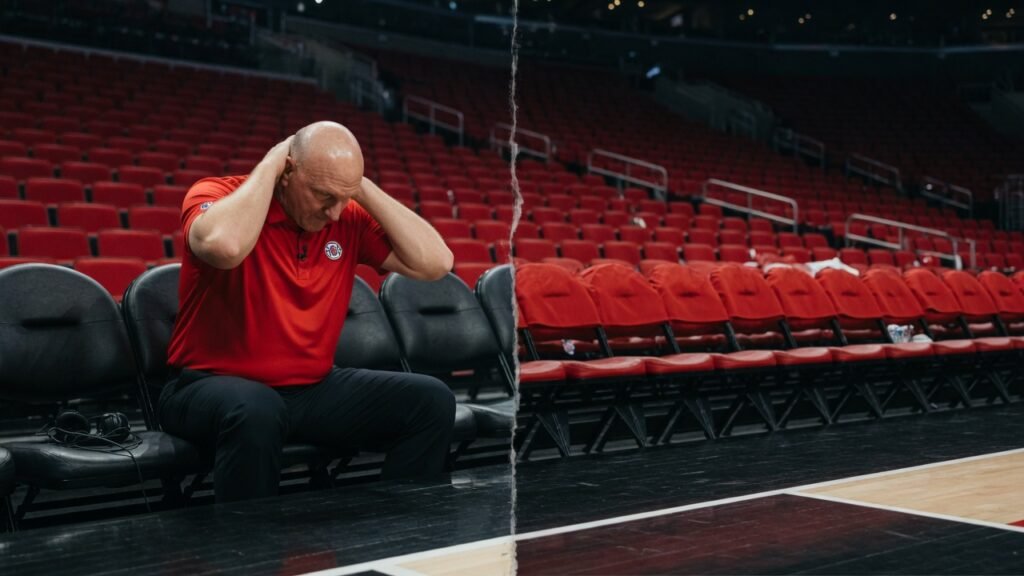
Adam Silver walked into that New York press conference Tuesday and did something the richest man in the NBA still could not buy his way around. He shut the door.
“The discipline is final,” Silver said. No appeals. No good-behavior rebate on those five first-round picks. No soft landing for Steve Ballmer after a year of investigators peeling back the Clippers’ side deals. I heard that sentence and I understood exactly what the commissioner was doing. He was telling every other billionaire in the room that the salary cap is not a suggestion and the league will not flinch when the checkbook is the biggest one in the building.
Ballmer spent eleven days vowing to fight. The Clippers called the probe a “heavily biased investigation seeking to justify a predetermined narrative.” Then Sunday night arrived, the fine was already paid, and the apology dropped. Ballmer accepted responsibility for “the distraction and distress.” Silver thanked him for the compliance and still refused to reopen a single penalty. That is how you prosecute ownership.
Five Picks Are the Point of the Case
The ledger is not subtle. Thirty million dollars, the largest team fine in league history. Ballmer banned from all league and team business for a full year. Gillian Zucker, the president of business operations, suspended without pay for the same stretch. Lawrence Frank, the basketball side, six months. And the part that actually rewrites the franchise’s future: first-round selections in 2029, 2030, 2031, 2032, and 2033, gone. Silver made clear he would not follow the old Timberwolves playbook and hand any of them back later. The picks stay docked.
I keep coming back to what the league actually found. A pattern of misconduct. Multiple significant rules violations. The organization affirmatively initiating off-court income opportunities for Kawhi Leonard with four companies tied to Clippers business, facilitating those deals, inducing the companies with team work, and covering personal expenses that never got reported the way the rules require. Aspiration Partners sat at the center of the original reporting, a roughly twenty-eight-million-dollar arrangement over four years that Pablo Torre’s podcast blew open in September 2025. The investigation then widened to Boingo Wireless, Daktronics, and Lockton Insurance. This was not one sloppy contract. This was a system.
Silver framed the whole package as a setback, not permanent damage. I buy the deterrent half of that sentence more than the comfort half. Five straight first-rounders is how you tell every other front office that the next clever workaround will cost them a decade of draft capital. The Clippers already carried a prior mark for cap games. Silver treated the second offense like a franchise that needed to feel it in the asset column, not just the checking account.
Leonard Walked, and Silver Chose the Harder Target
Kawhi Leonard paid seven hundred thousand dollars. No suspension. No voided contract. He completed his trade to Toronto on Monday and is free to chase the next extension in a market that still remembers 2019. Leonard accepted responsibility for “lapses in judgment by people within my inner circle” and denied knowing about any intent to circumvent the cap. The NBPA signed off. The league locked in the deal so Ballmer could not drag the whole matter into player-side arbitration.
Some fans want Leonard’s head on the same spike. I understand the heat. He sat at the center of the schemes the investigators mapped. Silver decided the message that mattered more was the one aimed at the owners who write the side deals and control the companies. Go after the easier, more famous name and you win a news cycle. Go after Ballmer, Zucker, and the draft board, and you change behavior in the rooms where the next circumvention gets pitched. Silver met with Leonard, cleared the trade, and kept the hammer on the people who actually run the franchise. That is hardball with a purpose.
The federal side is still its own story. Reports in mid-September put the Brooklyn U.S. Attorney’s office and the SEC looking at related dealings in early stages, separate from the NBA’s work. Whatever those probes produce sits outside Silver’s jurisdiction. Inside the league, the case is closed.
Ballmer’s money built the Intuit Dome and kept the Clippers relevant through every Kawhi availability question. None of that bought him a second hearing. Silver stood in front of the Board of Governors and treated the wealthiest owner in the sport like any other party that broke the rules on purpose. The discipline is final because the alternative is a league that sells competitive balance while letting the biggest check rewrite it. Five first-round picks between 2029 and 2033 will sit on the board every June as the receipt. Silver did not blink. The rest of the ownership group just got the memo in permanent ink.