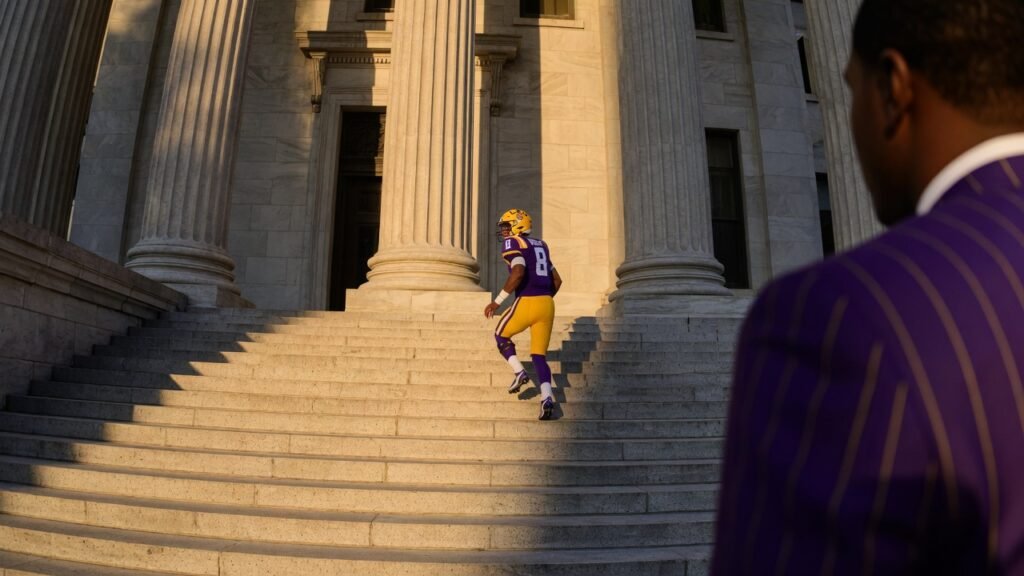
Dae’Quan Wright walked out of a Baton Rouge courthouse talking about fun. Not leverage. Not lawsuits. Fun. “Just putting on a college uniform again,” he said. “Going out there and having fun. Embracing my opportunity.” Hours earlier, the SEC had sued its own charter member, its own coach, and its own administrators in federal court in Alabama to stop him from doing exactly that.
I have covered this league long enough to know when a rules fight is about principle and when it is about panic. This one reeks of the second.
Judge William Jorden cleared Wright and defensive tackle Zxavian Harris, both former Ole Miss players under Lane Kiffin, to be rostered by LSU after a marathon hearing. Both men signed undrafted free agent deals, got cut, and came looking for a fifth year the NCAA’s new calendar never gave their class. Wright took a $25,000 signing bonus from the Eagles and nothing from the Browns. Harris collected $190 in gas money from the Saints while rehabbing a surgically repaired foot. That is the “professional” experience the SEC is treating like a nuclear breach of its core values.
Gas Money Does Not Buy You a First Amendment Crisis
Let me tell you something about Greg Sankey and the presidents who rubber-stamped those penalties. They built a hammer that includes a fine equal to half a sport’s annual budget, a half-season suspension for the head coach, and the loss of conference voting rights. Then a Louisiana judge told them they could not swing it at these kids. So the conference filed in the Northern District of Alabama, arguing that forcing the SEC to associate with LSU’s roster choices violates its expressive association rights under the First Amendment.
Read that again. A multi-billion-dollar conference is claiming constitutional injury because a tight end who bounced through two NFL camps wants to block for the Tigers against Clemson. The filing alleges LSU “waged a deliberate and coordinated campaign to recruit professional athletes.” According to the complaint, Kiffin, AD Verge Ausberry, and President Wade Rousse saw an opening and exploited it. Maybe they did. In this economy, every coach with a pulse is hunting every available body the courts will clear. Pretending LSU invented the scramble is theater.
Tony Clayton, the attorney for Louisiana’s 18th Judicial District, put it in the only language that fit: “Justice was served to the SEC. It was served like a cold cup of gumbo, and that judge forced them to eat it.” I have watched Sankey operate for years. He is meticulous. He is powerful. He is also watching the bright line between college and pro dissolve in real time, and he is reaching for federal court because state court already told him no.
The SEC’s public statement was pure institutional frost: “We disagree with the Court’s decision. … The Conference and its member universities have the right to establish, through agreed-upon governance procedures, the rules under which they voluntarily compete and to expect those rules to be followed.” Voluntarily. That word does a lot of work when one of your members is under a state injunction and your answer is a second lawsuit in a different courthouse.
Kiffin Is Playing the Only Game Left
I have watched Lane Kiffin for years, from the chaos years to the Ole Miss rebuild to this LSU arrival, and I am telling you he did not create this market. He read it. Wright and Harris played for him in Oxford. They know the system. He knows their bodies. Harris said he may need a couple of weeks and is aiming for the September 19 game against Ole Miss, his former team. Wright wanted Clemson this weekend. Their lawyer made the obvious point: the court cleared them; whether they dress is Kiffin’s call.
That is the actual stakes. Not some abstract purity test. A coach decides if two grown men who never stuck in the league get to compete while the conference that claims them tries to freeze the roster from Birmingham. The Big 12 ran a similar First Amendment play against Texas Tech over Brendan Sorsby earlier this summer. Sorsby walked rather than drag it out. LSU is not walking. The roster deadline hit Friday night. The injunction stood. The federal case had no immediate order. Conflicting courts, same athletes, same Saturday.
I said when the Power 4 started layering these professionalism bans that the first real test would not be a star who cashed a real NFL check. It would be a kid who got a tank of gas and a practice squad handshake. Here he is. Harris’s entire pro haul, by his own testimony, was $190. Wright’s was a five-figure bonus and a cut. If that is enough to trigger half a budget in fines and a coach suspension, the rule was never about protecting amateurism. It was about protecting control after NIL and the transfer portal already auctioned control off.
The Conference Is Suing the Chaos It Helped Build
Legacy is the only currency that still clears in this sport. Sankey’s legacy is order. Kiffin’s is opportunity, sometimes messy, always aggressive. Wright’s is a second chance in purple and gold. The SEC can appeal. It can keep filing. It can ask the College Football Playoff to police what its own injunction cannot. None of that changes the picture from Thursday: a state judge told a conference it could not punish schools for rostering these plaintiffs, and the conference sued the school anyway.
I am done pretending this is a close call on the merits of “professional.” A man who never practiced for the Saints is not Tom Brady walking back into the SEC. He is a football player who left too early, got hurt, got nothing, and found a court that said the five-for-five rule’s selective rollout denied him fair notice. Dozens of athletes joined that case. Hundreds more are fighting similar fights nationwide. LSU happened to have the coach who already knew two of them and the lawyer who served the gumbo cold.
The Tigers will decide who dresses. The SEC will keep litigating its right to disassociate from the decision. Wright just wants the uniform. In the middle of all that noise, the simplest sentence in the building was the one that mattered most, and it came from the player, not the commissioner.