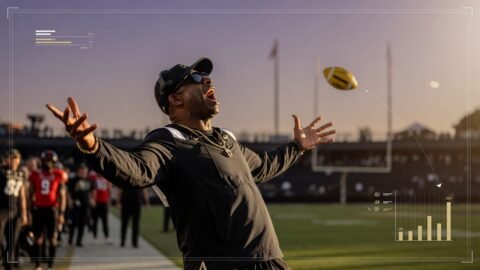
Nick Saban walked onto First Take the morning after the Senate’s 77-22 vote and drew a clean line between two paychecks. Player money and coach money, he said, live in different markets. The backlash arrived before the commercial break because the Protect College Sports Act hard-codes that split while leaving the coach side largely untouched.
“These things are totally different markets. That’s like asking me ‘Does a student’s scholarship equal the professor’s pay?’ I mean, how much value does a coach create for a university?” Saban told the desk. He is right on the economics. A head coach is a scarce executive whose recruiting network, scheme design, and donor access move nine-figure media and ticket revenue. A scholarship athlete is a high-turnover labor input in a sport that already generates the inventory. Different markets is not spin. It is how the labor curves actually bend.
The problem is what the bill does with that distinction.
The Act Caps the Player Side and Leaves the Coach Side Open
The Protect College Sports Act, co-sponsored by Sens. Ted Cruz and Maria Cantwell, now moves to the House after that bipartisan Senate passage. It creates a retention fund of up to $22.5 million that can expand to $27.5 million for schools investing in non-revenue, women’s, and Olympic sports NIL. Stacked on the current revenue-sharing ceiling of roughly $21.3 million, the total compensation envelope can reach $48.8 million per school. Agent fees on NIL deals for current athletes are capped at 5 percent. Undergraduates get one penalty-free transfer, with exceptions for coaching changes, sport discontinuation, or misconduct. Eligibility sits inside a five-year age-based window. FBS coaches are barred from bolting mid-season for another head job.
What did not survive: any hard ceiling on coach salaries. An amendment that would have imposed one failed. Brian Kelly’s remaining LSU buyout still sits near $54 million. Saban himself nodded at the optics without surrendering the market frame. Rather than chase dollar totals, he argued for shorter contracts and limited buyouts as the cleaner fix. The legislation took the transfer and agent constraints and left the buyout problem as a suggestion.
That asymmetry is the real heat. The bill regulates athlete mobility and the agents who move them. It does not regulate the executives who can still extract multi-year guaranteed exits that dwarf most roster shares. Saban’s professor-student analogy holds only if the university can also fire the professor with a $54 million check and keep recruiting at full tilt. College football cannot.
Value Creation Does Not Excuse Uncapped Exit Costs
Saban’s career earnings, often pegged by outsiders in the nine-figure range, and his unpaid advocacy for the bill with Deion Sanders, make him an easy target. The better critique is structural. Athletic departments already face rising revenue-share obligations, facility arms races, and the need to keep Olympic sports solvent. The PCSA’s HBCU funding line of $180 million annually through 2032 shows Congress understands some of those pressures. Yet the same framework that protects non-revenue sports still treats head-coach contracts as private market outcomes while treating player transfers as public goods that require federal fences.
Fans do not buy tickets to watch a headset. They buy them to watch the players who put their bodies on the line every Saturday. The jersey sales, the TV windows, the conference realignment money all run through those athletes. Once the House settlement opened the revenue-share door, the political choice became whether to build guardrails around both sides of the ledger or only the side that turns over every three years. The Senate chose the latter. Saban is defending the choice as market realism. The backlash is defending the other side of the same realism: if coaches create outsized university value, their exit costs should face the same discipline the bill now imposes on player movement and agent cuts.
House prospects remain uncertain before the midterms. The 77-22 Senate margin bought political cover, not automatic law. Until a coach-salary or buyout provision actually attaches, the Protect College Sports Act will keep reading like a one-way restraint. Different markets can coexist. Different rules for the same balance sheet will not hold forever.