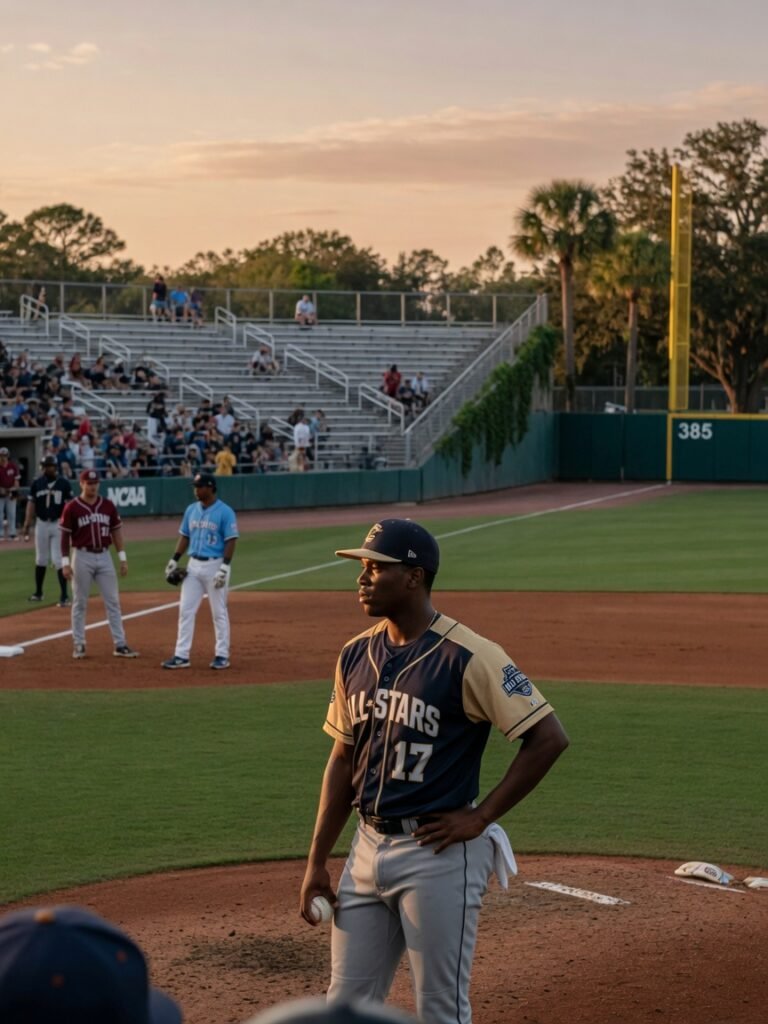
Forget the All-Star glow. The Coastal Plain League’s mid-summer classic isn’t about celebrating current dominance; it’s a cold, hard analytics audition for future impact. While casual observers might fixate on flashy batting averages or gaudy strikeout totals, I’m looking for something deeper: the underlying metrics that actually translate from wood-bat summer ball to the next level. Most of what you think you see from these All-Stars is noise. I’m here for the signal.
When I dive into the CPL All-Star rosters, I’m not just scanning for the best stat lines. I’m analyzing profiles, dissecting how these numbers are generated, and comparing them against historical benchmarks for success. As one veteran MLB scout told me, “You’re seeing these kids come out of their comfort zone, playing with wood bats, facing guys from different conferences. It’s a real test of their raw tools.” This isn’t just about showing up; it’s about adapting.
For position players, I’m immediately drawn to plate discipline and contact quality. A high batting average with aluminum in college doesn’t guarantee anything with wood. I prioritize a player’s **Walk Rate (BB%)** and **Strikeout Rate (K%)** in the CPL. A prospect flashing a BB% north of 12% coupled with a K% below 20% against varied collegiate pitching is demonstrating an advanced approach and pitch recognition that directly correlates to higher projected on-base ability at the professional level. Pure power numbers are appealing, but I’ve found **Isolated Power (ISO)** with a wood bat to be a far more predictive metric than sheer home run totals. An ISO above .200 in the CPL suggests genuine bat speed and barrel control, not just aluminum-aided pop.
On the pitching side, I’m less concerned with ERA than I am with **Strikeout-to-Walk Rate (K-BB%)** and underlying contact metrics. A pitcher with a sub-2.00 ERA might be getting lucky with sequencing or a high Groundball Rate (GB%) on weak contact. What I’m truly looking for is swing-and-miss stuff and command. A K-BB% above 18% in the CPL indicates a pitcher who consistently misses bats and limits free bases, which are the foundational pillars of sustainable success. I’m also digging into the shape and velocity of their fastball and the effectiveness of their secondary offerings. Is their fastball generating a high percentage of whiffs at the top of the zone? Is their breaking ball inducing chases outside the zone or weak contact in it? I evaluate these elements through the lens of expected outcomes, looking for pitchers whose stuff profiles to generate a low **Expected FIP (xFIP)**, regardless of their current ERA. As a long-time college coach once put it, “I never worried about the numbers as much as the adjustments. How did they handle adversity? Did they stick to their approach?” That resilience, reflected in consistent metrics despite varied competition, is gold.
The wood bat itself is a crucial variable. “The CPL is a proving ground,” another scout emphasized. “It’s where you separate the toolsy guys from the guys who can actually hit with wood.” This isn’t just a philosophical statement; it’s an analytical filter. Players who maintain elite contact quality (low K%, high BABIP on competitive pitches) and power (high ISO) with wood bats are demonstrating a mechanical efficiency and strength that often translates directly to the pro game. I’ve seen too many aluminum heroes falter when the barrel shrinks. This league is designed to expose those who rely on equipment rather than pure skill.
So, when I look at the Coastal Plain League All-Stars, I’m not seeing a collection of current college stars. I’m seeing a cohort of data points, each telling a story about projectability, adaptability, and underlying skill. The names on the roster are less important than the metrics they’re generating and the *way* they’re generating them. Those are the players I’d be betting on to make an impact long after their summer in the CPL is over.