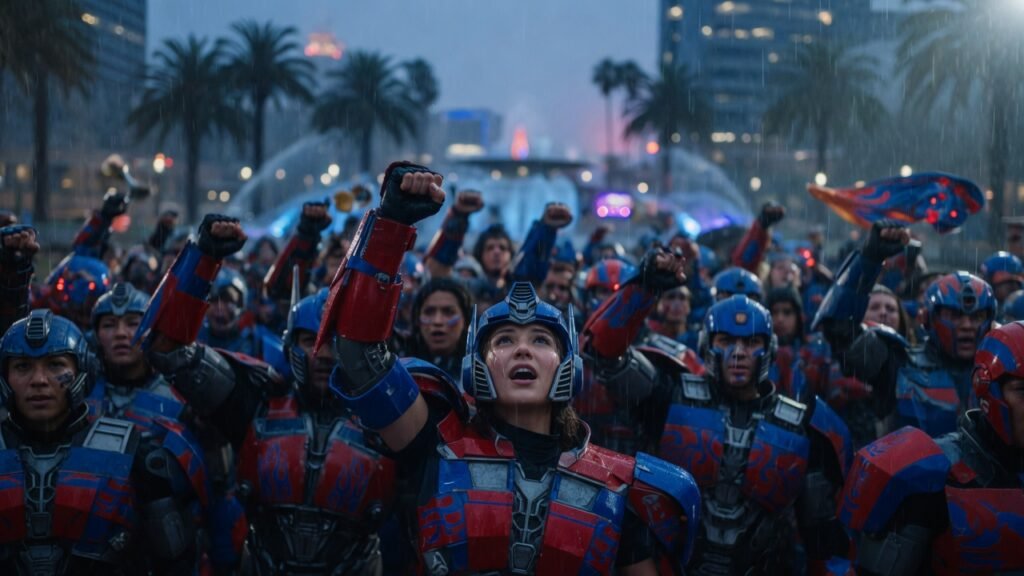
Peter Cullen died Wednesday at his home in Los Angeles, and for a few hours the internet did something it almost never does with a voice actor: it treated the absence like a character death. Not a franchise update. A person gone. He was 85. The family asked the world to remember one line he carried for forty years. Be strong enough to be gentle.
That was never a slogan. It was the entire performance.
Cullen did not invent Optimus Prime as a product pitch. He borrowed him from a Marine. His brother Larry, a decorated Vietnam veteran, came home quieter and harder and somehow kinder. Cullen watched. He listened. When the Hasbro audition called for a hero who was also a truck, Larry’s cadence walked into the booth with him.
“He said, ‘Don’t go yelling and screaming. He’s strong enough to be gentle.’ And that resonated with me, and I could hear his voice all the way to the audition,” Cullen told interviewers later. “When he drops down, when he gets serious, is where I found Optimus Prime.”
Stay with me here. Most franchise heroes are built the other direction. Volume first. Snark as armor. Cullen went the opposite way and somehow made a transforming Peterbilt the moral center of a generation of boys who would never admit they needed one. The voice sat low. It never begged for respect. It assumed you already understood the job.
The Truck Was Never the Point
Look, I get the temptation to file this under “beloved cartoon guy dies, fans sad.” That undersells the craft. Cullen’s Optimus worked because the writing around him was often average-to-bad and the performance still held the frame together. The 1986 animated movie killed the character after a duel with Megatron and kids lost their minds. Producers scrambled him back for a straight-to-video resurrection the next year. That is not nostalgia. That is a performer making an audience protect a toy line like it had a pulse.
When Michael Bay dragged the property onto live-action screens in 2007, rehiring Cullen after two decades away was the only non-negotiable decision in a movie full of negotiable ones. Cullen described the return the only way a working actor would: “I describe it as kind of slipping into an old pair of very comfortable shoes that you haven’t worn for a while. I just slipped right into them, and they felt as good as the last time I put them on.”
The first Bay film cleared $709.7 million worldwide. The sequels kept printing. Dark of the Moon and Age of Extinction each cleared more than a billion. Cullen stayed through The Last Knight, Bumblebee, Rise of the Beasts. Seven live-action turns. The robots got louder, the jokes got cheaper, the human plots sagged under military porn and product placement, and still that voice arrived like someone had finally walked into the room who remembered why any of this mattered.
Now, you might be thinking the Bay films succeeded in spite of the writing because of the spectacle. Fair. But strip Cullen out of those mixes and you are left with metal folding in on itself. The gravitas was rented from a Montreal-born stage actor who once did Shakespeare in Stratford, Ontario, and learned farm animals by ear as a kid. Specificity is the whole trick. He could do King Kong in 1976, the clicking predator mouth noises for Schwarzenegger’s monster in 1987, the evil K.A.R.R. on Knight Rider, and still make a depressed donkey sound like your uncle who has given up on the weather.
“I get an awful lot of reactions from, especially, young kids, when I go up and just say, ‘Hello. Thanks for noticing me,’” he told NPR in 2014, dropping into Eeyore. Two poles of the same instrument: the leader who never raises his voice and the pessimist who never expects to be heard. Both landed because Cullen refused to tip either into cartoon.
Hollywood Keeps Auditioning Louder Men
Here is the part the industry will politely skip in the obituaries. Cullen’s version of heroism is almost unfashionable now. Modern tentpoles prefer protagonists who announce their trauma, ironize their duty, or win by being the cleverest person in the frame. Optimus, as Cullen played him, did none of that. He stated the principle, took the hit, and expected you to keep up. No TED Talk. No origin-story apology tour.
He said it plain about Larry: “He was my hero, and he certainly was the mainstay behind the character. I just did an impression of Larry, and he’s still alive in my mind today because every time I do Prime, there’s my brother Larry.”
That is not branding language. That is an actor locating the moral weight in a real human being and then protecting it for forty years across syndication, direct-to-video, billion-dollar sequels, and video games. A Daytime Emmy nomination for Transformers: Prime. A lifetime achievement honor from the Children’s and Family Emmys in 2023. More than two hundred credits. None of the hardware explains why grown men still tear up in convention lines.
Cullen saw that coming. Before MegaCon Orlando in 2019 he said, “I expect that I will run into a father with his son, and the father will more than likely get choked up. And then I get choked up, and then the kid is saying ‘What are these two grown men getting choked up about?’”
The kid is asking the right question. The answer is that somebody finally sounded like the adult in the room when the adults in the room were busy selling the next SKU.
The family statement asked people to honor him by serving their communities with compassion, integrity, and loyalty, and to remember the line. Be strong enough to be gentle. They did not ask for a moment of silence in a theater. They did not ask for a CGI cameo. They asked for the behavior the voice modeled.
Cullen passed peacefully, surrounded by family, held by friends and the kind of fans who quote robot dialogue at funerals without irony. The credits will keep rolling. Someone else will say the lines. The shoes will not fit the same way. They never do when the original pair was cut to a brother’s walk home from a war and then worn, without complaint, for every generation that needed to hear that strength and gentleness were not a contradiction.
Until all are one was the slogan. The craft was quieter. A man from Montreal made a truck speak like it had read the room, and for once the room listened.