One Ohio judge just turned college basketball’s offseason into open warfare, and half the sport is still pretending this is about “student-athlete welfare.”
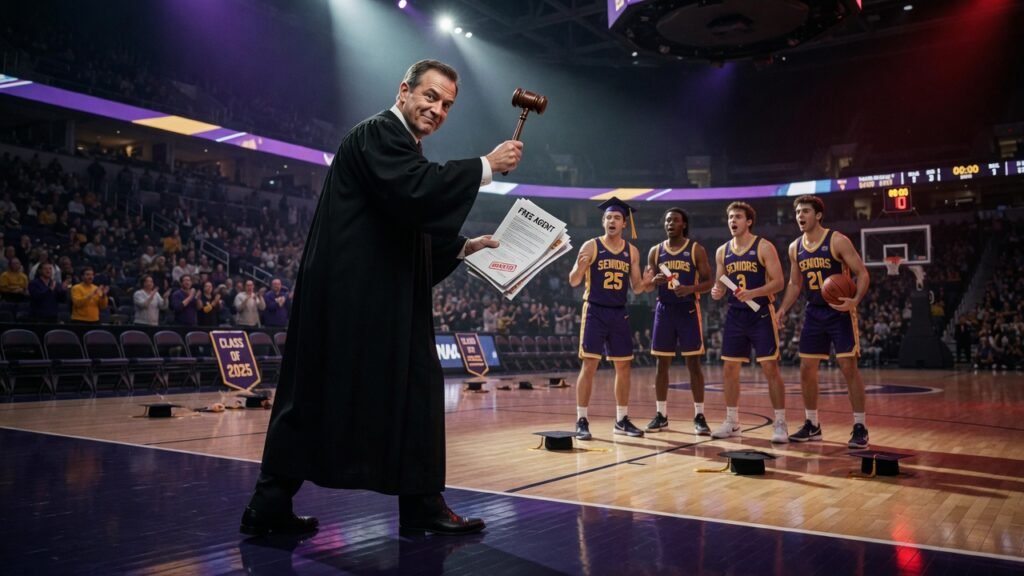
Judge Christopher Wagner dropped a preliminary injunction on July 9 that let a group of graduating players — Filip Borovicanin, MJ Collins Jr., and the rest of that Hamilton County crew — chase a fifth season the NCAA tried to snatch. The age-based eligibility model the Division I Cabinet rubber-stamped on June 23 was supposed to clean up the mess. Five seasons in five years. No more endless redshirt gymnastics. Full rollout for the kids showing up in fall 2027. Current guys get whichever system helps them more. The ones who already burned their last year in 2025-26? Door closed. Permanently.
Except Wagner looked at that door and kicked it off the hinges for the named plaintiffs. Portal access outside the window that slammed shut in April. A real shot at 2026-27. The NCAA immediately screamed it would “seek all avenues for reversal.” Cute. They already lost the stay. These players are eligible right now while the appeals crawl.
I know what you’re about to type. “It’s only 15 guys.” Or 24, depending which filing you’re reading. Doesn’t matter. Attorneys Darren Heitner and Ryan Downton are already gearing up copycat suits in other states. Colorado has a federal class action cooking. This isn’t a one-off. This is the template.
The NCAA Sold a Product and Got Sued by the Inventory
Wagner didn’t dance around it. In the opinion he wrote that the NCAA is a “voluntary membership organization” that “controls, markets, and sells a product: student-athletes.” Then he twisted the knife: “Despite arbitrarily excluding a class of athletes from taking part in a fifth season of intercollegiate competition, the NCAA seeks to evade judicial review and possibly punish member institutions for their participation in the legal process.”
That’s not a judge. That’s a guy calling the cartel a cartel in open court.
He went further. The NCAA “claims to value competition.” Wagner’s response: “However, it is unclear how these rules, arbitrarily enforced against these plaintiffs, promote competition.” And he made zero pretense about the academics angle. “The court is under no illusion that academics play a role in the plaintiffs’ request for injunctive relief. Plaintiffs are seeking to take part in a $1.3 billion organization, from which they claimed they have been arbitrarily and capriciously excluded.”
Exactly. Nobody is suing for an extra semester of organic chemistry. They’re suing because March Madness still pulls nearly 11 million viewers a night and NIL checks don’t bounce. The NCAA built a system where some fifth-years got COVID mulligans, some future kids get the new five-year clock, and the Class of 2022 kids who actually stayed and played four straight years got told to go find a real job. Arbitrary doesn’t even cover it. That’s selective amnesia with a rulebook.
This is what happens when you spend decades pretending amateurism is a principle instead of a pricing strategy. Eventually a judge in Cincinnati reads the bylaws out loud and everybody looks ridiculous.
Who Has Money Left Is the Only Roster Question That Matters
While coaches were in Las Vegas for the live period, half of them were staring at their phones instead of the 17-year-olds. Agents flooded the Strip asking the same brutal question: who has money left?
Most Power conference rosters were already locked. Revenue-sharing pools maxed against the House settlement cap. Any fifth-year add has to come 100 percent from NIL, and a lot of ADs already spent every dime. One power conference head coach flat-out said he had no idea if his AD would sign off on another dollar. That’s not strategy. That’s a budget funeral.
Gonzaga losing Mario Saint-Supery to Spain on the same weekend suddenly looks like the luckiest break in July. An open starting point guard spot with actual cash still available is a gold mine right now. Everybody else is stuck watching agents shop guys who were supposed to be in Summer League or the G League. Exhibit 10 deals that looked fine on Thursday started looking like pocket change by Saturday once the college NIL math hit.
MJ Collins averaging 17 a night at Utah State and now linked to Cincinnati after following Jerrod Calhoun is the prototype. Borovicanin giving Xavier another body. Multiply that by every lawyer who can find a courthouse. The transfer portal didn’t reopen. The lawsuit portal did.
Traditional media wants to frame this as chaos and instability. Spare me. This is the free market finally showing up to the meeting the NCAA kept postponing. Players who generated the product are demanding another year of earning power. Schools with dry powder get better. Schools that spent like drunken sailors on the first wave of NIL get to watch. That’s not a bug. That’s the entire point.
The NCAA wanted Congress to save them with a nice clean antitrust exemption. Instead they got an Ohio judge who refused to pretend the emperor had clothes. Every graduating senior with four years already banked just became a free agent whose only remaining eligibility question is whether their attorney can file fast enough.
You still think the age rule was about competitive balance? Or do you finally admit it was about controlling the labor pool until the labor pool hired better lawyers?