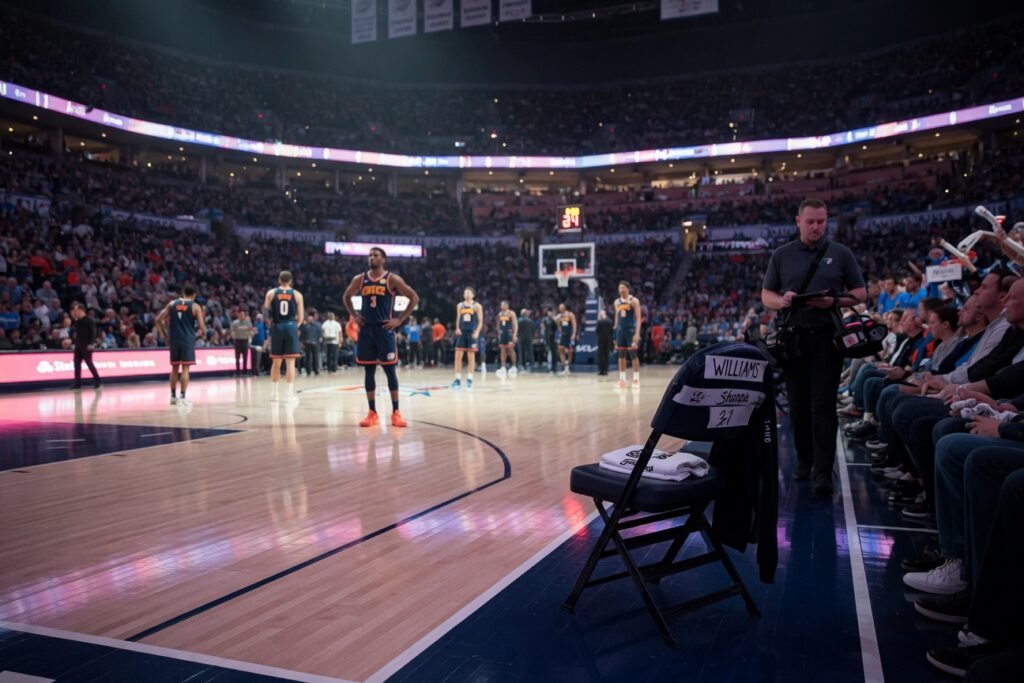
The Thunder’s season now hinges on a Game 7 they must win without Jalen Williams, and the math on that absence looks brutal once you lay out what he actually supplies on both ends. Williams aggravated the left hamstring in Game 2, sat the next three, then logged just ten minutes off the bench in the 118-91 loss that forced this do-or-die. He turned the ball over twice, including one dribble straight out of bounds, and never showed the first-step burst that lets him finish through contact or switch onto perimeter creators. Coach Mark Daigneault said it plainly after that outing: “He’s obviously not 100%. He didn’t know what to expect. I didn’t know what to expect.” That uncertainty carried straight into Friday’s ruling that Williams would sit.
I watched the same limited minutes and came away convinced the hamstring issue is not just soreness. Williams played through right-wrist surgery recovery earlier this year and still earned third-team All-NBA honors, but the left hamstring strain that cost him six regular-season games plus the first six playoff contests has now robbed him of the vertical pop he needs to contest shots at the rim. The Thunder’s defensive rating climbed without him on the floor during those earlier absences, and the Spurs exploited every switch and closeout that used to be automatic. Game 6 only confirmed the trend: when Williams cannot plant and recover, the entire help defense behind him gets pulled out of position.
Daigneault added that Williams “hasn’t done a full return to play protocol like he would if this was the regular season, and yet he just wants to do whatever he can to try to contribute whatever he can to the team.” Credit for the effort is due, but the numbers from the regular season already showed how thin the margin is. Williams appeared in only 33 games because of the wrist and the prior right hamstring flare. Every time he returned, the Thunder posted better net ratings with him on the floor than without, particularly in transition and in the half-court sets where he can guard four positions. Removing that versatility for an elimination game against a Spurs team that has now seen the blueprint forces Oklahoma City into smaller lineups or heavier reliance on players who have not carried that kind of defensive load all year.
The historical record on stars missing Game 7 is unforgiving. Teams that lose their second-best player to injury in the conference finals or beyond win at roughly a 35 percent clip when that player normally logs 32-plus minutes. The Thunder’s offense will have to generate more from the perimeter without Williams’ secondary creation and his ability to punish drop coverage with short rolls. Shai Gilgeous-Alexander will see more attention, and the spacing that Williams provides as a shooter and cutter shrinks the floor. I ran the season-long lineup data in my head again last night and the five-man groups that include Williams post a higher assist rate and lower turnover rate than the combinations that replace him with pure wings or stretch bigs. That gap does not close in one practice.
Defensively the problem compounds. Williams’ ability to guard the point of attack and still rotate onto the weak side is what lets the Thunder stay in their aggressive shell without giving up corner threes. The Spurs scored 118 points in Game 6 largely because those rotations slowed once Williams left the floor after ten minutes. If Oklahoma City tries to compensate by switching more aggressively, they expose help defenders who have already shown they can be beaten off the dribble in space. The alternative, dropping back into more zone principles, hands the Spurs open looks from the top of the key that their shooters have proven they can knock down when given time.
I keep coming back to the wrist injury Williams played through last postseason. That version of him still finished plays at the rim and guarded the perimeter at an All-Defensive level. This hamstring version does neither at full strength. The medical staff made the right call to shut him down rather than risk a longer-term tear that would carry into next season, but the cost is immediate. The Thunder now need contributions from players who have not shouldered this kind of responsibility in a Game 7 setting. That includes bench wings asked to defend starters and bigs asked to set better screens than they have all series.
If Oklahoma City advances, the Finals open against the Knicks on Wednesday in Oklahoma City. The Knicks’ physical frontcourt and switching wings would test any healthy Thunder roster; without Williams the mismatch problems multiply. New York can load up on Gilgeous-Alexander knowing the secondary creator who usually punishes those traps is unavailable. The Thunder’s season-long success has rested on two-way versatility from multiple starters. Losing one of those pieces in the biggest game of the year is not something scheme adjustments can fully erase in 48 hours.
The Spurs have already shown they can score in volume when the Thunder’s help defense is late. Game 7 will test whether Oklahoma City can generate enough offense from the remaining core to overcome that defensive drop-off. Williams’ absence does not make the Thunder a bad team, but it does strip away the margin that has defined their regular-season and playoff identity. The data from the six prior games without him is consistent: lower defensive efficiency, fewer transition opportunities, and more reliance on isolation scoring that the Spurs have begun to anticipate.
I said earlier this postseason that the Thunder’s health would decide how far the roster could stretch its talent advantage. That prediction now faces its sharpest test. Williams will not be available, the coaching staff has acknowledged the limitations, and the Spurs have 48 hours to prepare for a version of Oklahoma City that has not yet closed out a series without its All-NBA wing. The outcome will rest on whether the remaining players can replicate even a fraction of the two-way impact that has been missing since Game 2.