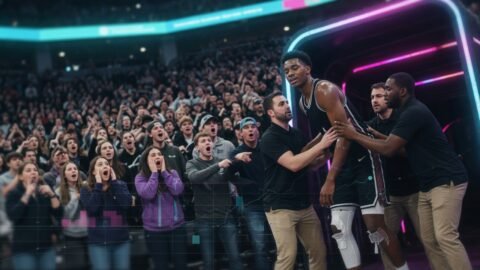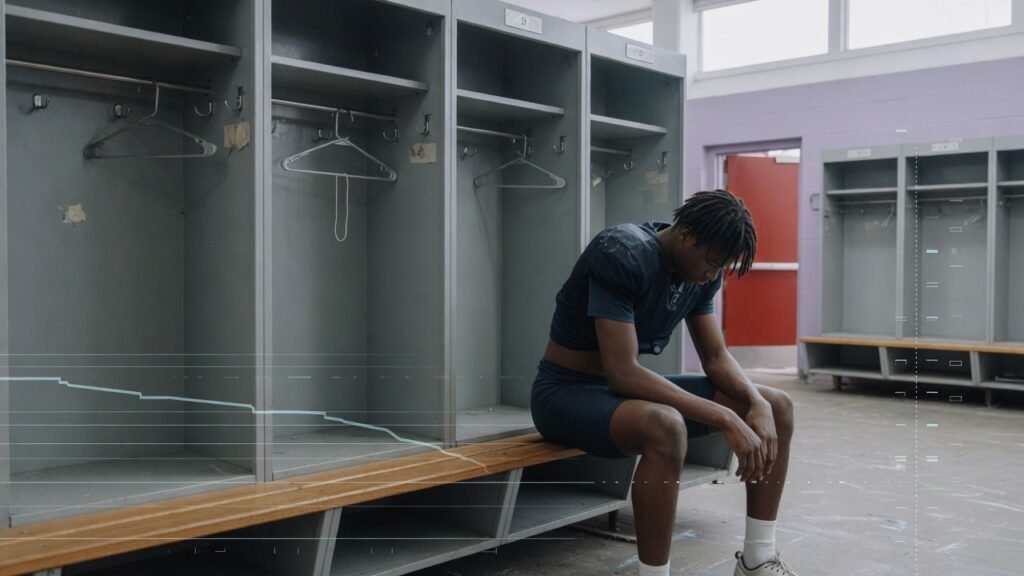
Losing three championship contributors felt like losing family to Chet Holmgren. He said it Saturday in Southern California, and the phrasing was deliberate. Luguentz Dort, Aaron Wiggins, and Isaiah Joe helped deliver Oklahoma City the 2025 title. Sam Presti traded all three for seven future second-round picks and a cleaner payroll. The emotion is real. The architecture underneath it is colder and smarter.
Holmgren did not flinch from either side. “It’s like losing a family member. That’s how the business of this game goes,” he said. “No team, all 17 guys, sticks together forever. But it doesn’t make it hurt less when you see guys go. At the same time, I’m excited for [Dort and Wiggins] and the opportunity they’re going to have in Atlanta. I’m happy for whatever major milestones they reach over there.”
That is the entire modern NBA in four sentences.
Presti Chose the Apron Over Nostalgia
The trades were pure financial engineering. Dort carried a team option near $17.7 million. Joe sat around $11.3 million. Wiggins hovered near $9 million. Presti moved them without taking salary back, collected seven seconds, and re-signed Isaiah Hartenstein on a three-year, $75 million deal. Holmgren and Jalen Williams step into max-level money near $41 million each in 2026-27. Shai Gilgeous-Alexander is already locked on a long-term max. Stack those four and the second apron becomes a hard wall.
Presti labeled it without spin: “This was a financial decision.” The multi-year payroll and tax savings land in the hundreds of millions depending on the projection. Those dollars get reallocated to future rosters. That is how you keep a contending core intact under the current CBA instead of watching it fracture in three years.
Holmgren’s buy-in is the part that separates this from ordinary roster churn. “I have complete trust in our team and the moves they make,” he said. “I trust what they’re doing is to get it right. It’s my job to be in the gym all summer to get my stuff right.” At 24, coming off his first All-Star season at 17.1 points, 8.9 rebounds, and 1.9 blocks, he understands the assignment. His job is the paint and the perimeter spacing next to Hartenstein. Presti’s job is the spreadsheet that keeps that tandem legal.
The Spurs Series Made the Cost Visible
I watched the Western Conference Finals. Injuries to Jalen Williams and Ajay Mitchell thinned the rotation. Holmgren’s Game 7 against Victor Wembanyama produced four points and four rebounds. San Antonio closed it out in seven. Dort’s on-ball pressure and help rotations, Joe’s catch-and-shoot gravity, and Wiggins’ secondary creation were exactly the connective tissue that vanishes when you prioritize apron room. Oklahoma City still won 64 games in the regular season. Depth still matters when the playoffs turn into a half-court grind.
This is not unique. Championship cores almost never retain every useful wing. The Warriors cycled through role players after the first two titles. The Spurs rotated 3-and-D pieces for two decades while Tim Duncan and Tony Parker aged. Presti lived the earlier version of this movie with Kevin Durant, Russell Westbrook, and James Harden. He chose flexibility over the family photo this time, and the math supports him.
What Holmgren said next is the real tell. “We learned the same lesson [in 2026] as the year that we won it: It was almost more of a reminder of just how hard it is to accomplish, and how much goes into it. There is no guarantee. You can put in all the work and still come up short. At the end of the day, you have to be okay with putting in the work with no guaranteed outcome. We came up short this year. That doesn’t change the process.”
That is not soft talk. That is a young star absorbing the actual cost of contention. The Thunder remain one of the betting favorites for 2027 because the core of SGA, Williams, Holmgren, and Hartenstein is secured. The depth chart will look different. The defensive shell will have to regenerate perimeter stoppers. The spacing will lean harder on whoever steps into Joe’s minutes.
Family language captures the locker room. Trust language captures the hierarchy. Process language captures the next two years. Holmgren already drew the line correctly: no 17-man unit survives forever. The teams that win again treat the hurt as information, not as a reason to freeze the roster. Presti just spent the summer proving Oklahoma City will not let loyalty write the tax bill. I trust that more than I trust nostalgia.