The most cinematic moment in Jennifer Lopez’s early love life just dropped a quarter-century late, and it stars her first husband calling Sean Combs a coward in a dark driveway while the cops roll up. Ojani Noa sat down with The Sun and walked through the whole reel like he’d been saving the director’s cut for exactly this market window. Diddy is serving 50 months. The brand is ash. Suddenly every old confrontation has distribution.
Noa and Lopez were married roughly eleven months, from February 1997 into early 1998. He was launching The Conga Room in Los Angeles; she was cutting *On the 6* with Combs producing tracks in New York and Miami. “Everything was great and we were so in love,” Noa said. Then the distance started doing what distance does when a rising star and a rising producer share a studio. Hotel friends in Miami started calling. She called it work. Then the photo hit: Lopez on Combs’ lap at a Miami Beach hotel pool. “We started to fight really badly as I knew she was cheating on me.”
That part is pure tabloid physics. The sequel is where Noa turns it into an action sequence.
The Party Was Just the First Act
They divorced. They stayed friendly. They even talked about starting over “the year she dumped him.” Combs showed up uninvited to a birthday party Lopez threw for her assistant in Los Angeles. Everyone froze. Noa walked over. “I went over to him and told him to leave and he told me to back off. He asked me who I was, to which I replied, ‘F–k you’. I told him he had slept with my wife.” Lopez got between them, promised Combs would leave, then left in Combs’ car herself. Classic second-act betrayal beat. The audience is supposed to feel the sting.
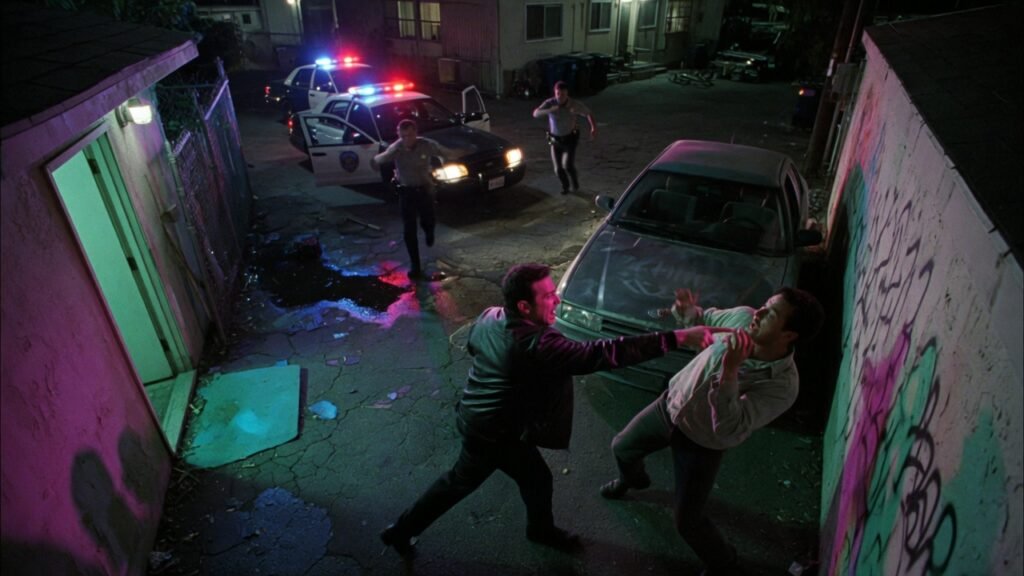
A few weeks later the third-act set piece arrived. A “terrified” Lopez called. Combs was outside her place screaming her name. Noa drove over into pitch black. “That’s when I fronted him up. Jennifer was on the balcony and told me not to, as she was worried. She told me he had guns but I told him that I would f–k him up.” Neighbors or someone dialed the police. Combs ran. Noa’s verdict, delivered to the man’s face and now to every outlet that will print it: coward. “That’s why he was always with bodyguards with guns because anyone could take him one on one.”
Stay with me here. I’m not here to fact-check a driveway argument from the early 2000s that only one living participant is currently narrating on the record. Page Six reached out to both camps and heard nothing back, which is the standard non-answer when the past suddenly becomes content. What I’m allergic to is the packaging. This story has the exact shape of a mid-budget revenge thriller that never got greenlit: wronged husband, threatened superstar, gun whispers, police sirens, the villain fleeing into the night. It is clean. It is punchy. It casts Noa as the only adult in the room who would say the quiet part out loud.
Look, I get it. If even half of it tracks, Combs was already running the intimidation playbook long before the federal case made the pattern undeniable. Noa claims Lopez tried to leave earlier and got threats aimed at her family. He claims she told him Combs “could do bad things.” Those lines land differently in 2026 than they would have in 2001, when the couple was still the glossy centerpiece of the VMAs and a nightclub shooting that left Lopez in a cell for more than twelve hours with zero charges. Context changed the lighting. The old footage suddenly looks like foreshadowing.
Timing Is the Real Producer Credit
Here is the part the tell-all industrial complex never wants you to notice. These stories almost never surface when the powerful person still has leverage. They surface when the powerful person is in a federal facility and the residual value of every associated name spikes. Noa has been around this orbit before; he partially blamed Combs for the divorce on *Despierta America* in 2024. The Sun interview is the expanded cut with better fight choreography. That does not make him a liar. It makes him a man who understands release windows.
The writing problem is structural. Celebrity journalism has become a franchise factory for unresolved 90s and early-2000s drama. Every ex gets a miniseries the second the former partner’s reputation collapses. The beats are identical: the slow-burn suspicion, the public photo that “proves” it, the physical confrontation that somehow never produced a contemporaneous police report worth citing, the hero who “fronted him up.” It is mystery-box plotting with the box already empty. We already know how the Combs story ends in the present tense. The past is being reverse-engineered to fit the ending we already watched.
Compare it to the stories that actually stuck. When the serious allegations against Combs piled up, they came with patterns, multiple voices, timelines that could be cross-checked. Noa’s account is one voice, two decades later, delivered to a British tabloid while the subject cannot easily counter-program. That is not the same genre. Treating it like courtroom corroboration is lazy. Treating it like pure fiction is also lazy. The honest read is messier: a short marriage, a messy overlap, a man who still feels the wound, and a culture that will pay for the most dramatic version of that wound the second the antagonist is safely caged.
Lopez herself stays offstage, which is the smartest move available. She has spent years turning the “Jenny from the Block who survived the circus” narrative into a brand. Relitigating whether she left a birthday party in the wrong car in 2001 does nothing for her. Combs, serving his sentence after convictions on transportation counts, has bigger structural problems than an ex-husband’s monologue. So the vacuum fills with Noa’s version, and the internet does what it does: clips, outrage cycles, “he was always like this” posts that treat a single sourced interview as the missing reel from *The Last Dance*.
I walked into this expecting another recycled betrayal yarn and walked out annoyed at how efficiently the machine still works. Great storytelling requires stakes that feel lived-in and consequences that stick. This has the former on Noa’s side of the microphone and almost none of the latter for anyone still breathing free. The coward Noa describes may or may not match the man currently sitting in federal custody. The real cowardice is cultural: we keep mistaking high-drama personal score-settling for revelation, then act stunned when the next ex hits send on the next exclusive.
The driveway scene makes for a hell of an opening image. It just does not close the case. It closes a content loop. And Hollywood, even the tabloid wing of it, has always preferred a clean loop to an honest mess.