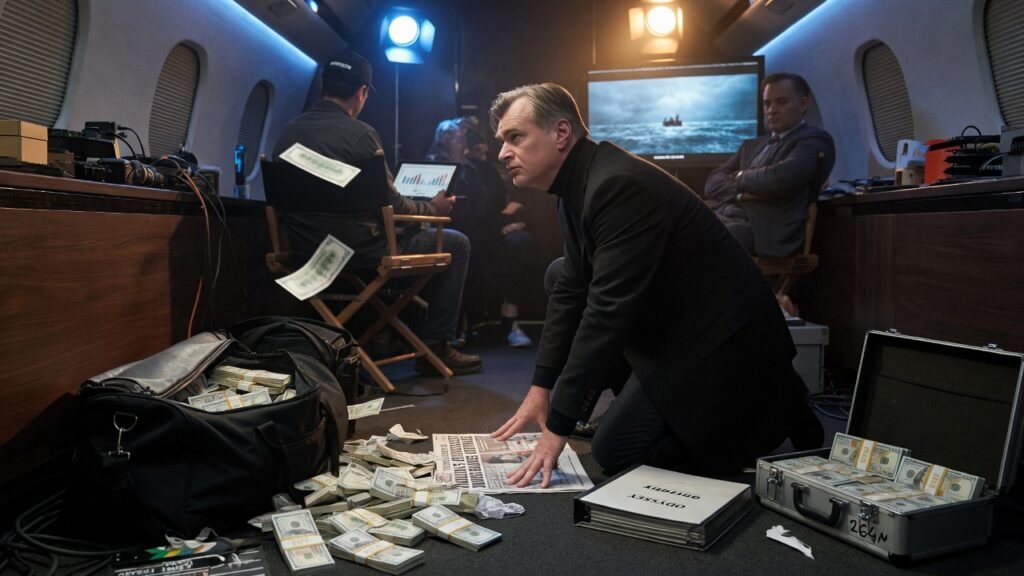
The loudest voices on the internet spent months screaming that Christopher Nolan had desecrated Homer. Then audiences dropped $264.1 million worldwide in a single weekend and proved them spectacularly wrong.
“The Odyssey” opened to $124.5 million domestic and $139.6 million overseas, Nolan’s biggest global debut ever and the third-largest opening of 2026 behind two animated juggernauts. An R-rated, nearly three-hour sword-and-sandal epic does not do that by accident. It does that because people still trust the guy who made “The Dark Knight,” “Inception,” and “Oppenheimer” to deliver an event worth leaving the house for. Premium formats carried it: IMAX alone hauled in $51.8 million globally, with the 41 70mm screens doing $6.3 million by themselves. This is the first feature shot entirely on IMAX cameras, Nolan’s “longest-held ambition,” and the screens are already sold out deep into the coming weeks.
The pre-release culture war was pure noise. Matt Walsh declared that “Not one person on the planet actually thinks that Lupita Nyong’o is ‘the most beautiful woman in the world’” and called Nolan a “coward” for casting her as Helen. Elon Musk posted that Nolan had “desecrated the Odyssey so that he would be eligible for an Academy Award” and would “never live it down.” The usual checklist followed: Elliot Page as the warrior Sinon, Travis Scott as a bard, American accents, modern English, not enough Greek faces in the leads. All of it framed as proof the film was doomed.
Nolan’s response in The Telegraph was pure clarity: “these conversations that happen before people see the film — they’re always irrelevant, because no one having them knows what the film actually is yet.” He reached back to his Batman years: “What I learnt over my time on that trilogy is you can’t worry about any of that at all. What you have to do is honor the original text by interpreting it in the strongest way you personally can.” On Travis Scott specifically he was even sharper: “I cast him because I wanted to nod towards the idea that this story has been handed down as oral poetry, which is analogous to rap.” That is not cowardice. That is a filmmaker treating a 3,000-year-old oral epic like living material instead of a museum diorama.
The movie itself rewards that approach. Matt Damon plays Odysseus as a weathered, cunning survivor rather than a marble statue. Anne Hathaway’s Penelope carries real steel. Zendaya’s Athena feels like divine intervention made flesh. The ensemble (Robert Pattinson’s Antinous, Charlize Theron’s Calypso, Tom Holland’s Telemachus, Lupita Nyong’o’s dual turn) gives the myth human texture without sanding off its brutality. The R rating is earned. This is not a sanitized classroom version. It is bloody, long, and immersive in the way only Nolan’s large-format obsession can deliver. CinemaScore gave it an A. Critics sit at 95 percent. Half the audience was 18-34. Males were 56 percent. The “go woke, go broke” crowd keeps losing to the same data point: when the movie is actually good, people show up.
David A. Gross put it cleanly: “Christopher Nolan is the only filmmaker working today who could take an ancient story like this, attract a cast as sprawling and accomplished as this, and make it a pop culture event.” Universal’s Jim Orr felt the floor: sold-out premium showtimes stretching weeks ahead, mid-week included. The film has a clean runway until “Spider-Man: Brand New Day” at the end of July. That $250 million production budget plus another $125 million in marketing needs legs, and the early word-of-mouth says it has them.
This is bigger than one opening weekend. It is another data point that the loudest online factions do not speak for the people buying tickets. Nolan treated Homer the same way he treated theoretical physics in “Interstellar”: as the best available speculation turned into a world you can feel. Some scientists hated “Interstellar.” Some purists hate this. Both groups missed the point. Adaptation is not photocopying. It is sincerity of intent. Audiences can smell the difference between a cash-grab lecture and a real swing.
I walked out buzzing the same way I did after “Oppenheimer.” Not because every choice is the one I would have made, but because the whole thing commits. The scale is real. The craft is undeniable. The story still lands three millennia later. That is the only metric that matters once the lights go down.
WATCH. 9/10. A rare R-rated epic that earns every minute and every IMAX frame while turning culture-war static into background static.