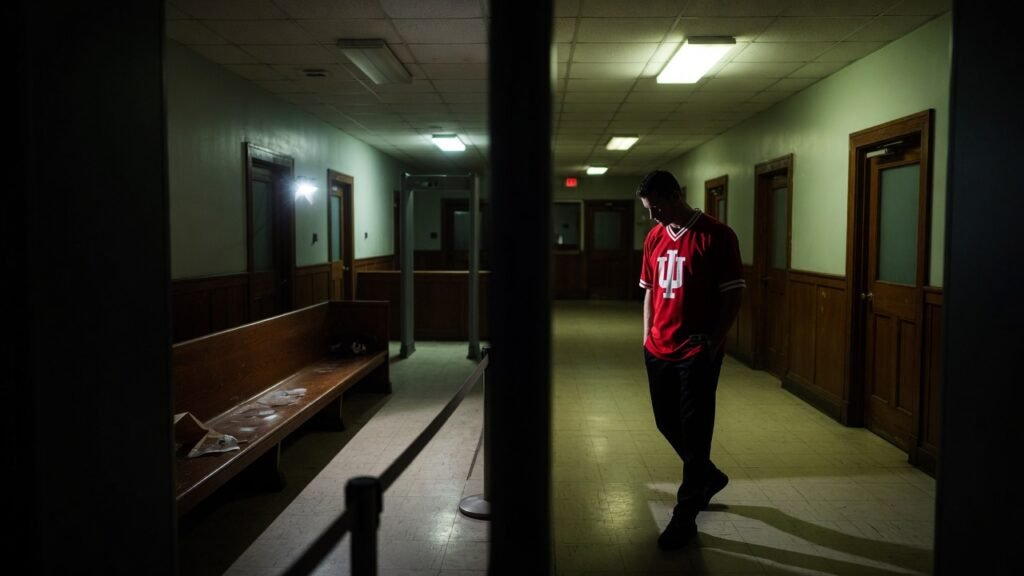
Eighty-nine more athletes just walked into a Monroe County courtroom and demanded the fifth college season the NCAA already decided they do not get. That is the amended complaint that dropped at the start of Monday’s hearing in the Daley case, and it turns one local TRO into a national eligibility free-for-all I cannot ignore.
Tre White, Tamin Lipsey, Riley Kugel, former Indiana big Sam Alexis jumping from a Tennessee filing, plus football, swimming, and volleyball names from multiple states. The original eight plaintiffs who won temporary relief on September 4 watched that order expire with the hearing. Stephen Daley and Kellan Wyatt are temporarily ineligible again while everyone waits on proposed findings due Thursday. I am done pretending this is tidy governance.
The NCAA Division I Cabinet adopted the age-based five-for-five rule on June 23. Five seasons inside a five-year window. Traditional redshirts largely gone. Most waivers gone. Then the association carved out the high-school class of 2022 athletes who had already burned four seasons under the old system by the end of 2025-26. Colorado’s Judge Charlotte Sweeney answered with a class-wide preliminary injunction on July 31 and a special portal window. The 10th Circuit stayed it August 21. So the fight moved to state court, where athletes can still get a judge to look them in the eye.
The Rule Book Never Said the Quiet Part
Judge Kara E. Krothe’s September 4 TRO did not hedge. “To be clear, it is the Court’s intention to place Plaintiffs in the position they were in at the end of their last college sports season. As long as they would have been eligible, academically and otherwise, to continue playing college sports in the following semester if they had a fifth year of eligibility, they are eligible today.”
Monday she spent five and a half hours on the expanded case. She pressed NCAA counsel with the question that should end the spin tour: “Why doesn’t the rule book state the actual rule.” When the association floated the zero-sum roster argument, she cut it colder: “We didn’t hear any testimony that anybody would be pushed out.”
I keep coming back to that empty chair. Competitive balance is the NCAA’s favorite shield, yet the hearing produced no testimony of a single player getting shoved off a roster. Zero. Ryan Downton, counsel for the athletes, thanked her for the time and the recognition of what this means to kids who traveled to be there. He should. After the federal stay, Monroe County is one of the only venues left that will still hear them.
Late August the NCAA was already defending nearly 60 lawsuits covering 322 former student-athletes. Later counts climbed toward 79 suits and roughly 450 athletes, about 235 of them in men’s basketball. That is not a fringe disagreement over a waiver form. That is an entire graduating class refusing to accept that five-for-five starts the year after them and ends the year they needed it.
Legacy Gets Measured in Seasons the NCAA Erased
Let me tell you something about Stephen Daley. Nineteen tackles for loss in 13 games last season. He led the Hoosiers. Combined with Wyatt the prior year produced 63 tackles, 7.5 sacks, and two forced fumbles. Another season is not a hobby for those two. It is the difference between finishing a body of work and watching the calendar close because the association rewrote the eligibility clock after they had already paid four years under the old rules. Same stakes for Malik Reneau at Miami, Yohan Traoré at Butler, the Indiana swimmers, the volleyball player, and every basketball name now sitting on that amended complaint.
Coaches and athletic directors are left managing rosters while injunctions appear, get stayed, and reappear in a different courthouse. Programs have to guess which order sticks long enough to matter in November. The complaint seeks temporary, preliminary, and permanent relief, a short portal window, and protection from NCAA restitution rules for the schools that actually put these athletes on the floor. The association created the vacuum by drawing a hard line around one class. The athletes filled it with filings. Judge Krothe now has the testimony, the empty competitive-balance chair, and the rule book that still will not say out loud what the NCAA needs it to say.
Proposed findings and conclusions of law are due Thursday. Whatever lands, the record already shows the association lost the claim that this cutoff was clean, consistent, or finished. Five-for-five for everyone except the class that already completed four seasons under the prior system. A stayed federal injunction. Then 89 more names in one morning in Bloomington. The five-and-a-half-hour hearing is over. The amended complaint is on the docket. The rule book still refuses to state the actual rule. That is the file Judge Krothe has to rule from, and it is the file the rest of college sports is stuck living with until somebody finally writes the eligibility clock in plain English.