The NCAA sent Cincinnati a letter of inquiry, and I’m just sitting here, staring at my screen, wondering if these clowns even *know* what year it is. Brendan Sorsby, the dude who got himself permanently banned for dropping more cash on parlays than I spent on my kid’s college fund, is now the reason the Bearcats are getting the side-eye from the sport’s most impotent governing body. This isn’t a surprise. This is a *foregone conclusion* when you let the inmates run the asylum.
I know what you’re about to type in the comments. “But Ryan, the NCAA is finally doing its job!” “They’re cracking down on gambling!” My guy, take a seat. This ain’t the flex you think it is. This is the NCAA showing up to the party three hours late, wearing a dusty tuxedo, and asking if anyone’s seen the punch bowl. They’re not proactive; they’re *reactive*. And when they react, it’s usually with the precision of a blindfolded dart thrower.
Let’s be real. Sorsby got cooked. He admitted to placing thousands of impermissible bets, racking up an estimated $90,000 across his time at Indiana, Cincinnati, and Texas Tech. Ninety. THOUSAND. Dollars. I don’t care if you’re a walk-on or a Heisman frontrunner, that’s an astronomical amount of dough to be throwing around on sports you’re directly involved with. He wasn’t just dipping his toe in the water; he was doing cannonballs into the deep end.
The NCAA’s report detailed at least 165 impermissible bets totaling at least $38,000 in 2024 alone. And the kicker? Three of those wagers were on Cincinnati men’s basketball, made on a shared FanDuel account. Shared. FanDuel. Account. I mean, come on, dawg. Did he think the NCAA was just going to shrug that off? Did he think they wouldn’t eventually connect the dots? That’s not a player with “dawg in him” on the field; that’s a player with an “L” stamped on his forehead off it. His decision-making was 2K rating 40 overall, absolute garbage.
But here’s where it gets spicy. The NCAA is now poking around Cincinnati’s locker room, asking what they knew and when they knew it. And Sorsby’s agent, Ron Slavin, isn’t holding back. He went on Dallas radio and flat-out said, “Cincinnati should be ‘questioned or catching heat’ for its role in the Sorsby saga, stating that the school knew of Sorsby’s gambling for two years and ‘never said anything.'”
TWO YEARS.
Let that marinate. If Slavin is even *half* right, then Cincinnati has some serious explaining to do. This isn’t just a player making bad choices; this is an institution potentially looking the other way while a student-athlete engages in behavior that could compromise the integrity of the game. That’s not just an NCAA violation; that’s a war crime against the salary cap, a blatant disregard for the rules that are, theoretically, supposed to keep everything fair.
Cincinnati, naturally, denied it all with the kind of corporate boilerplate statement that makes my eyes roll so hard they almost get stuck. “All of our student-athletes receive extensive gambling education multiple times throughout the year, and we would never knowingly play an athlete who violated NCAA sports wagering regulations,” a spokesperson told ESPN. “If we ever became aware of impermissible wagering, we would report to the NCAA and comply with sanctions.”
Oh, so they give “extensive gambling education”? Cool, cool. I guess Sorsby just missed those classes, huh? Or maybe, just maybe, “extensive gambling education” is about as effective as telling a cat not to chase a laser pointer. It’s a talking point, not a solution. It’s the kind of weak sauce response you hear from every institution caught with its pants down. It’s the equivalent of “thoughts and prayers” after a natural disaster – sounds good, does nothing.
And let’s not forget Cincinnati is suing Sorsby for breach of contract. They want their bag back. Which, fine, I get it. But it also adds an extra layer of pettiness to an already chaotic situation. They’re trying to reclaim their investment while simultaneously deflecting any responsibility for how he operated under their roof. It’s peak L energy from a program trying to navigate a new conference and a new era.
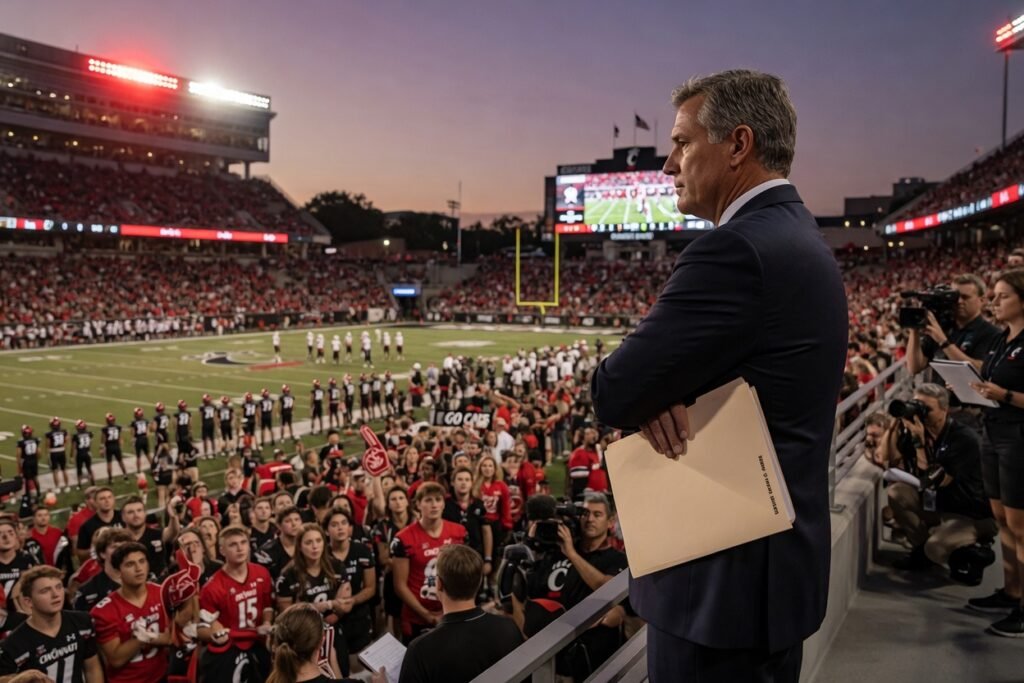
Meanwhile, Cincinnati coach Scott Satterfield is out here at Big 12 Media Days, declining to comment. “No comment.” The classic move. The tried and true dodge. It’s what you say when you either have something to hide or nothing good to say. I respect the hustle, but it doesn’t exactly project an aura of transparency, does it? It’s the kind of move that makes me think Slavin might be closer to the truth than Cincinnati wants us to believe.
Here’s the real problem: the NCAA is losing its grip, and everyone knows it. This Sorsby saga, the legal battles, the temporary injunctions, the Big 12 suing Texas Tech – it’s a full-blown circus. The transfer portal is basically free agency without the salary cap, NIL deals are the wild west, and now gambling is openly rampant. The NCAA’s model is broken, shattered, and scattered across the timeline like bad takes after a major upset.
They want to enforce rules, but they simultaneously profit from the very thing they’re policing. How many NCAA-sanctioned events have betting partners now? How many TV deals are juiced by the massive sports betting market? The hypocrisy is thicker than a defensive tackle’s neck. They preach “integrity” while counting the money from DraftKings and FanDuel. That’s not just a bad look; it’s an institutional self-own.
This isn’t about Sorsby being a bad kid. It’s about a system that is fundamentally flawed. When players are making bank through NIL, when they’re constantly on the move through the portal, the lines of “amateurism” are so blurred they’re practically invisible. They’re telling these kids they’re pros in every way *except* when it comes to betting on games. That’s a cognitive dissonance so severe it should be studied.
The NCAA’s letter of inquiry to Cincinnati isn’t a sign of strength; it’s a desperate flail. It’s them trying to put out a forest fire with a water pistol. This is just the beginning. As more money pours into college athletics, as more players realize they’re commodities, and as the lines between legal and illegal betting get thinner, we’re going to see more Sorsbys. We’re going to see more inquiries. We’re going to see more chaos.
And the NCAA, with its glacial pace and inconsistent rulings, is completely unequipped to handle it. They’re trying to apply 1950s rules to a 2024 problem. It’s like bringing a flip phone to a TikTok dance battle. They’re nerfed, they’re outdated, and they have no aura left. This isn’t a one-off; this is the new normal.
So, go ahead, Cincinnati. Keep denying. Keep talking about your “extensive gambling education.” But I’m watching. We’re all watching. And I think the real question isn’t what Sorsby did, but what you *really* knew.
And if you knew, what are you going to do when the NCAA, the one organization that seems to consistently fumble the bag, actually decides to drop the hammer?