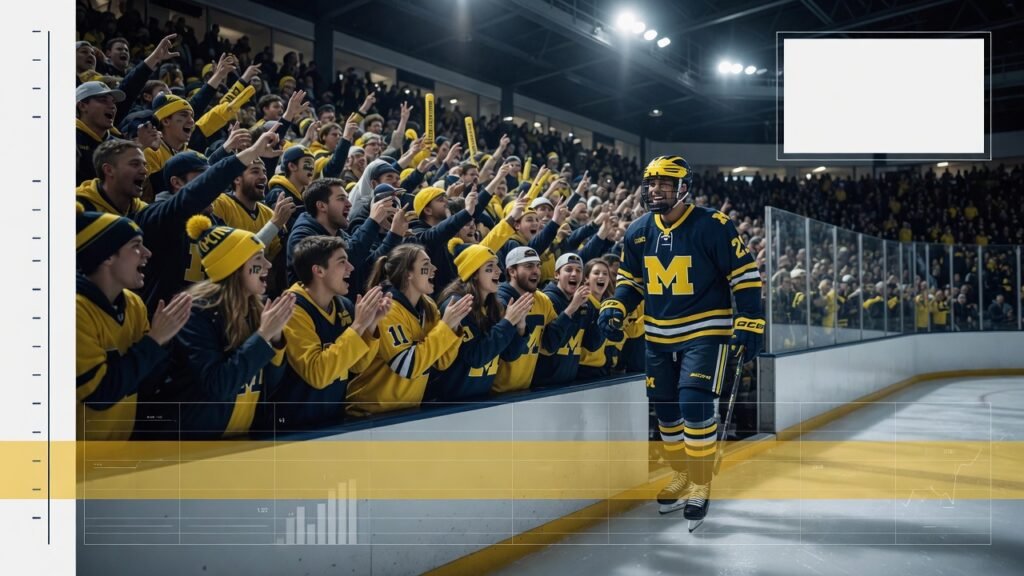
Landon DuPont committed to Michigan in his draft year, and the rest of college hockey just got handed a problem it cannot scheme around. Exceptional-status defensemen who put up 73 points in 63 WHL games and another 23 in the playoffs do not arrive as ordinary freshmen. They arrive as the reason opposing coaches rewrite their breakout plans in August.
I keep coming back to the mechanism. The NCAA’s CHL pathway turned major-junior production into campus inventory, and Brandon Naurato is treating that inventory like a salary-cap team that never hits the ceiling. Seven freshmen landed in the official July announcement. Three of them already carry first-round NHL draft pedigree on the letterhead. DuPont is projected at the very top of the 2027 class. The pipeline did not slow down after the Frozen Four run either. Dima Zhilkin, a captain who just dropped 75 points in 59 OHL games, is already locked for 2027-28.
This is not a reload. It is a stacking operation with real NHL Draft capital on every pair.
Horcoff-Hage-Perron Is the Matchup Line Everyone Else Has to Survive
Michael Hage sits in the middle of what the early projected lineup correctly called a group that “could be the best line in the entire NCAA.” That is not marketing. Hage’s vision and puck skill already made him one of the nation’s premier young forwards. Will Horcoff, at 6-foot-5, wins the battles and creates the crease space that lets skill breathe. Jayden Perron fills the soft spots and finishes the reads. One early projection framed it cleanly: “If you’re trying to build a line capable of matching up against anyone in college hockey, this is probably it.”
I buy that framing. All-American potential on a single unit forces every opponent into a hard choice on deployment. You shadow them and the second unit eats you. You roll four lines and they still generate the highest-danger chances on the sheet.
That second unit is where the depth argument stops being theoretical. Malcolm Spence, Jack Nesbitt, and J.P. Hurlbert. The projection did not hedge: “Calling this Michigan’s second line almost feels unfair. It’s 3 first round NHL picks.” Nesbitt, the Flyers’ 12th overall selection in 2025, just put up 58 points in 55 OHL games. Hurlbert torched the WHL for 42 goals and 97 points, took Rookie of the Year, and went in the first round to Detroit. Spence already showed the two-way maturity as a freshman and has room to climb. That is a second line that would headline most Big Ten rosters by itself.
The Back End Now Carries First-Round Weight on Multiple Pairs
Cam Reid arrived as Nashville’s 21st overall pick and the captain of a Memorial Cup champion. He produced 56 points in 57 OHL games and another 14 in the playoffs. Pair him with DuPont and you are looking at a top pair that can run power play one and still kill penalties without a drop-off in exit quality. Behind them sit returning pieces and more CHL arrivals. The blue line no longer needs to hide anyone in a sheltered role.
Naurato’s roster construction now mirrors the modern NHL preference for interchangeable skill over rigid hierarchy. Cole McKinney can slide up or sit on a fourth line that still has Kieren Dervin and Aidan Park bringing pace. Dervin switched from Penn State after a 42-point OHL season and carries his own draft stamp. The projection noted the obvious: this is not a typical fourth line, and it will eat real minutes. That keeps Hage’s group fresh for the late periods that decide Frozen Four weekends.
Secondary scoring is the variable that separates contenders from champions. Garrett Schifsky anchors the third line as captain. Adam Valentini brings freshman pace. Nick Moldenhauer supplies the creativity when healthy. Consistent production from that group turns Michigan’s depth chart into a four-wave problem instead of a star-and-support structure. Opposing defenses cannot load up against one matchup without leaving another first-rounder open.
The Real Stakes Sit Past Opening Night
Michigan went 31-8-1 last season, earned the No. 1 overall seed, and reached the Frozen Four before Denver ended it. The core that remains already knows what a national-title window feels like. Adding DuPont, Reid, Nesbitt, and Hurlbert in the same cycle raises the floor more than the ceiling. The ceiling was already high. The floor just became the hardest thing in college hockey to crack on a Tuesday night in January.
I am not interested in the narrative that every blue-blood reload is automatically a title favorite. Minutes management with this much pedigree becomes its own tactical test. Freshmen who dominated junior can still need time to adjust to the college schedule and the defensive detail Naurato demands. Injuries will test the fourth-line trust theory in real time. None of that erases the structural edge. When your “second line” is three first-round picks and your top pair includes a projected No. 1 overall talent playing his draft year, the rest of the field is already chasing.
The roster sheet for 2026-27 is the deepest of Naurato’s tenure. Opening night will not settle the argument. The first weekend an opponent has to kill three straight power plays against this group will.