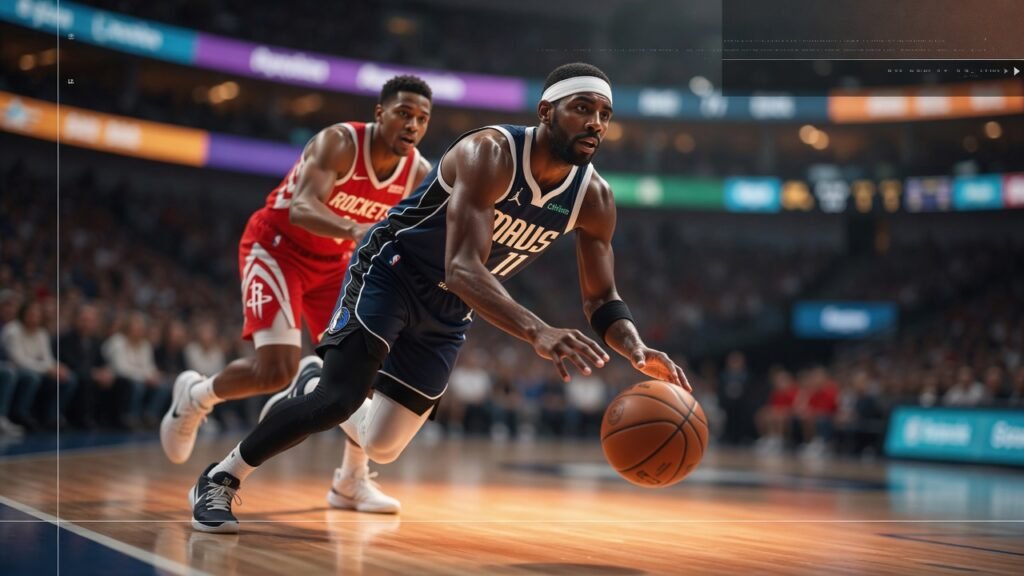
Five hundred and eighty-six days is an eternity for an aging guard who relies on lateral deceleration and change of direction, but the geometry of the basketball court remains exactly as he left it. The Dallas Mavericks needed a secondary creator to unlock the Cooper Flagg era and replace the gravity of a post-Luka Doncic rotation. Sunday night in Macao, they got a 22-minute preview of a 34-year-old who still understands the angles better than the defenders tasked with containing him.
The broader NBA betting market will argue that a 17-point performance in an international preseason exhibition against the Houston Rockets carries zero predictive value for a grinding 82-game regular season. The box score answers that directly with the efficiency of a zero-turnover performance across roughly 22 minutes of heavily scrutinized half-court usage. The Mavericks routed the Rockets 132-115, and the primary takeaway is that the surgically repaired left knee holding this entire rebuild together successfully handled the torque of high-level professional basketball.
The First Possession Dictates the Scheme
The play design from head coach Dusty May on the opening tip revealed the exact hierarchy of this new Dallas offense. Flagg initiated the action, forcing the defense to respect the reigning Rookie of the Year, while the movement was specifically drawn to get a downhill look at the rim for a guard returning from a catastrophic injury.
“Grateful that Dusty called the first play for me. Had my mind made up just to attack,” Kyrie Irving told reporters after the win, per ESPN. “… I was imagining how it was going to go, dreaming about how it was going to go. I’m just glad I got that out of the way.”
The result was a reverse layup. The advanced implications highlight a deliberate effort to establish the veteran as the primary half-court pressure point. A guard coming off a March 2025 ACL tear against the Sacramento Kings—and a December 2025 Grade 2 calf strain that derailed his rehab—needs to test the structural integrity of his foundation in traffic. Doing it on possession number one removes the psychological hesitation that often plagues returning stars.
I focus heavily on usage efficiency, and the splits from Sunday provide a clear blueprint for managing a 34-year-old primary ball-handler. Six makes on 13 attempts, including 3-of-3 from the stripe, alongside three assists and zero turnovers in 21 minutes and 56 seconds of floor time. The coaching staff deployed a rigid load-management structure: roughly eight minutes in the first quarter, slightly more in the second, and a firm shutdown five and a half minutes into the third.
Executing Without Relying on Pure Explosiveness
The 24.7 points per game Irving averaged before the knee gave out in Sacramento were built on elite burst and finishing through contact. The 2026 iteration of this skill set relies heavily on pacing, hesitation, and an uncanny ability to read the secondary rotation before it commits to the ball.
Rockets head coach Ime Udoka recognized the rhythm immediately. “He’s back to being who he is. He’ll only get better as he gets his rhythm back in real NBA games,” Udoka noted, via ESPN.
When the opposing coach confirms that the timing and release points remain intact, the mathematical ceiling for the Dallas offense fundamentally shifts. A team anchored by Flagg requires a perimeter operator who demands a hard closeout and can punish the resulting defensive scramble. The two-of-six shooting from beyond the arc will normalize as the legs adjust to game speed, but the ability to separate from a primary defender without relying on peak athleticism is the most critical variable for the upcoming campaign.
Even May sounded slightly surprised by the immediate efficiency. “I didn’t expect him to play this well after being off for so long, just [because of] the rhythm of the game,” May said, per ESPN. “It’s just a testament to his work.”
The Mavericks are attempting to construct a contender by blending a young superstar wing with a veteran point guard returning from a massive 19-month layoff. The success of this experiment hinges entirely on whether the front office can surround them with enough tertiary shot creation to keep the minutes limit strictly enforced throughout the winter.
The medical clearance arrived without restrictions in late September, but the real test is the back-to-back scheduling that arrives in January. The prolonged absence effectively preserved a year and a half of physical tread on the tires, and the flawless return in Macao establishes a high baseline for what this half-court offense can produce. The margin for error in the Western Conference remains razor-thin, and Dallas just bet their early-season rotation on the durability of a 34-year-old knee navigating heavy traffic in the paint.