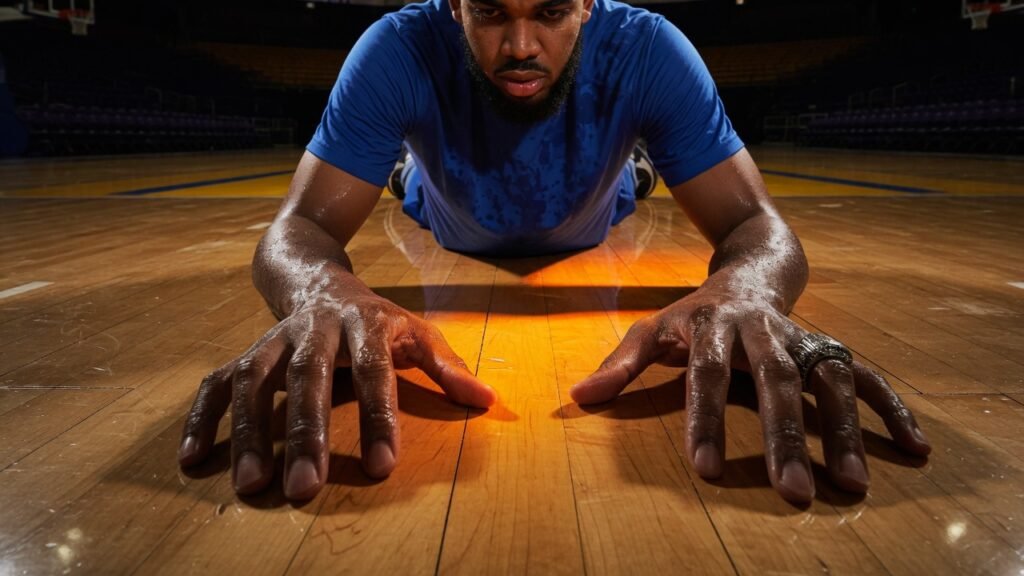
Karl-Anthony Towns thought he had the Knicks cornered, and the front office just showed him the door.
The defending champions dropped a press release on Friday afternoon that effectively told their starting center to go play basketball and drop the contract demands. They tabled all extension talks until later in the season, freezing negotiations for Towns, Josh Hart, Miles McBride, and Tyler Kolek to focus entirely on the title defense.
Towns stood in front of the media on Sunday and let the frustration bleed out over a microphone.
“It was news to me,” Towns told reporters at the Tarrytown facility. “Very disappointed to say the least. Let’s state the obvious: It’s business, but there is business on the court for us to handle.”
He admitted he had not even considered what happens next regarding his $61 million player option for the 2027-28 season.
“Because I never thought we would get to that point,” Towns said. “But I think right now what’s best for our team is we just focus on the basketball. It’s going to be a fun game tomorrow.”
He is disappointed because his leverage just vanished into thin air. He spent the last week complaining about the front office, trying to weaponize the glow of New York’s first championship in 53 years to secure a four-year, projected $276 million max extension. He miscalculated completely. The Knicks are offering around $200 million, and they refuse to budge.
Fans on social media are glazing Towns for his playoff rebounding and screaming that James Dolan is disrespecting the guy who helped hang a banner. They point to his 15.9 points and 10.6 boards during the championship run and argue the franchise is fumbling the chemistry right before opening night.
That logic is entirely cooked. New York is operating with absolute precision here.
The Second Apron Reality
The modern NBA collective bargaining agreement exists to dismantle expensive rosters, and the Knicks are fighting to keep their core intact. Staying under the second apron operates as a strict roster-building imperative for Dolan, regardless of what the internet demands.
Breaching the second apron triggers frozen draft picks, lost mid-level exceptions, and zero flexibility to make trades. My patience for players who demand the absolute maximum while preaching team chemistry evaporated the moment the new CBA dropped. The immediate casualty of the cap crunch already materialized when Mitchell Robinson walked to the Celtics for a salary starting at $15 million. The Knicks had to patch that massive hole in the paint by signing Andre Drummond on a $2.4 million league minimum. Replacing a prime defensive anchor with a minimum-salary center is the exact kind of roster degradation that happens when the math gets suffocating.
Towns wants to eat up roughly $69 million a year while demanding the front office surround him with elite depth. The math simply falls apart. You cannot demand the supermax and then complain when the supporting cast gets completely nerfed. Josh Hart is sitting right there, eligible for his own extension in the $130 million range, watching this entire drama unfold. Paying Towns the absolute max could force the franchise to make brutal decisions about glue guys like Hart, who holds a $22 million team option for 2027-28.
He exposed his own flawed logic earlier in the week when he laid out his contract demands to the press.
“Simply put, I want to do something that can keep the team together and work with the Knicks and also values me,” Towns said. “None of those things have come close to happening.”
The dissonance hurts to read. He wants the team together, but he demands a contract structure that mathematically guarantees the team will be torn apart. A four-year offer of $200 million represents a hyper-calculated valuation of a guy scheduled to make $57.1 million this season anyway.
Misreading the Market
Towns genuinely believes the June parade granted him total immunity from the salary cap math.
“No s–t, Sherlock. I just won a championship,” Towns said last week regarding his expectation of a massive deal. “You’d think it was pretty easy. Unless you guys think I have something else to prove.”
That quote exposes a player who misunderstands his role in the hierarchy. He was phenomenal during the title run. He adapted his game, hit massive shots, and secured his legacy as the essential piece next to Jalen Brunson. A second option simply does not command a blank check that sinks the balance sheet.
The Knicks issued their Friday statement because Towns tried to litigate this $76 million gap in the press, and complaining about $200 million to reporters has absolutely no aura.
“As an organization, our entire focus is preparing for the upcoming season and delivering another year for our fans to be proud of,” the team statement read. “As a result, we will not be negotiating contract extensions until later in the season and will remain solely focused on preparing for the start of the season.”
That statement serves as a corporate gag order.
To sign an in-season extension after the October deadline, Towns would have to decline his $61 million option and lock in a new number. He thought he could force the Knicks to blink and secure the max before opening night. Instead, they called his bluff, shut down the table entirely, and told him to lace up.
Even as he tried to pivot on Sunday, the damage was done.
“We’re all humans,” Towns said. “My only philosophy since we won, the only thing I’ve had in my mind, is about how do we win another one. So for me it’s the same focus that I came in this season with: How do we keep the trophy in New York past just this one summer?”
The front office knows the open market will not pay him $276 million next summer. They know the fan base will ultimately side with the logo over a contract dispute involving a guy making $57 million right now. The opening tip happens tomorrow, and Towns has to decide if his ego is worth sacrificing a perfectly built title contender over roughly $76 million.