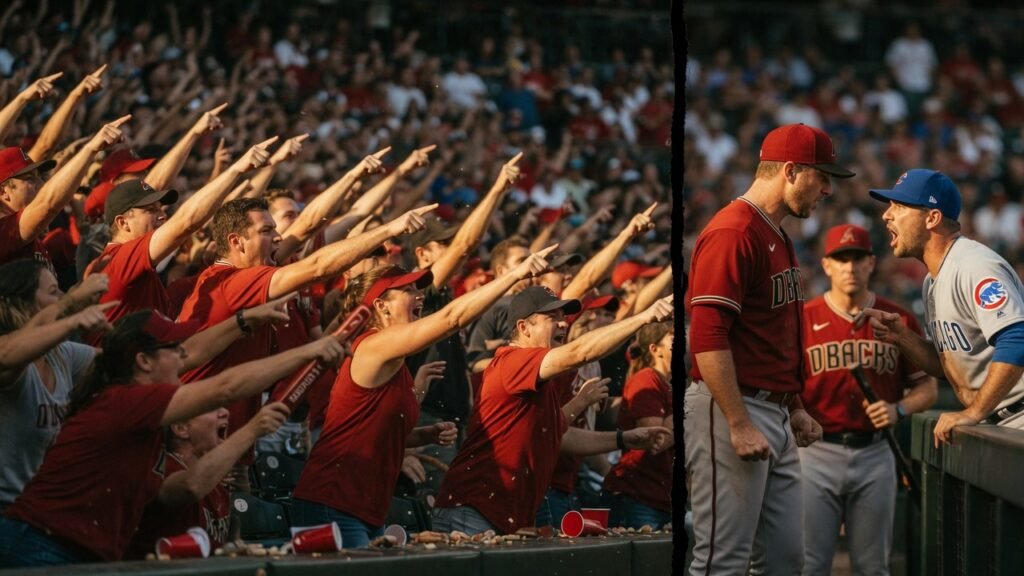
Merrill Kelly stepped off the rubber in the fifth inning at Chase Field, locked eyes on Quintin Berry standing in the third-base coach’s box, and the entire National League wild-card picture got a little less polite. Arizona suspected Berry was reading the open angle of Kelly’s glove, picking the changeup grip, and feeding it to Cubs hitters with a runner at second. Dugouts erupted. Fingers waved. Jeff Banister and Ryan Flaherty went at it while pitching coach Brian Kaplan yelled toward the home-plate umpire. No benches cleared. No ejections. Just pure August heat in a 7-0 Cubs shutout that felt bigger than the final score.
I have watched this league long enough to know the difference between a runner at second tipping a pitch and a coach operating as a satellite dish. Kelly drew that line with precision after the game, and I am drawing it with him.
Inside the Lines Is Baseball. Outside Is Theater.
“Stealing signs is as old as baseball,” Kelly said. “I think if it’s a guy on second base and they see the grip in your glove, or if the hitters can see something that you’re doing with your glove, I think that’s fair game. I think it’s a little bush league when it comes from outside that. I think inside the lines is one thing.”
That is the entire case. A baserunner who sees a grip earns the information. A hitter who catches a tip from the pitcher’s hand owns it. A third-base coach stationed in a two-foot half-rectangle, supposedly constrained by the 2026 rule that forbids leaving the box once the pitcher is on the rubber, turning himself into a human scoreboard is a different species of edge. Berry never left the box. He stayed legal by the letter. That is exactly why the rule looks like window dressing. If you can still decode grips and relay them without taking a step, the box is decoration.
Kelly went further: “That was probably the most egregious that I’ve seen from coaches… I think in that situation, I think it should stay between the players.” He also owned the part nobody wanted to hear. “That being said, I’ve got to take a look at what I’m doing because clearly he had something.” Twenty-eight changeups on the night, twenty-one of them to lefties, and the Cubs believed Berry was flashing every one. Kelly finished with 5.2 innings, five hits, three earned runs, and a loss that dropped him to 8-12. Kevin Gausman answered with seven shutout innings. Michael Conforto and Carson Kelly went back-to-back in the sixth. The scoreboard made the argument for Chicago. The principle still belongs to Arizona.
Craig Counsell called it “gamesmanship that goes on every day in the league.” Of course he did. Counsell manages a club holding a wild-card lead and just took a series opener on the road by seven runs. Banister shrugged it toward the calendar: “That’s part of the spirit of the game at times, right? I mean, it’s competitive. It’s August.” Torey Lovullo tried to hose it down completely. “Like, we’re going to go out there and fight type of a thing? Fight at the bike rack at 3 o’clock after school? No. It did not get personal.”
I am not buying the bike-rack dismissal. Two clubs clawing for October positioning do not jaw across dugouts and wave each other off for fun. They do it because the edges matter and everybody knows it.
The Rule Failed the Moment Berry Stayed Put
MLB installed the coaches’ box restriction this season specifically to cut the angles for reading grips. Stay inside the half-rectangle or eat a warning and then an ejection. Berry complied. The suspicion still flew. That means the rule solved the optics and left the actual problem untouched. You can stand perfectly still and still steal if the pitcher hands you the information and the coach has the nerve to use it.
I said for years that sign-stealing would never leave this sport. It only changes uniforms. The 2017 Astros version needed trash cans and cameras. This version needs a coach with good eyes and a pitcher who opens his glove a fraction too wide. Kelly’s own postgame honesty convicts the process better than any umpire ever could. He admitted Berry “had something.” He admitted other clubs will pick it up next. He admitted the fix starts with him. That is a professional talking. That is also an indictment of every pitcher who still believes the glove angle is private property once a man is standing ninety feet away with a job to do.
The Cubs did not invent this. They exploited it. There is a difference, and October does not care about the difference. Contenders take what the game offers. Contenders also live with the reputation that comes attached.
Wild-Card Baseball Runs on This Exact Voltage
Both of these clubs are playing for positioning that will decide who hosts and who travels in October. A 7-0 result with dugout fireworks is not a distraction. It is the product. Kelly and Berry chirping after the starter exited only confirmed what the fifth inning already announced: neither side is interested in quiet professionalism right now. They are interested in edges, in messages, and in making the other club uncomfortable for the next two nights of the series.
I have seen too many late-summer series turn on exactly this kind of spark. The team that pretends it did not happen usually loses the next one. The team that adjusts the grip, tightens the glove, and keeps the temperature high usually keeps winning. Kelly already said the quiet part. He has to change what he is showing. Berry already showed what he is willing to do while standing inside a painted box that was supposed to stop him.
Sign-stealing will still be here in September. The only open question is which club is still standing when the calendar flips and the edges stop being optional. Chase Field just reminded everybody that the old game never left. It only learned to stay inside the lines while it works.