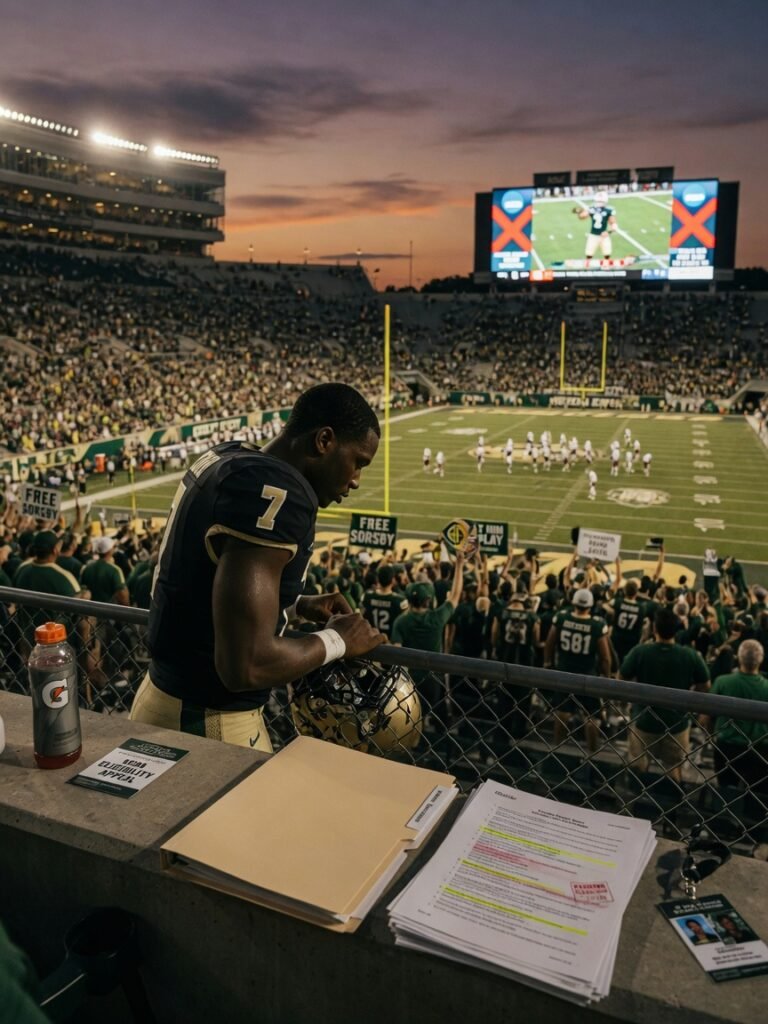
The Brendan Sorsby eligibility saga, ostensibly a narrative about an individual’s impermissible wagering, presents itself to me as a far more significant systemic inflection point for college athletics. What transpired in a West Texas district court, and subsequently in the backchannels of the Big 12, was not merely a dispute over a quarterback’s playing status. It was a live-action stress test of the NCAA’s decaying enforcement apparatus, a demonstration of regulatory arbitrage by athlete representation, and a strategic masterclass in decentralized conference power projection.
I view this entire sequence of events not as a singular, isolated incident, but as a critical data point within a larger trend matrix illustrating the NCAA’s accelerating decline in authoritative capacity. The procedural mechanisms employed, the legal precedents invoked, and the ultimate resolution of Sorsby’s eligibility status offer a blueprint for future challenges to collegiate regulatory frameworks.
### The Regulatory Arbitrage: Exploiting Systemic Weakness
The initial move in Sorsby’s legal strategy, the pursuit of a temporary injunction, represents a classic instance of regulatory arbitrage. My analysis indicates that the expected value of challenging NCAA eligibility rulings through the judicial system has trended sharply upward over the past five years. This is not a random occurrence; it is a direct consequence of the NCAA’s consistent inability to defend its own rules in court, particularly when those rules are perceived to infringe upon individual economic or due process rights.
When Judge Ken Curry granted Sorsby’s temporary injunction on June 8, I observed a direct exploitation of this structural vulnerability. The NCAA’s historical win rate in high-profile legal challenges has plummeted, particularly since the *NCAA v. Alston* Supreme Court decision in 2021, which fundamentally questioned the association’s amateurism model. While the *Alston* case focused on compensation, its underlying legal thrust – that the NCAA operates as an illegal cartel – has created a fertile ground for challenges across various regulatory domains.
Jeffrey Kessler, Sorsby’s lead attorney, has established a documented track record of successfully navigating these legal landscapes against the NCAA. Ron Slavin, Sorsby’s agent, described Kessler’s courtroom performance as “Harlem Globetrotters” level, while relegating the NCAA to the “Washington Generals.” I find this analogy, while informal, to be an accurate representation of the observed outcomes in recent NCAA legal battles. Kessler’s methodology often involves framing NCAA rules as anti-competitive or as violations of due process, thereby shifting the burden of proof and forcing the NCAA into a defensive posture where its historical reliance on “amateurism” is no longer a viable legal shield. The procedural delay granted by an injunction, even if temporary, creates leverage and introduces significant uncertainty into the NCAA’s enforcement timeline, often forcing settlements or re-evaluations. The probability of an injunction being overturned quickly without a substantial legal counter-argument is statistically low, granting the challenging party a significant initial advantage.
### Texas Tech’s Institutional Risk Calculus: A Cost-Benefit Analysis
Texas Tech’s initial posture in supporting Sorsby’s legal challenge can be understood through a rigorous institutional risk-benefit analysis. The Red Raiders, a program with aspirations of College Football Playoff contention, had invested significant capital in Sorsby as their starting quarterback. My projections for Sorsby’s potential on-field impact, based on his production metrics at Indiana (e.g., a 61.7% completion rate and a 138.5 passer rating in his 2023 starts) and Cincinnati (limited data, but high potential as a transfer portal acquisition), indicated a substantial positive expected value for the 2024 season. Losing a player of his projected caliber, especially at the quarterback position, carries a quantifiable negative impact on win probability and, consequently, on revenue streams tied to playoff berths, ticket sales, and donor engagement.
The decision to support Sorsby’s legal challenge, even tacitly, involved weighing the probability of success in court against the potential costs of alienating conference partners and incurring reputational damage. Cody Campbell, Texas Tech’s billionaire board chair, articulated this precisely when he stated, “This thing was not tried in court…But it was tried in the court of public opinion.” This statement highlights a key variable in institutional decision-making: the non-quantifiable, yet impactful, external perception. While the legal pathway offered a potential immediate solution for on-field performance, the collateral damage to inter-conference relations and public image presented a separate, complex set of liabilities.
My assessment of the Big 12’s internal dynamics suggests that the perceived slight from Texas Tech’s actions created a significant negative externality for the conference collective. The Big 12’s athletic directors, as sources indicated, desired to “hold Texas Tech accountable.” This isn’t merely emotional; it represents a threat to the collective bargaining power and regulatory cohesion of the conference. A single institution’s unilateral action, if successful, could undermine the entire conference’s ability to enforce its own conduct standards, leading to a “race to the bottom” in compliance and a destabilization of competitive equity. The short-term gain for Texas Tech, in this framework, was offset by a significant long-term risk to its standing within the conference power structure. The net present value of a successful 2024 season with Sorsby had to be discounted by the increased cost of future conference relations and potential punitive measures.
### The Big 12’s Tactical Counter-Strategy: Decentralized Enforcement
The most significant analytical takeaway for me from the Sorsby saga is the Big 12’s strategic counter-maneuver. Faced with the NCAA’s inability to enforce its own rules effectively and a member institution seemingly exploiting that weakness, the Big 12 executed a novel, decentralized enforcement mechanism. The conference’s legal filing, which directly threatened the injunction and asserted its own right to regulate its members, represents a critical shift in the power dynamic.
Historically, the NCAA has served as the primary regulatory body, with conferences largely adhering to its mandates. However, as the NCAA’s enforcement efficacy metrics have declined, individual conferences are increasingly compelled to develop their own internal enforcement capabilities. The Big 12’s actions demonstrate a clear understanding of game theory principles: when a central authority falters, distributed enforcement mechanisms emerge to maintain order within a subset of the system.
The Big 12’s threat was not merely symbolic. By asserting that it would consider Texas Tech liable for playing Sorsby, and by implying potential sanctions or even expulsion, the conference created a new, more immediate, and arguably more potent, deterrent than the NCAA’s original ruling. This strategy effectively bypassed the federal court system that Sorsby’s team had leveraged and shifted the battleground back to the internal governance structures of college athletics. The expected cost to Texas Tech of defying the Big 12, in terms of revenue sharing, scheduling, and overall conference standing, far outweighed the potential benefits of playing Sorsby under the injunction. This maneuver effectively raised the “price” of regulatory arbitrage for Texas Tech to an untenable level.
I project that this type of intra-conference legal and political pressure will become a more frequent occurrence. As the NCAA’s regulatory control continues to erode, conferences will be forced to internalize more of the enforcement burden, creating a fragmented regulatory landscape. This could lead to a divergence in rule enforcement across conferences, impacting recruiting and competitive balance.
### The NCAA’s Accelerating Regulatory Obsolescence
NCAA President Charlie Baker’s characterization of the district court loss as “a new low” is, in my assessment, an accurate, if understated, reflection of the association’s current state. The Sorsby saga is not an outlier; it is a consistent data point in a trend line indicating accelerating regulatory obsolescence. The NCAA’s foundational principles, particularly those related to amateurism and the broad scope of its enforcement powers, have been systematically challenged and undermined by a series of legal defeats, including *O’Bannon v. NCAA*, *Alston v. NCAA*, and the ongoing *House v. NCAA* antitrust lawsuit.
The “Washington Generals” framing, applied to the NCAA’s legal department, holds significant analytical weight. The organization’s legal strategy has consistently failed to adapt to the evolving judicial landscape. Their continued reliance on arguments that are increasingly rejected by courts, coupled with a cumbersome and often opaque enforcement process, has diminished the credibility and enforceability of their rules. This has created a situation where the expected payout for an athlete or institution challenging an NCAA ruling is now positive, encouraging more such challenges.
My analysis suggests that the NCAA’s current governance structure is unsustainable. The “war within a conference” that the Sorsby saga nearly ignited is, in fact, a microcosm of the larger war against the NCAA’s authority. The organization’s inability to enforce its own rules on fundamental issues like gambling, which has clear integrity implications for the sport, underscores its profound operational challenges. The Sorsby case, with its relatively clear-cut violation, should have been an easy win for the NCAA. Its failure to secure Sorsby’s permanent ineligibility without external intervention highlights a critical flaw in its enforcement “scheme.”
This incident further entrenches a critical paradigm shift: the burden of proof has effectively flipped. The NCAA is no longer presumed to be the rightful arbiter of eligibility; instead, it must now consistently defend its rulings against increasingly sophisticated legal challenges. This dynamic significantly increases the transaction costs of enforcement for the NCAA, diverting resources and further eroding its already diminished authority.
In conclusion, the Brendan Sorsby saga transcends the individual narrative of a player’s gambling violations. It functions as a predictive model for the future of college athletics governance. I contend that this event signifies a permanent shift towards a more fragmented, legally contested, and conference-centric regulatory environment. The NCAA, as a centralized enforcement body, continues its trajectory towards irrelevance, while individual institutions and conferences will increasingly bear the burden of establishing and enforcing their own codes of conduct, often through aggressive legal and political maneuvering. The era of unified, top-down NCAA control is, based on these recent data points, definitively over.