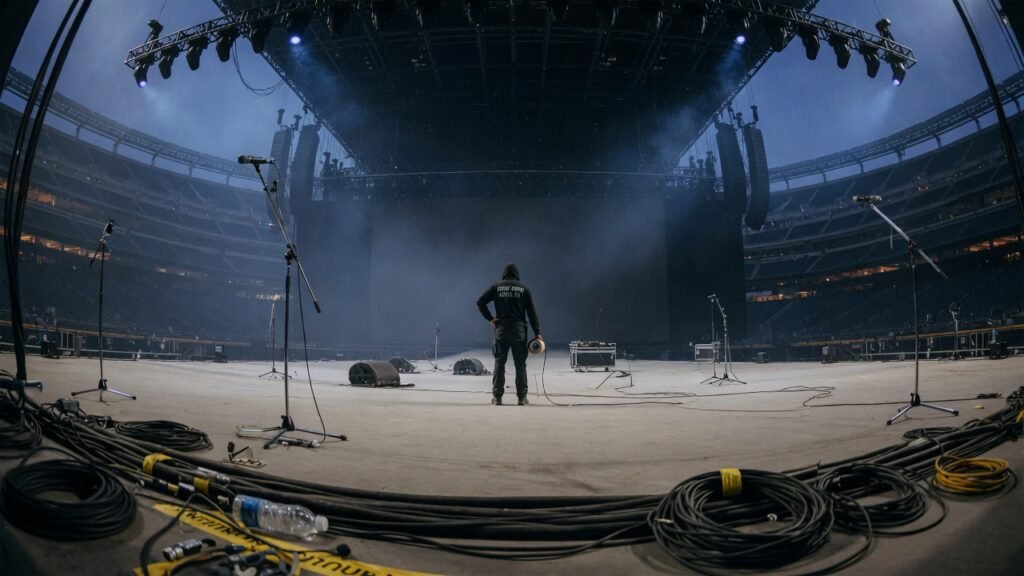
Harry Styles just canceled a São Paulo stadium show hours before doors with the vaguest possible explanation, and somehow that is the least surprising part of the whole mess.
Live Nation Brasil dropped the statement like a wet towel on a Tuesday morning: the July 21 concert at MorumBIS was off “due to a health issue on the tour.” Tickets refunded. Friday still on. Extremely limited inventory if you want to scramble for the makeup night. No diagnosis. No name attached to the body that is actually sick. No timeline. Just the corporate shrug that has become the official language of modern pop when the machine hits a snag.
Look, I get it. Medical privacy is real. Nobody is entitled to Harry Styles’ chart notes. But stay with me here. This is a man who, roughly a month earlier, dropped to the Wembley stage floor for about seventeen seconds after choking on water during his signature whale-spit fountain bit. He tapped his chest. He waved. He ran off. The internet did what the internet does and lost its mind in real time. That incident had a cause you could actually name. This one arrives wrapped in the same opaque gift paper every major tour uses when something goes sideways: “tour illness.” “Health issue.” The words are designed to end the conversation, not start one.
Mystery Is the Product Now
The Together, Together Tour is already a physical endurance test dressed up as a victory lap. Sixty-eight dates. Multiple continents. Four nights planned in São Paulo alone, two of them already in the books before Tuesday got scrapped. This is the first full cancellation. That matters. Not because artists never get sick—of course they do—but because the infrastructure around someone at Styles’ level has become so massive that any crack in the schedule requires crisis management instead of a simple “he’s not well, here’s the plan.”
A rep told outlets the Friday show “will play as scheduled” and that they worked with the venue to free up whatever seats they could. Fine. Logistically competent. Emotionally hollow. Fans who flew in, took time off, spent real money on a Tuesday night now get an email from Ticketmaster and a lottery ticket for Friday. The machine absorbs the inconvenience and keeps rolling. The body that has to actually sing for two-plus hours in a Brazilian stadium is reduced to a scheduling conflict.
Now, you might be thinking this is just one bad week in a long career. Maybe. But the pattern of near-misses is stacking up fast enough to notice. The Wembley choke. The wardrobe malfunction a few days later where he had to zip his fly mid-set while the crowd screamed. The very public thank-you to his One Direction bandmates, including a pointed nod to Liam Payne, at the final London show. Styles stood there and said, “I wouldn’t be on this stage if it wasn’t for four friends of mine that were a massive part of this journey,” then named them all and called Liam “my dear friend.” That was July 4. A few weeks later the tour hits its first hard stop for an unspecified health problem. You do not have to be a conspiracy theorist to feel the cumulative weight of a man performing at this scale while the people around him keep the details locked down.
Great touring shows used to feel like shared risk. Springsteen sweating through three hours because the night demanded it. Prince turning a technical disaster into legend. Even the chaos of early Madonna or the physical toll on Beyoncé’s Formation run felt like the artist and the audience were in it together. What we have now is a polished apparatus that treats the performer like a fragile luxury good and the fans like subscribers who will accept a refund code and a vague apology. “We deeply regret to inform you” is not communication. It is liability language.
The Whale Spit Was Honest. The Press Release Was Not.
The Wembley collapse was ugly and human. Water went down the wrong pipe during a bit he has done a hundred times. He stayed down. People watching the livestream said they were afraid for a few seconds. That moment had stakes because it was unscripted and visible. Tuesday’s cancellation has none of that clarity. It arrives as a finished product: canceled, refunded, next show still happening, please remain calm. The difference is the difference between a performer who is still a person and a brand that cannot afford specificity.
I am not diagnosing anybody from a desk in another hemisphere. I am saying the culture that built this tour—stadium residencies, Guinness World Record nights at Wembley, an album cycle that demands constant motion—has incentives to keep every setback as abstract as possible. Concrete details create narrative. Narrative creates scrutiny. Scrutiny slows the money. So we get “problema de saúde na turnê” and a promise that Friday will go on, inventory extremely limited.
Styles is thirty-two. He has already lived several public lives: boy-band escapee, solo auteur, fashion experiment, film actor, stadium messiah. The voice still works. The charm still works. The problem is not talent. The problem is that the industry has decided the only acceptable story is relentless forward motion, and any pause must be laundered through the softest possible nouns. Health issue. Tour illness. Deeply regret. The writing on these statements is always the same because it is written by the same committee of people whose job is to make sure nothing sticks.
If Friday happens and he is sharp, fine. Credit where it is due. But if the pattern continues—another collapse, another last-minute scrub, another press release that says everything and nothing—then we are not watching a pop star manage a rough patch. We are watching a system that will keep extracting until the body or the voice finally forces a harder conversation. Fans already proved they care. The replies under the Live Nation post were mostly well-wishes and genuine worry. They do not need more mystery. They need the people running these tours to treat the human being at the center like something more than a revenue engine that occasionally needs a software patch.
The São Paulo cancel is not a scandal. It is a symptom. And the fact that we have all been trained to accept “health issue on the tour” as a complete sentence is the real tell. Great storytelling requires stakes and specificity. Right now the only thing specific is the refund policy. Everything else is fog, and fog is what you get when the people in charge would rather you dance no more than ask why the music stopped.