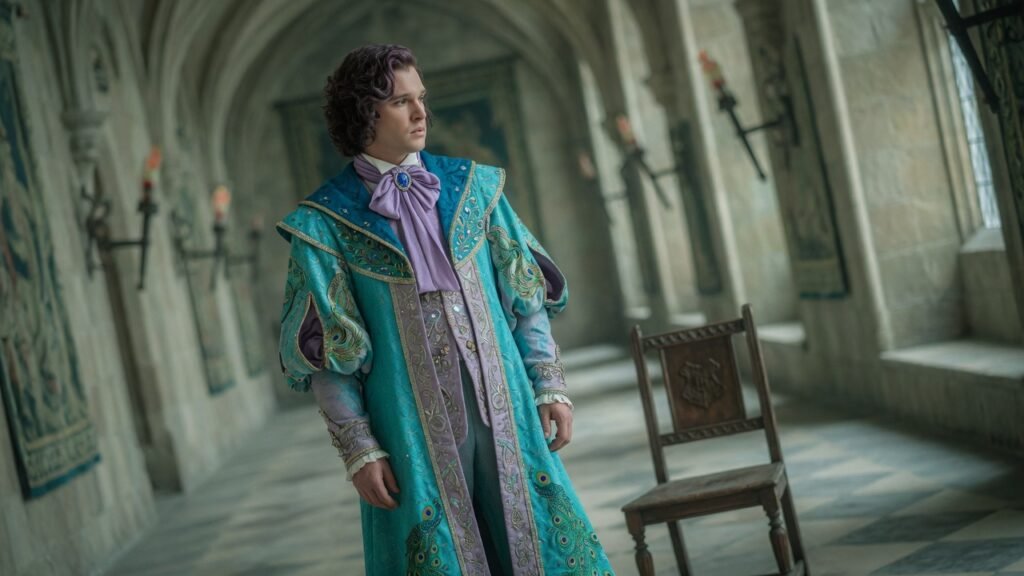
Kit Harington just got upgraded from audiobook vanity project to flesh-and-blood fraud, and somehow that is the cleanest casting decision this whole Harry Potter reboot has made.
Less than two weeks after Nicholas Hoult was announced as Gilderoy Lockhart, HBO let him out of the deal and slid the former Jon Snow into the robes. The official line, posted with the kind of breezy calm only a franchise with a decade of runway can afford, read: “Before we begin year two at Hogwarts, there has been a slight change due to schedule: Kit Harington will be stepping into the role of Gilderoy Lockhart.” Slight change. Sure. Lockhart is the entire comic and thematic engine of Chamber of Secrets. Swapping him midstream is not rearranging the silverware. It is replacing the guy who is supposed to teach you how fame lies.
Hoult’s exit is pure logistics. Two prior projects, a production calendar that shifted, and suddenly the Superman actor could not make the Lockhart block work. No scandal. No creative clash. Just the industrial reality of an actor who books like a man trying to outrun his own calendar. Hollywood treats “scheduling issues” as a polite shrug. Here it accidentally handed the part to the one person already on record admitting he understands the character’s disease.
He Did Not Audition. He Confessed.
When Harington voiced Lockhart for Audible’s full-cast editions late last year, he did not play it like a paycheck. He played it like a man who had already lived a softer version of the joke. “There was a part of me that was wondering, ‘Why have they come to me for Lockhart?’” he told Variety in December 2025. “There’s a little part of Lockhart in all of us, and there’s more than a little bit of Lockhart in me.” That is not actorly charm. That is a diagnosis.
Lockhart is not a cartoon. He is a cautionary tale wearing perfect teeth. Five-time winner of Witch Weekly’s Most Charming Smile Award. Author of books that steal other people’s heroics and file the serial numbers off with Memory Charms. Dumbledore hires him as Defence Against the Dark Arts professor because the man is famous, and fame, in Rowling’s second book, is treated as its own kind of dark magic. Kenneth Branagh played him in the 2002 film as a preening theatrical peacock, all curls and manufactured awe. Funny. Memorable. A little safe. The joke stayed on the surface.
Harington has a different angle of attack available. He survived eight seasons as the face of the biggest fantasy show on television, then watched the cultural conversation turn him into a meme, a heartthrob, a punchline, and finally a working actor again on Industry. He knows what it feels like when the persona outruns the person. “I like Lockhart,” he said in that same Variety interview. “I can see the trap he’s fallen into. I’ve probably fallen into it many times in my life being an actor. He’s a wonderful fable for anyone in the creative arts about getting ahead of yourself, hubris and this terrible lesson about seeing who you are but everyone else can see who you are.”
Stay with me here. That is the entire part. Not the hair. Not the smile awards. The gap between the story you sell and the man left standing when the charm fails. Hoult would have been excellent at the surface comedy. He always is. Harington can play the rot underneath without winking at the camera every three seconds, because he has already admitted the rot is familiar.
The Book Nerd Got the Joke First
This is also not some cynical franchise parachute. Harington grew up inside the books the way the target audience did. “I was one of those people who was given the book — I was 11 and Harry was 11,” he told Variety. “I grew up with them.” He never bonded hard with the movies. He came back through Stephen Fry’s audiobooks and has used them as a sleep aid for years. When Audible called about Lockhart, his answer was blunt: “It was a really simple yes, because I love the character. As far as cameos in a series go, you don’t get much more entertaining and fun to do as an actor than Gilderoy Lockhart. It was a no-brainer.”
Now look at the production math. Season 1, Philosopher’s Stone, lands Christmas Day 2026. Season 2 is already greenlit and starts filming this fall under Francesca Gardiner and elevated co-showrunner Jon Brown, with Mark Mylod still in the director’s chair for multiple episodes. The kids (Dominic McLaughlin, Alastair Stout, Arabella Stanton) are locked. Lithgow’s Dumbledore, McTeer’s McGonagall, Essiedu’s Snape, Frost’s Hagrid: the adult spine is set. Lockhart is the first major new energy injection of year two. He has to walk into Hogwarts already believing the press clippings, seduce half the staff, fail upward, and then collapse in a way that teaches Harry something permanent about glory.
Branagh’s version entertained. A Harington version that leans into the self-awareness he already voiced could actually sting. The man who once joked there is a little Gilderoy in all of us is now contractually obligated to prove it on camera while a generation of kids watches their new Harry learn that celebrity is often just theft with better lighting.
The recast looks messy from the outside. Two weeks between announcement and replacement. Fans on X doing the usual “yikes” math. Hoult walks away clean toward whatever he was already building. None of that is the interesting part. The interesting part is that HBO’s scheduling chaos routed the role to the actor who had already done the homework, already named the hubris, and already said he would take any job in this universe, background extra included.
Lockhart’s whole racket is writing himself into other people’s victories. For once the universe wrote the right man into the part. The smile awards can wait. The real test is whether Season 2 lets him be pathetic enough to be dangerous.