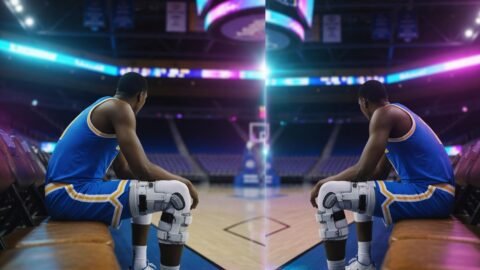
Melvin Council Jr. has a court date on September 23 that will decide whether a Big 12 Newcomer of the Year gets to play college basketball again, and the NCAA still cannot explain why a man with three Division I seasons on his résumé has already run out of time.
I am looking at the record, not the noise. Council put up 12.7 points, 5.0 rebounds, and 5.1 assists across 35 starts for Kansas in 2025-26. He logged 34.8 minutes a night, led the Jayhawks with 177 assists, hit a career-high 36 points with nine threes against NC State, and walked out of the season as Big 12 Newcomer of the Year and an All-Big 12 honorable mention. Before that: 14.9 points at Wagner, 14.6 points and third-team All-Atlantic 10 at St. Bonaventure, and roughly 1,400 points as Monroe College’s all-time leading scorer with two NJCAA All-America nods. Three NCAA seasons. One elite JUCO résumé. Age 24. Rochester, New York. And the eligibility clock says he is finished.
That is the case file. Now watch what the system did with it.
The Waiver Died in May. The Courtroom Opened in September.
On May 7, Council submitted a waiver through Kansas compliance seeking a sixth overall season and a fourth at the Division I level, arguing his two junior-college years should not burn the five-year clock the way the NCAA applied it. On May 19 the NCAA denied him. On July 23 he sued in Douglas County District Court in Kansas, naming the NCAA and Josh Whitman in his capacity as chair of the Division I cabinet, seeking injunctive relief and immediate eligibility. The complaint argued the clock started improperly at JUCO enrollment because of extenuating circumstances tied to criminal charges that were later dismissed, and that Council had only three NCAA seasons on the books.
A temporary injunction hearing was set for September 4 in front of Chief Judge Mark Simpson. Then, late August, Council dismissed the Kansas case without prejudice. No public explanation. His side refiled in Monroe County Supreme Court in New York, his home state, this time seeking a TRO and injunction to practice, roster, and compete in 2026-27. On September 10, Judge Daniel J. Doyle signed a show-cause order requiring the NCAA to appear September 23 at 2 p.m. Eastern. Doyle did not grant the piece that would have made Council eligible immediately. The NCAA, in its memorandum, argued Council manufactured the urgency by waiting after the May denial and then changing venues.
I will give the NCAA this much: venue-shopping after a summer-league run with the New Orleans Pelicans does not scream emergency. Council went undrafted, posted 8.0 points, 1.7 rebounds, and 3.7 assists in three Summer League games, and had already entered the transfer portal in April as a safety net. He is listed in the KU directory, which means he is already in the building. The late-enrollment petition deadline sat on September 21. The legal path got longer while the calendar got shorter.
But the NCAA’s urgency lecture does not erase the underlying absurdity. A guard who averaged 14.1 points, 5.4 rebounds, and 4.2 assists across 102 Division I games is being told two JUCO seasons closed the window on a fourth year at the highest level. That is the rule as applied. It is also the reason judges keep getting these files.
Bill Self Is Monitoring. The Roster Is Not Waiting Forever.
Bill Self’s public posture has been pure institutional caution. “We’re aware of Melvin’s legal efforts to pursue an additional year of Division I eligibility, similar to what a number of student-athletes across the country are doing. At this point, we’re simply monitoring the process and allowing it to play out,” Self said in late July.
Monitoring. Allowing it to play out. That is coach-speak for “I will take the production if a judge hands it to me, and I will not stake the program on a lawsuit I do not control.” Kansas had filled 14 of 15 roster spots by summer reporting, holding one for the potential eligibility of Mihailo Musikic. Even a win for Council does not guarantee a return to Lawrence. Big 12 rules on professional athletes and interest from other programs sit in the fine print. Self is not wrong to stay measured. He is also not wrong that this is now a national pattern, not a one-off grievance.
I keep coming back to the same exhibit: Council was good enough to start every night in the Big 12 and lead Kansas in assists. The NCAA’s denial turned that production into a courthouse exhibit. Monroe County is about to hear why a three-season Division I guard should get a fourth. The show-cause order is the closest thing college basketball has to a real eligibility hearing that does not disappear into a compliance black hole.
September 23 will not rewrite the entire five-year clock. It will decide whether Melvin Council Jr. gets to keep playing under it. The numbers he already posted in Lawrence are the best argument in the room. The rest is lawyers, venue, and a rule book that keeps forcing athletes into court because it will not write the clock in plain English. I will be watching the docket. Kansas should be watching it too.