College hockey just painted NHL trapezoids behind every Division I net, and the goalies who treated the corners like private real estate lost half their map overnight.
The rules package that cleared the NCAA committees for 2026-27 does more than draw new lines. It rewrites possession starts, stacks major penalties into automatic ejections, kills the icing timeout loophole, and hands coaches a tighter challenge window. Marco Hunt laid the list out at CCHA media day. The through-line is structure over freelancing, and the product will feel different the first time a goaltender freezes a puck outside the trapezoid and eats a delay-of-game.
The official language is clean. “Starting with the 2026-27 season, Division I men’s ice hockey games will use a trapezoid area marked below the end line. Goalkeepers will be allowed to play the puck below the goal line in this area of the ice, but not outside this area toward the corners of the rink. This aligns with National Hockey League rules and markings.” Division III gets a one-year delay to 2027-28 so rinks can plan. The puck position decides the call, not the goalie’s skates. That single detail ends the old debate about whether a keeper was “in” or “out.”
Dump-Ins Just Got a New Risk Profile
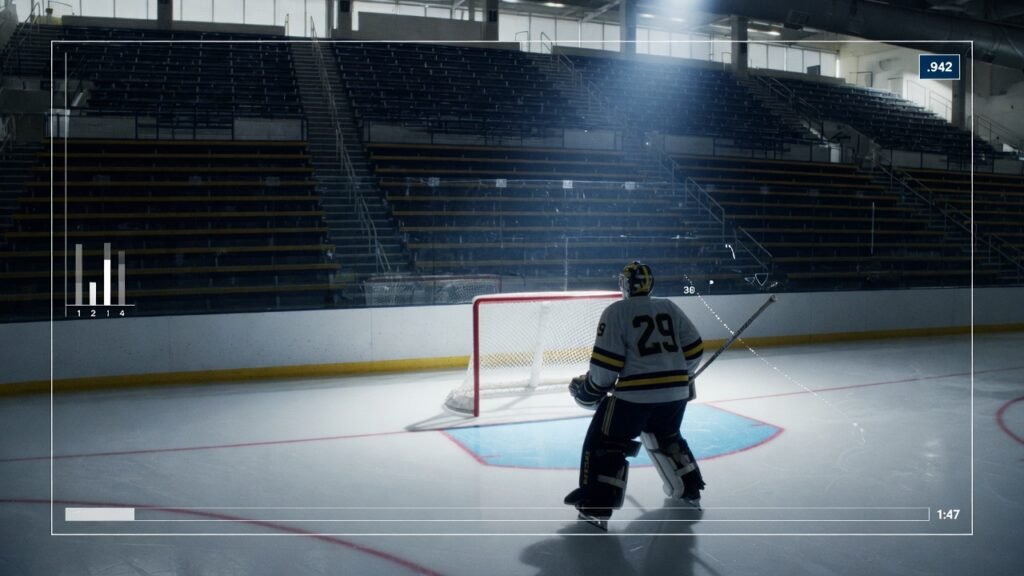
I keep coming back to the dump-and-chase math this creates. Goalies who roamed the corners to start breakouts or kill pressure now operate inside a cage. Forwards who banked on a free retrieval in the soft spots face a different calculation: force the goalie outside the lines and you might buy a free faceoff in the offensive zone. That is pure scheme. The NHL installed the same restriction after the lockout for the same reason, and college just imported the mechanism wholesale. Rinks at Miami and Merrimack already painted the lines this summer. The visual is the tell.
Hand passes now live if they start and finish inside the defensive zone. Offsides hinges on control of the puck before the skates cross the blue line, not mere contact. Both centers must have their stick blades flat on the ice before the drop. Hunt framed that last one as an attempt to keep face-offs cleaner and fairer. Small rule, big friction reduction at every stoppage.
Majors Stack, Timeouts Die, Diving Gets Called
The penalty cleanup is the second half of the story. A player’s second major in a game now carries a game misconduct. Fighting is redefined as throwing repeated punches instead of a single punch. Post-whistle contact gets roughing or unsportsmanlike. Throwing a stick outside the playing area is an automatic game misconduct. Officials have been told to call diving and embellishment when they see it.
Hunt put it plainly: “It is something that obviously you don’t want to see in hockey. It is something the teams have been trying to cooperate with. Nobody wants diving done on their teams. Hopefully we can eliminate some of the embellishment in diving.” That is enforcement language, not suggestion. The second-major trigger is the one that will change bench management first. Coaches who used to ride a physical forward through one big penalty now have to pull him or risk the ejection.
No-change situations just got teeth. If a team ices the puck, it hits the net, and the goaltender freezes it, that is now a no-change. Same as a net knocked off its moorings or a puck leaving the rink. Teams can no longer call a timeout in those spots to rest the unit that just iced it. The additional overtime timeout disappears in the regular season and returns only in the postseason. Late-shift dump-ins used to buy a free reset. That edge is gone.
Coach’s challenges expand in two directions. A coach can challenge a disallowed goal that came from a goaltender-interference minor. An unobserved major must be initiated through a challenge; officials only start the process if they saw the major on ice. One challenge per first stoppage by the same team. That is a narrow window, and it forces coaches to burn the challenge with real conviction.
Cut-resistant neck, wrist, and ankle protection is recommended for 2026-27 and mandatory for Division I men and National Collegiate women starting 2027-28. Trevor Large, the Canisius coach who chairs the Division I Men’s Ice Hockey Rules Subcommittee, framed the safety push directly: “Some other levels of hockey have moved to mandate equipment intended to enhance student-athlete safety. The committees at all levels believe this is an important step forward as our sport evolves.” Women’s rules moved on a parallel track with stick-above-shoulders freedom and body-contact clarifications, but the men’s package is the one reshaping the professional pipeline.
I am not buying the idea that this is cosmetic. The trapezoid rewires zone exits. The no-change timeout ban rewires line management under fatigue. The second-major rule rewires physical play. Faceoff blades flat on the ice and control-based offsides remove gray areas that used to slow games. College hockey spent years talking about pace and cleanliness. This package actually installs the mechanisms.
The painted lines behind the nets are already there. The first delay-of-game for a goalie who drifts outside them will settle the argument faster than any committee release. That is the 2026-27 product, and it looks a lot more like the league most of these players are trying to reach.