Nearly 20 percent of Division I college hockey now runs through the Canadian Hockey League, and I am telling you the people still treating that like a temporary ripple have already lost the argument. One rule change. One full season. Two hundred ninety-six former CHL athletes on campus. That is not evolution. That is a takeover executed while half the sport was still debating whether the old professionalization ban was sacred scripture.
I watched this league treat major junior like radioactive material for decades. Play a game in the OHL, WHL, or QMJHL, take the stipend, and your NCAA clock died on the spot. Then November 7, 2024 hit, the Division I Council flipped the classification, and August 1, 2025 opened the gates. The first full season produced 143 CHL entrants. Another 164 are rolling in as freshmen. One hundred thirty-one of that first wave stayed put. Do the math with me: nearly one in five college hockey players now carries a CHL stamp, and the talent density jumped overnight.
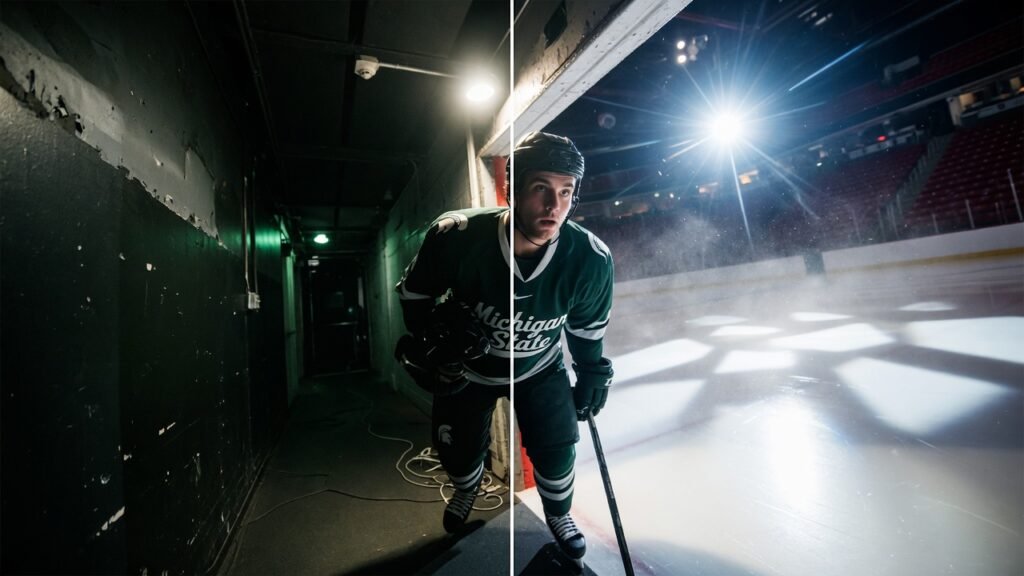
Gavin McKenna did not just sample Penn State. He put on a Nittany Lions sweater at 17, finished as a Hobey Baker top-10 finalist, and walked out as the first-overall pick in the 2026 draft. Porter Martone used Michigan State the same way, signed with Philadelphia, and made Flyers fans care about college hockey in April. Both were NHL locks either path. Both chose the NCAA year because it sharpened the stock. Michigan State lived atop the polls. Penn State hovered near No. 5 and punched a tournament ticket. That is what elite junior talent does when you finally let it breathe under a college roof.
The Programs That Loaded Up Already Own the Next Decade
Bowling Green put 18 former CHL athletes on the roster. Penn State sits at 14. Hockey East alone rostered 62 across 11 teams, more than a fifth of the entire Canadian collegiate contingent, because those coaches stopped romanticizing the old feeder system and started hunting. The Big Ten grabbed the marquee names. Hockey East grabbed the volume. Stonehill grabbed zero. Air Force and Army get a pass under military rules. Everybody else who sat on their hands just volunteered for the slow death of roster irrelevance.
I have watched enough of these cycles to know the difference between a gimmick and a structural reset. Heading into 2025-26, 32 already-drafted CHL players entered Division I. Another 49 are following. That is not filler. That is the draft board relocating. Landon DuPont, the heavy favorite for No. 1 in 2027, is playing this season at Michigan. The early 2028 names are already circling college commitments while they are still 16. For 25 years the No. 1 overall pick usually came straight out of Canadian junior: Crosby, McDavid, Bedard. Now the pipeline runs through Owen Power, Macklin Celebrini, McKenna, and whoever Michigan develops next. College hockey stopped being the backup plan and became the preferred finishing school.
Denver coach David Carle said it clean at the Frozen Four: “This is going to make college hockey better.” Then he added the part nobody wanted to hear out loud: “Obviously, it’s probably happened quicker than we thought.” Quicker than the traditionalists thought. Quicker than the USHL gatekeepers thought. Quicker than the programs that spent the last decade treating Canadian junior as the enemy thought. Nearly 20 former CHL players showed up on the four Frozen Four rosters alone. National average sits around 2.2 per team. The teams still alive in April had at least three. Compete level rose. Stakes rose. The product on the ice stopped apologizing for itself.
American Kids Lost Spots. The Sport Gained a Pipeline.
US-born players on Division I rosters dropped by 147 between 2024-25 and 2025-26. Canadian numbers climbed by 97. Minnesota kids alone fell by 27. I am not going to dress that up. Rosters are capped near 26 under the House settlement world. Spots are finite. When 34 percent of the freshman class arrives with CHL miles, somebody from the old feeder lanes gets cut. Former CHL athletes took 42 percent of the all-rookie team slots across conferences. The talent won the argument the second the eligibility wall came down.
Approximately 30 percent of NHL Opening Day rosters already traced back to the NCAA. Hockey East’s Steve Metcalf has been projecting the college share climbing toward two-thirds. That is the real legacy play. The CHL did not invade college hockey to ruin it. College hockey absorbed the CHL’s best remaining development years and turned them into a direct NHL springboard with NIL money attached. Overagers skipped their 20-year-old seasons in bunches. USHL kids flowed the other direction into major junior because the eligibility tax disappeared. The entire North American development map redrew itself in twelve months.
I said the old rule was negligence dressed up as amateur purity. The programs that understood the new math immediately are the ones sitting on McKennas and DuPonts. The ones still clinging to the pre-2025 worldview are going to spend the next five years explaining why their third line cannot keep up. Nearly 20 percent is the floor, not the ceiling. The sport just got better, meaner, and more honest about where the best 18- and 19-year-olds actually want to play. College hockey stopped protecting a museum. It started building a factory. The scoreboard already noticed.