She broke her own promise before the first chorus landed.
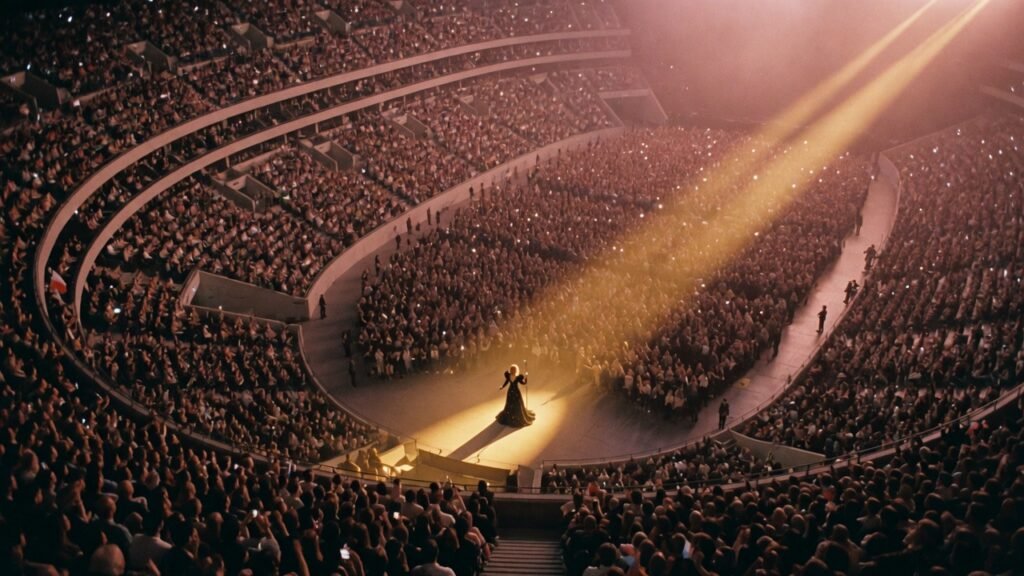
On September 12 at Paris La Défense Arena, Céline Dion stepped into a black gown, opened with “On Ne Change Pas,” and the tears arrived on schedule even though she had forbidden them. Fifty-eight years old. More than six years since her last full headlining set. Europe’s largest indoor venue packed with roughly 30,000 people who had waited through a diagnosis, a pandemic-truncateded Courage Tour, and every public rumor that her voice might never return at this scale. She paused, held the microphone out so the crowd could carry the bridge, and kept singing. That single opening number already contained the entire argument of the night.
This was the first date of a sold-out Paris residency that now stretches to 26 shows: 16 through mid-October 2026 and another 10 in May 2027. More than nine million people registered for early access. The fall block alone moved hundreds of thousands of tickets in hours. The economic forecasts for the region run into the hundreds of millions of euros. None of those figures explain why the room felt smaller than the math.
The Tears Were the Contract
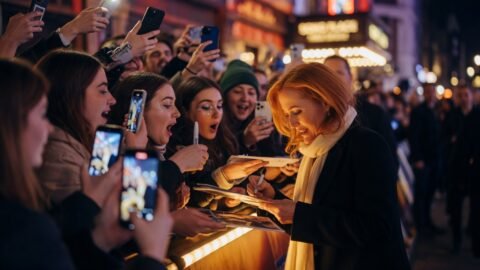
She addressed the crowd in French and English with the same unvarnished directness that has always defined her best work. “I promised I wouldn’t cry – but they’re tears of joy,” she said, according to Reuters. Later she added the line that will travel farthest: “I made a promise. I made a promise to come back and to be back on stage. Here I am singing for you, and singing for me. Thank you so very much for your support, your patience. I am everything I am because you love me.” The Guardian captured that full stretch. It is pure Dion: no filter, no irony shield, just the old transactional honesty between a singer who still needs the room and a room that still needs the singer.
Stiff person syndrome is rare, roughly one in a million. She announced the diagnosis in December 2022 after the spasms and stiffness made touring impossible. Limited appearances followed, most memorably the 2024 Olympics performance of Édith Piaf’s “Hymne à l’amour” from the Eiffel Tower and a later fashion-show set in Riyadh. Those were carefully framed, high-stakes cameos. Saturday night was the opposite: a full catalog night that ran deep into both the French and English repertoires, roughly two dozen songs depending on the count, including “My Heart Will Go On,” “All By Myself,” “The Power of Love,” and “It’s All Coming Back to Me Now.” Staging stayed muted. She changed through a series of black gowns. When she missed a moment she stopped, reset, and continued. No elaborate video apology. No pre-taped explanation of the disease. Just the work and the visible cost of doing it.
British fan Catherine Rushforth put the feeling cleanly to Reuters: “She didn’t shy away from what she suffered and she shared it with her audience.” That is the part the highlight reels will keep missing. Pop comebacks in this decade usually arrive armored in concept, choreography, and controlled narrative. Dion’s return traded the armor for presence. The rocky path she named onstage—“The path was rocky, the road was longer than planned but I held on”—was not branding. It was the price of admission she refused to hide.
Why This Landing Hit Differently
Context matters. She announced the residency on her birthday, March 30, in a video shot under the Eiffel Tower. Demand forced the expansion almost immediately. A nearby metro station received a temporary thematic nod. Fans camped outside the hotel. None of that is new for her; the scale simply reminded everyone what a true global draw still looks like when the artist is willing to stand still long enough for people to feel it.
The cultural timing is sharper than nostalgia. Audiences have spent years watching carefully managed returns that treat vulnerability as a marketing chapter rather than a live condition. Dion’s night flipped the script. She did not perform wellness. She performed the song in front of people who already knew the medical story and still showed up to hear the voice itself. When she told the room, via the Variety-sourced stretch reported by Vulture, that “we don’t know what the person next to us is going through” and that music exists to share energy across hardship and joy, it landed because the messenger was still visibly inside the hardship. The tears of joy were not a bit. They were proof the promise had weight.
Vocally she was not the 1990s peak machine, and anyone claiming otherwise is selling a different night. What she delivered was control, phrasing, and the old instinct for where a note has to sit so the lyric can finish its work. Restarting a song after a stumble only underlined the point: this was live, fallible, and still hers. The black gowns and restrained production kept the focus on that transaction instead of spectacle.
Julien Faruch, another fan on site, told Reuters her fight “is an example for all of us.” Melanie McGill, who flew in from Los Angeles, told CBC she had already cried three times before the set even deepened. Those reactions are not manufactured. They are what happens when an artist of this magnitude treats the audience as co-authors of the return rather than consumers of a product.
The legitimacy debate already circulating online misses the actual test. Sustainability questions are fair; SPS does not vanish because the house is full. But comeback legitimacy has never been a medical clearance form. It is whether the performer can still create the specific charge that only happens when thousands of strangers decide, in the same two hours, that the songs still matter. On that metric Saturday night cleared the bar by a distance.
She has fifteen more fall dates and another run next May. The body will set the limits. The voice, on this evidence, still knows exactly what to do with the room once the lights find it. The opening night did not erase six years. It simply proved the years did not erase her.
The first song title was the thesis. We don’t change. The tears only confirmed she meant it.
VERDICT: WATCH — 9/10. A raw, fully felt Paris return that turned six years of silence into one unbroken contract with the audience.