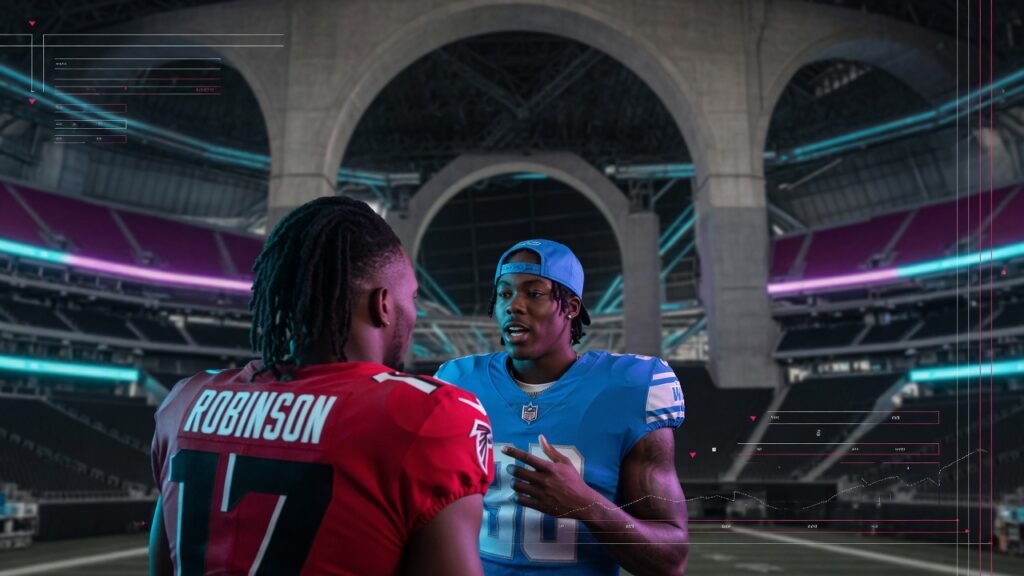
Bijan Robinson and Jahmyr Gibbs did not just hold in. They compared notes. That detail is the real story, and if you treat it like locker-room gossip you are already pricing the running back market wrong.
Two of the league’s most explosive young backs spent the summer applying the same pressure at the same time, and according to reporting around the hold-ins, they talked contracts while they did it. Then Atlanta blinked first. Sources told Adam Schefter the Falcons and two-time Pro Bowl selection Bijan Robinson reached agreement on a three-year extension worth up to $75 million that makes him the highest-paid running back in the league. The ink is barely dry and the next names in the queue are already obvious: Gibbs in Detroit, Jonathan Taylor after that.
I am not interested in the old sermon about running backs aging like milk. I care about the mechanism. Hold-ins used to be solitary acts. One guy sits, one front office digs in, the market stays frozen. When two premium backs in the same draft class start swapping information while they stay away from voluntary work, the isolation breaks. Information asymmetry dies. The leverage multiplies.
Atlanta Paid the Tax. Detroit Is Next.
The Falcons did not extend Bijan because they suddenly fell in love with the position. They extended him because the alternative was a public standoff that would have wrecked their offensive core messaging and put even more heat on the quarterback room. That three-year, $75 million structure is not charity. It is a calculated buyout of uncertainty on a dual-threat back who can win on early downs and still create mismatches in the passing game. The Bills, as the market chatter already notes, got ahead of this wave. Everyone else is now paying the new sticker price.
Lions GM Brad Holmes has already addressed Gibbs’ hold-in publicly. That is not a soft signal. When a general manager has to speak to the situation, the internal clock is running. Gibbs is not Bijan, but he is close enough in production profile and age that the Robinson deal becomes the comp sheet, not the ceiling. Detroit’s salary structure is tight and their window is open. Paying Gibbs market is painful. Losing him to a prolonged hold-in or a franchise-tag staring contest while the offense is built to feed him is worse.
I keep coming back to the coordination angle. Running backs have watched wide receivers and edge rushers professionalize their leverage for a decade. Collective information, timed absences, quiet pressure. Bijan and Gibbs talking money while both sat is the first clear sign that the position finally absorbed the lesson. You do not need a formal union play. You need two guys with identical incentives and clean tape who refuse to let the old discount stand.
The Old Discount Just Expired
For years the argument against big running back money rested on three pillars: short careers, replaceable production, and the draft providing cheap alternatives every April. Bijan’s deal does not kill those pillars overnight. It does force every front office to re-run the numbers on the backs who actually create explosive plays and pass-game value instead of just grinding between the tackles. Robinson is not a committee piece. Neither is Gibbs. When those two profiles hit free agency or extension windows at the same time, the market stops pretending they are interchangeable with a fourth-rounder.
The Falcons locking up their offensive core around this extension also throws the spotlight straight onto the quarterback question in Atlanta. That is not accidental. You do not drop top-of-market money on the backfield if you plan to keep the rest of the operation in flux. The deal is a statement of internal priority even if the public framing stays polite.
Jonathan Taylor is already being named in the same breath. He should be. Once one elite young back resets the number, the next two or three get to walk into meetings with a live comps sheet instead of a lecture about positional value. The Bills looked smart for moving early. Everyone who waited is now negotiating against a $75 million reality.
I am not saying every team should hand out Bijan money. I am saying the hold-in-plus-conversation model just worked in public, and the copycats are already lining up. Gibbs has the tape and the age. Holmes has already had to address it. The quiet part got loud the moment two stars decided to talk through the math instead of suffering alone.
The running back market did not explode because of one press release. It shifted because the players stopped accepting the old isolation tax. Bijan got paid. Gibbs is next in line. The rest of the position is watching the film.