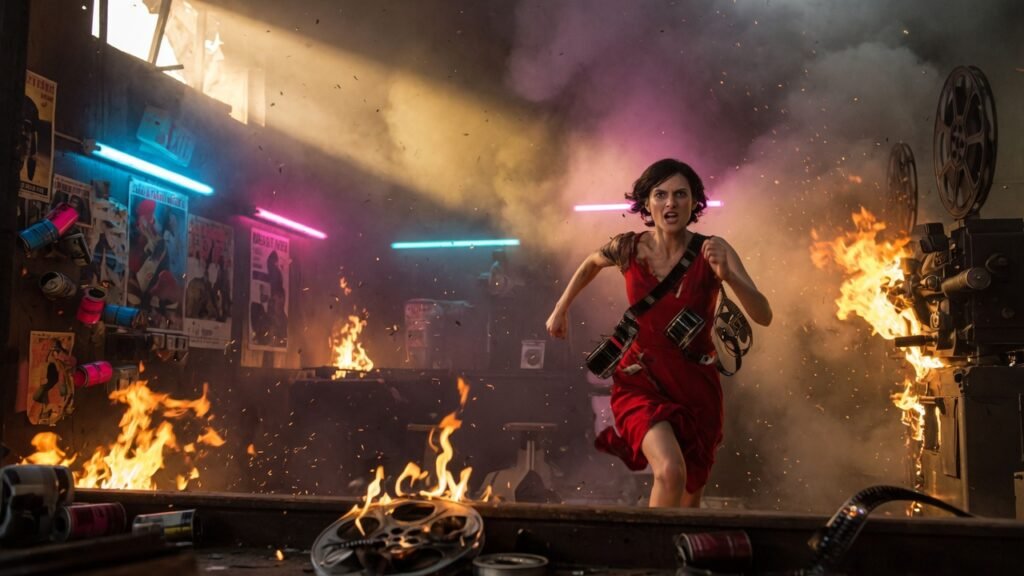
Period pieces polish the past until it shines. Alternate history movies set the past on fire and dare you to look away. That is the difference, and right now it is the only version of historical storytelling that still feels dangerous.
Straight costume dramas keep selling reverence. They light the manor house just so, cast a prestige actor as the conflicted monarch, and ask you to nod along while history repeats itself on expensive linen. Alternate history refuses the assignment. It hijacks the timeline, rewrites the ending, and forces the audience to confront what they actually want from the past: justice, revenge, escape, or the cold recognition that one wrong turn could have erased everything they know.
That hunger is why these films keep outlasting the prestige cycle. They are not documentaries with better lighting. They are arguments.
Tarantino Understood the Assignment First
Quentin Tarantino did not invent alternate history, but he made it feel like bloodsport. Inglourious Basterds turns the Holocaust revenge fantasy into a theater burning. Once Upon a Time in Hollywood lets the Manson murders miss. Both films work because they understand that audiences do not only want to witness history. They want to correct it, or at least fantasize about the correction without apology.
The brilliance is structural. Basterds spends two hours building tension around real power structures, real language barriers, real Nazi vanity, then detonates the record. Hollywood does the opposite: it lingers in the texture of 1969 until the violence that actually happened starts to feel like the glitch. You walk out less interested in what “really” occurred and more unsettled by how thin the membrane was.
That is the genre’s real weapon. Period pieces reassure you that the past is settled. Alternate history reminds you it never was.
Watchmen takes the same idea into comic-book scale and somehow makes it colder. Nixon stays in power. America wins Vietnam with superhero help. The Comedian does the dirty work the state will not admit. Zack Snyder’s film is messy in places, but its central trick still lands: the most honest version of the Cold War might be the one that admits a godlike figure would not save us. He would just rearrange the body count.
C.S.A.: The Confederate States of America goes further into the nightmare. Shot as a fake British documentary about an America where the South won, it turns every “heritage” talking point into a grotesque commercial break. It is uncomfortable on purpose. That discomfort is the point. A traditional Civil War epic can mourn the tragedy. C.S.A. makes you sit inside the victory lap and notice how easily propaganda sells.
The Ones That Hurt Because They Almost Happened
It Happened Here, Kevin Brownlow and Andrew Mollo’s 1964 film about a Nazi-occupied Britain, still feels like a warning shot. Made on a shoestring by obsessives who cared more about texture than studio polish, it follows an ordinary nurse sliding into collaboration. No grand speeches. Just the daily math of survival. That film understood something prestige period dramas still miss: fascism does not always arrive as a parade. Sometimes it arrives as a job offer.
Red Dawn (the 1984 original) gets dismissed as Reagan-era cheese, and sure, the politics are loud. But strip the soundtrack and you still have a clean alternate-history engine: Soviet and Cuban forces invade the American interior, and a pack of teenagers become the resistance. It works because it relocates the occupied-Europe story onto familiar soil. Suddenly the “it couldn’t happen here” reflex collapses. That is more honest than another tasteful Dunkirk recreation that already knows who wins.
Yesterday pulls the move in the opposite direction and somehow sticks the landing. One global blackout and the Beatles never existed. A struggling musician becomes the vessel for every song. The film is lighter than the war entries, but the ache underneath is real: what happens to genius when the timeline forgets it? What do we actually value, the art or the myth of the artist? Period pieces about the actual Beatles cannot ask that question. They are stuck inside the canon.
Children of Men belongs here too, even if its future is only a few degrees off our present. Infertility as slow apocalypse. Britain as a fading police state. Refugees as the last human stake. Alfonso Cuarón shoots it like reportage from a history that has not finished writing itself. The long takes are not flexes. They are immersion tactics. You stop watching a “what if” and start living inside the consequences. Most period films about real refugee crises keep the camera at a respectful, deadening distance. Children of Men refuses the distance.
Civil War, Alex Garland’s 2024 gut-punch, is the newest proof the form still has teeth. It does not explain the faction maps in soothing exposition. It drops you into a fractured America and makes journalism the only through-line left. People walked out arguing about whether it “picked a side.” That argument is the feature. A conventional political drama would have sanded the edges into a message. Garland left the bruise.
Why This Genre Owns the Moment
We are living through a period when history itself is contested terrain. School boards fight over curricula. Politicians sell competing origin stories. Online, every tragedy sprouts a counter-narrative within the hour. Straight period pieces often feel like they are trying to freeze a consensus that no longer exists. Alternate history thrives in the fracture. It admits the past is a battleground and then fights on it with style.
These films also free filmmakers from the biopic’s worst habit: the obligation to be fair to people who do not deserve fairness. You do not have to humanize the monster if the monster dies in a movie theater. You do not have to both-sides the Confederacy if you can show the commercials it would have run. Moral clarity becomes a creative tool instead of a branding exercise.
None of this means every alternate history swing connects. For every Basterds there is a limp streaming original that treats “what if” like a weekend pitch meeting. The failures usually share a tell: they change the facts without changing the feeling. The great ones alter the emotional weather of the world. You leave different.
So when the next glossy coronation drama arrives promising “the real story,” remember the better option. The real story is already available in textbooks and archives. What cinema can still do is the illegal thing: reopen the file, rewrite the ending, and make you complicit in the wish.
That is not escapism. That is the most honest history lesson the medium has left.
WATCH the stack. Start with Basterds, Hollywood, Watchmen, C.S.A., It Happened Here, Red Dawn, Yesterday, and Children of Men. Skip the safe prestige costume cycle until these have rewired what you think a period film is allowed to do. 9/10 for the form at its peak: alternate history does not decorate the past, it interrogates the audience’s hunger for a different one.