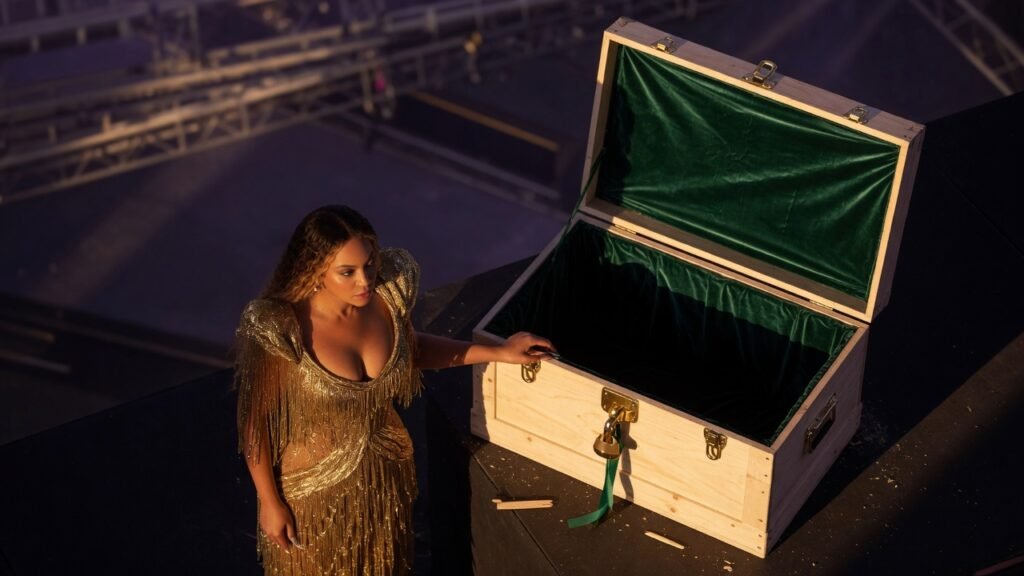
Beyoncé priced a pine box at her own birthday and left the vinyls out of it. Nine hundred forty-eight dollars and one cent. Five hundred units. Deep green velvet lining. Faux gator-skin strap. Gold hardware. And the three cleanest words on the entire product page: vinyls not included.
On September 4, her forty-fifth birthday and the twentieth-anniversary window of B’Day, Parkwood and the official shop dropped the Bey Keeper Collector’s Box and watched the timeline do what timelines do. The crate measures roughly 18 by 14 inches. It is solid pine finished in beeswax oil, engraved, exclusively numbered 1/500, and sold as “an essential piece of art for the Hive.” The shop’s own language is blunt about the rest. The records stay home.
The same drop carried real music product, including the B’Day 20th Anniversary Deluxe 4-LP Bayou Blue set at about $150. Bundle the empty keeper with the vinyls and you clear a thousand before shipping and tax. One cart math run put the fully loaded total past $1,100. Fans did not need a spreadsheet.
“This would’ve made sense if vinyls were included but almost 1k for just the box by itself…? girl no,” one wrote. Another: “A band and I can’t even get real gator on the strap?” Someone called it a coffin for a hamster. Someone else noted how cheap pine actually is and pegged a home-build near thirty dollars. A defender posted a cart screenshot and declared they would do what they want. A critic of the purchase answered harder: “If y’all idiots pay $948.01 for an empty box … that has a bee on it, y’all are psychos. Do you understand me?”
I understand both camps. Only one of them is looking at the object clearly.
The Birthday Decimal Is the Whole Pitch
$948.01 is not a cost-plus calculation. It is a calendar flex. Born September 4, 1981. The price is the birthdate wearing a dollar sign. That single design choice tells you the transaction better than the velvet does. You are not primarily buying storage. You are buying a numbered relic released on the day the artist turns forty-five, framed as hive scripture, limited hard enough to feel like a private club.
Forbes placed her in billionaire territory in late 2025. Coverage of this box will not let you forget it. The gap between that status and a fan staring at a pre-order for empty furniture powers every dunk. “Beyonceeeeee you’re a billionaire, not us,” one commenter wrote, then still offered the happy birthday. That split is the current superfan condition: protect the catalog, flinch at the register, sometimes click buy anyway.
Jay-Z’s Reasonable Doubt thirtieth-anniversary crate sat near $1,500 and at least arrived with discography inside. Fans clocked the contrast in real time. One put it clean: the husband brought the records; this version brought the furniture. Comparison is not cancellation. Comparison is product literacy.
She Did Not Hide the Emptiness
The pile-on is correct on materials and still slightly wrong on the con. Parkwood did not bait-and-switch. The listing states the absence in plain type. No official promise of Easter eggs. The fan theories that something secret sits inside are fan fiction layered on top of a display case. The box is a limited, numbered art object priced like secondary-market status before it even ships in November.
In a merch economy addicted to mystery FOMO, that bluntness is almost useful. Almost. Honesty about a near-thousand-dollar empty pine crate does not raise the pine to a thousand dollars. Beeswax oil and green velvet are finishes. They are not a visual album. They are not the live-instrumentation fight Beyoncé described when she built the original B’Day, when she wanted the record “big, percussive, hard, up-tempo and energized” and worked to preserve R&B bridges and melodies while hip-hop dominated the air. That album was craft under pressure. This crate is inventory under a bee.
The anniversary deserved the deluxe vinyl, the booklet, the art prints, the Bayou Blue pressing. Those objects hold the music. The Keeper holds air and a serial number. Scarcity can support a premium. It cannot manufacture soul.
Some of the five hundred will move. Numbered objects find collectors the way limited sneakers do. Someone will photograph the empty green velvet and call it an investment. Resale will either collapse into punchline or float on pure Hive liquidity. Both outcomes are already baked into the joke.
Proximity Was Always the SKU
The people mocking the box are right about cost of goods. Pine is cheap. Faux gator is faux. A strap that will not commit to real leather is a small tell with a large price. The people buying the box are not confused about cost of goods either. They are purchasing proximity, the 1-of-500 stamp, and the right to say they were in on the birthday drop. That is a different category from record storage. It is a membership plaque you can set on a shelf.
I will not lecture a grown adult’s credit card. I will grade the object. As furniture, it is overbuilt marketing. As anniversary celebration, it is a side quest that steals focus from the reissue that actually carries songs. As a cultural snapshot, it is almost too clean: billionaire artist, birthdate price, empty luxury vessel, fandom loud enough to turn a pre-order page into a referendum before dinner.
The records are not included. The $948.01 was never really about needing a place to put them.
VERDICT: SKIP THE BOX — 2.5/10. A numbered pine crate that admits its own emptiness and still charges birthday money for the privilege of carrying it home.