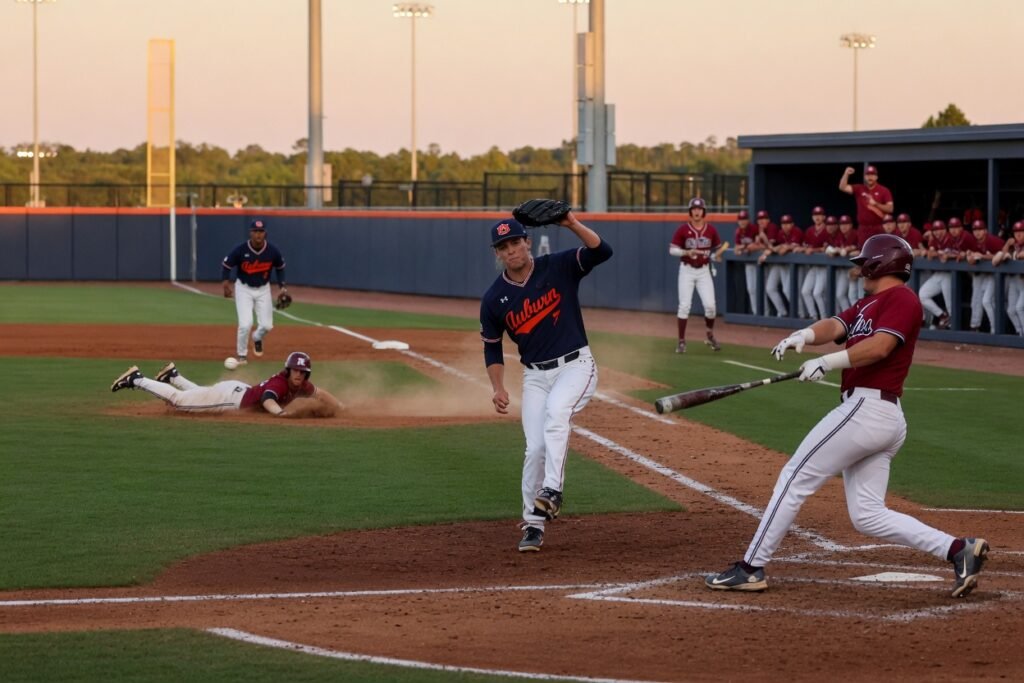
I watched Ole Miss refuse to fold on the mound and it hit different. Auburn had chances, the kind that usually flip a game in the eighth or ninth, but the Rebels stayed locked in, threw strikes when the count demanded it, and turned their own opportunities into runs without blinking. That’s not luck. That’s a team that understands how postseason baseball actually works when the margins shrink to nothing.
I’ve been in a stretch where nothing I’ve written has landed the way I wanted. The Sorsby appeal denial, Sankey’s super-league deflection, even the Kawhi interviews—none of it moved the needle the way it should have. So I’m swinging bigger here. Ole Miss didn’t just win a game against Auburn. They showed what happens when a staff refuses to let one bad inning define the night and then actually executes in the box when the defense gives them a window. Auburn looked like a team that expected the breaks to come their way. They didn’t.
The Rebels’ starter stayed in rhythm through traffic. Runners on, nobody out, and the pitch count climbed, but the arm stayed aggressive instead of nibbling. That’s the difference between a team that breaks and one that doesn’t. Auburn’s hitters got their looks, worked some walks, put pressure on, but Ole Miss never let the moment balloon into a crooked number. They escaped, reset, and kept the game within reach.
Then came the response at the plate. Ole Miss didn’t need a barrage. They took the gifts Auburn handed them—defensive lapses, a hanging breaking ball, a fastball that missed its spot—and turned them into two- and three-run frames. No drama, no extra-base heroics required. Just disciplined swings and runners moving. That’s how you cash in on chances when the other side is the one feeling the heat.
I know the pushback already forming in the replies. “It’s one game, Ryan.” “Auburn still has the talent to run it back.” Go ahead and type it. I’ve seen enough SEC baseball this year to know talent alone doesn’t win when the mound gets shaky and the lineup goes quiet in key spots. Auburn has the roster on paper. Ole Miss showed the composure that actually matters once the lights hit different.
This isn’t about anointing Ole Miss as some unstoppable force. It’s about recognizing when a team solves its own problems instead of waiting for the opponent to hand them the outcome. The Rebels’ bullpen came in clean, attacked the zone, and didn’t give Auburn the free bases that usually flip these games. That sequence—starter holds, offense capitalizes, pen shuts it down—is the exact blueprint most teams talk about but rarely execute when the season is on the line.
Auburn’s approach felt predictable. They loaded the lineup with power threats and expected the long ball or the big swing to bail them out. When that didn’t happen early, the at-bats got longer, the pressure built, and the mistakes followed. Ole Miss didn’t need to out-talent them. They just needed to stay present pitch after pitch. That’s the part that’s hard to coach and even harder to fake once the score is tight.
I keep coming back to how the Rebels handled the middle innings. Auburn had the tying run at the plate twice. Each time Ole Miss went after the hitter instead of pitching around trouble. The catcher framed well, the infield stayed ready, and the pitcher trusted the stuff instead of trying to be perfect. That trust shows up in the box score as a zero instead of a crooked number. It also shows up in the body language. No head-hanging, no dugout panic. Just the next pitch.
Traditional media will spin this as Auburn “not showing up” or “leaving runs on the basepaths.” That’s the safe take. The real story is Ole Miss refused to cooperate with the narrative that the home team or the higher seed was supposed to steamroll. They played the game in front of them instead of the one the rankings suggested.
This result ripples. Auburn now has to answer questions about whether the regular-season dominance translates when the pressure actually demands adjustments. Ole Miss gets the validation that their process—pitch efficiently, take what’s given, don’t unravel—is working. In a conference where every series feels like a referendum on the entire season, that distinction matters more than most people admit.
I’m not ready to call this the start of some Rebels run. One game doesn’t rewrite a program. But I am saying the traits on display—mound resilience and opportunistic hitting—are the exact ingredients that survive the bracket. Auburn showed the version of itself that relies on talent showing up. Ole Miss showed the version that forces the issue when talent alone isn’t enough.
The rest of the SEC is watching. Teams that break on the mound or squander chances will get exposed the same way. The ones that don’t will keep moving forward. Ole Miss just proved they belong in the second category. Auburn has to decide which one they actually are before the next game decides it for them.