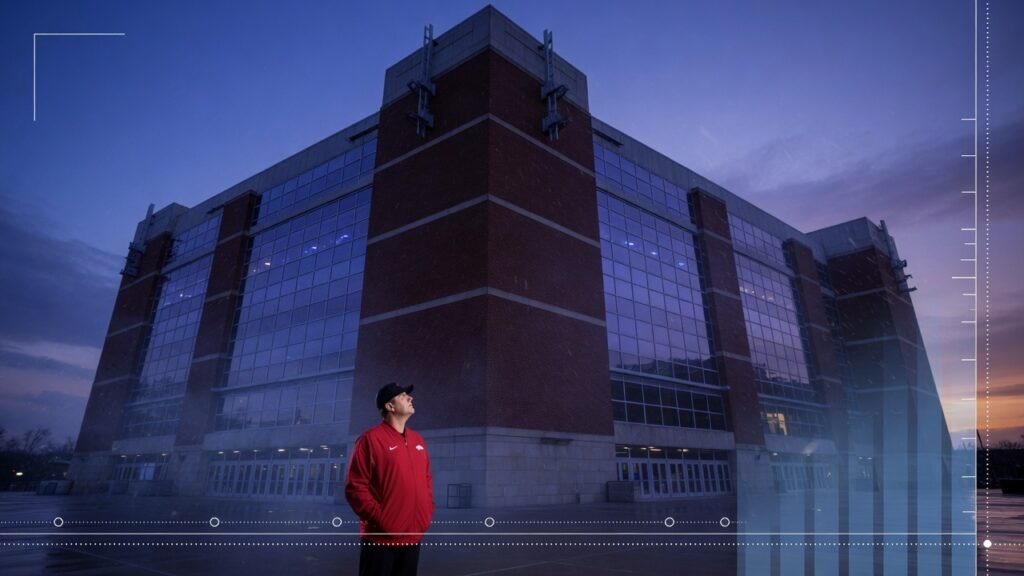
Nine of John Calipari’s Arkansas players make more than his assistants. The other three make more than his entire staff. He said it out loud on Wednesday, then spent Friday explaining that he is “GREAT” with his guys making money and wants them to make even more. The second statement only exists because the first one told the truth about where the ceiling still lives.
Calipari’s Wednesday presser was not a slip. It was a structural argument dressed as candor. Defending the Protect College Sports Act and the need for “order and some guardrails,” he walked straight into the payroll comparison:
“I’m going to say this. I probably shouldn’t. Nine of my players make more than my assistants. And the other three make more than all my staff. And we are not one of the highest payers. We’re just not.”
He followed it with the campus-wide frame: all coaches across every Arkansas sport make less than the school’s $22 million revenue share, so the players are already “getting more than the coaches.” That is the mechanism. Player pay gets cast as the imbalance that needs national standards. Coach pay gets biography. “I’ve been doing it 40 years. Started as a volunteer, two years as a part-time assistant. And I’ve kind of done OK at different programs. So, yeah, they’re paying me.”
The $7.75 Million Side of the Ledger Stayed Untouched
They are paying him $7.75 million this season, third-highest in men’s college basketball behind Bill Self and Dan Hurley. Career earnings sit north of $125 million. His top assistants are not working for tips: Kenny Payne is near $900,000, Chin Coleman at $700,000, Brad Calipari at a $250,000 base. Arkansas basketball’s NIL and revenue-share related payroll runs in the $15-16 million range. Those are real dollars. They are also the wrong comparison if the point is “guardrails.”
The Senate already answered which side of the ledger gets regulated. On September 28 it passed the PCSA 77-22. The bill builds national NIL and revenue-sharing standards, transfer and eligibility rules, health protections, and a limited antitrust exemption for the NCAA and conferences. Sen. Cory Booker’s amendment to cap coaches’ school salaries at $5 million and limit buyouts failed 52-47. Calipari’s own compensation sits comfortably above that proposed ceiling. The order he wants does not run through his contract.
That is why the viral clip hit. He framed players out-earning assistants as the instability, while the only salary-cap idea on the table died in the same week. The House is in recess until after the November midterms. The path is uncertain. The power map is not.
The Clarification Arrived After the Clip, Not Before the Policy
Friday’s social media post tried to reset the frame. “I’ve always been about the players and what benefits them my entire career.” He is “GREAT” with them making money and wants them to make more. He supports dialogue to stabilize college athletics. Fine. The timing is the tell. The complaint about nine players clearing assistant money came first, attached to a bill that stabilizes the institutional side without touching coach pay. The player-first language came after the backlash.
The strongest defense of Calipari is simple and I will take it straight: he is describing a real payroll inversion inside one program, Arkansas is not a top NIL spender by his own account, and chaos in recruiting and transfers does punish everyone. Order is not automatically anti-player. That defense still collides with the vote. If the problem is runaway compensation, the amendment that aimed at the highest coaching salaries lost. The bill that advanced does not. Calipari has been one of the loudest PCSA supporters. The structure he is selling protects the side that already cleared $7.75 million and a career haul past $125 million.
I am not arguing players should freeze staff raises. Assistants carry the scouting, the late nights, the portal grind. Their market is its own problem. The point is the hierarchy Calipari revealed when he thought he was making a fairness case. Players relative to assistants became the alarm. His salary relative to a failed $5 million cap never entered the sentence.
College basketball’s next fight is not whether athletes deserve money. That argument is over. It is which side of the spreadsheet gets the guardrails when Congress writes them. Calipari said the quiet comparison, then tried to walk it back into pure player advocacy. The numbers on both sides of his staff room, and the 52-47 vote that left coach pay alone, still sit on the table. The House calendar after the midterms is the next real pressure point. Players who treat the clarification as the policy will get the original presser instead.