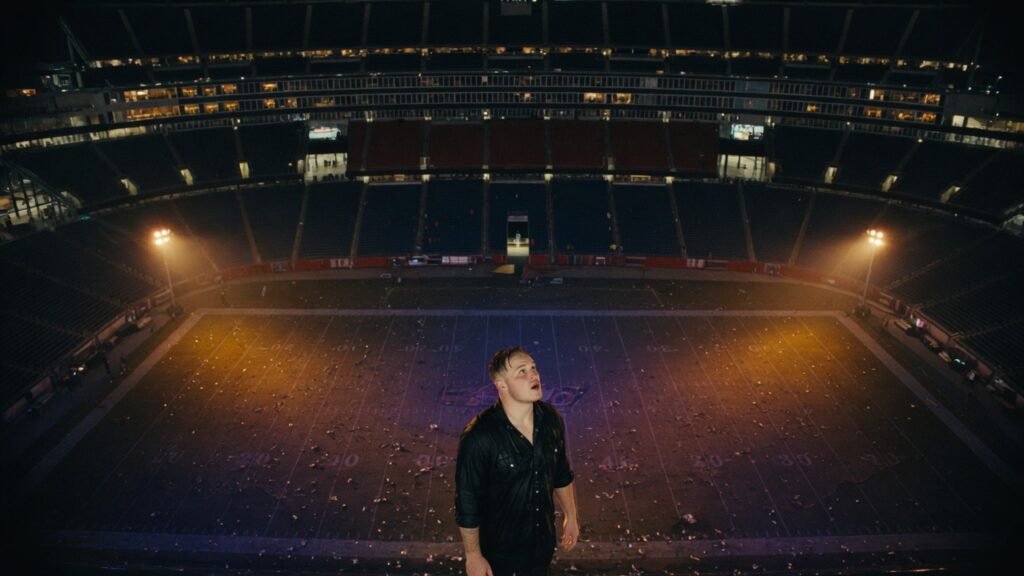
Zach Bryan walked onto Robert Kraft’s field Friday in a black shirt that read FREE PALESTINE in white block letters, a pine tree under the slogan, and the old revolutionary line AN APPEAL TO HEAVEN sitting right there with it. He did not give a speech. He did not roll a montage. Members of the band wore matching or similar shirts. Guitarist Noah Le Gros went further in a green Palestine soccer jersey and later posted himself in it in front of Kraft Sports and Entertainment signage. Bryan just played the first night of a sold-out two-night stand at Gillette and let the cotton do the talking.
Three weeks earlier, those same two words cost Macklemore the rest of Ed Sheeran’s Loop Tour.
At MetLife on September 4 and 5, Macklemore said them into a stadium mic, showed images from Gaza, performed “Hind’s Hall,” and framed the night as solidarity. “One of the reasons why I wanted to come on this tour was because I wanted to stand up here on stages and stadiums across America and say two words that are very near and dear to my heart: free Palestine.” He kept going: “I want those words to be loud and clear, so the people from Gaza all the way to the occupied West Bank know that we have not forgotten them.” Kraft barred him from Gillette over “recent actions, material shared from the stage during Ed Sheeran’s shows in New Jersey.” Macklemore said Kraft pressed other owners too. Sheeran’s camp called it a promoter call. Openers walked. Finneas posted, “Artists must not be silenced when they speak up for the oppressed,” then pulled out of the remaining dates. Sheeran’s Gillette run later died in weather. Macklemore flipped the moment into a short Free Palestine Tour in Europe that sold out immediately and pledged a million dollars from his Sheeran earnings to Palestinian aid groups.
The Shirt Is Louder Than the Ban
Bryan’s move is quieter and, in pure stagecraft terms, sharper. Macklemore made a monologue. Bryan made a costume choice and refused the soliloquy. No mic drop. No explanatory bridge. No “to all of my Jewish brothers and sisters” disclaimer of the kind Macklemore delivered at MetLife. Just the text on the chest in a building Kraft owns, on a night when the owner’s last public act on this subject was to kick a headliner’s opener for saying the same thing out loud.
That is why the photos moved so fast. Country’s current stadium machine, thirty years old, album With Heaven On Top already a No. 1 debut, two nights sold out at Gillette, closing the tour at Jordan-Hare a week later, walks into the Patriots owner’s house wearing the phrase the house tried to keep off the marquee. The band matching him turns it from a solo stunt into a unit look. Le Gros posting the jersey in front of the Kraft signage is the visual that finishes the sentence Bryan would not speak.
Stadium politics run on control of the frame. Kraft’s statement after Macklemore was pure frame control: the venue decides what material is shareable from its stage. Bryan’s answer is the oldest one in protest aesthetics. You cannot un-see a shirt once a stadium full of phones has it. You also cannot quote a speech that never happened. Silence is the craft decision. It denies Kraft a clean transcript to litigate and still puts the banned language under the lights.
Kraft Bought the Walls. He Did Not Buy the Merch.
Nobody from Bryan’s camp, the stadium, or Kraft had returned comment by the next day’s reports. The second show was still on the books for Saturday. That quiet is its own tell. After the Macklemore episode, departing openers like Finneas wrote statements. Bryan wrote nothing. He wore something. The difference is the whole column.
Macklemore later said, of his own rebound dates, “When those in power try to silence our calls for liberation, art will always be a form of resistance.” Bryan did not borrow that sentence. He borrowed the two words and left the essay at home. Whether you read that as courage, calculation, or country-star brand insulation depends on what you already believed about stadium owners and Gaza. The performance fact stays the same. The man who owns the Patriots and the building tried to scrub a phrase from his property. The man selling out that property put the phrase on his chest and played the set.
The pine tree and AN APPEAL TO HEAVEN are not random graphic design. They hitch a contemporary slogan to a Revolutionary-era flag that already meant a direct petition past earthly authority. That layer is either deliberate or the luckiest thrift-store accident in Foxborough. Either way, it is better visual storytelling than half the committee-written prestige TV that pretends politics are complicated while sanding every edge off the dialogue.
Gillette still belongs to Kraft. The shows still sold out. Bryan is still scheduled to finish the tour in Alabama. The shirt does not rewrite ownership deeds or end a war. It does prove that the ban on Macklemore did not retire the language. It only changed the delivery system from a rapper’s monologue to a country singer’s wardrobe, under the same lights, on the same turf, with the owner’s name still on the signage behind the band.