Macklemore did not waste the silence. Ten days after stadium owners forced him off Ed Sheeran’s Loop Tour for a Free Palestine set at MetLife, he put those same words in the tour title and pointed every ticket dollar at Palestinian relief. Dublin, Paris, London. The calendar that got cleared became the argument.
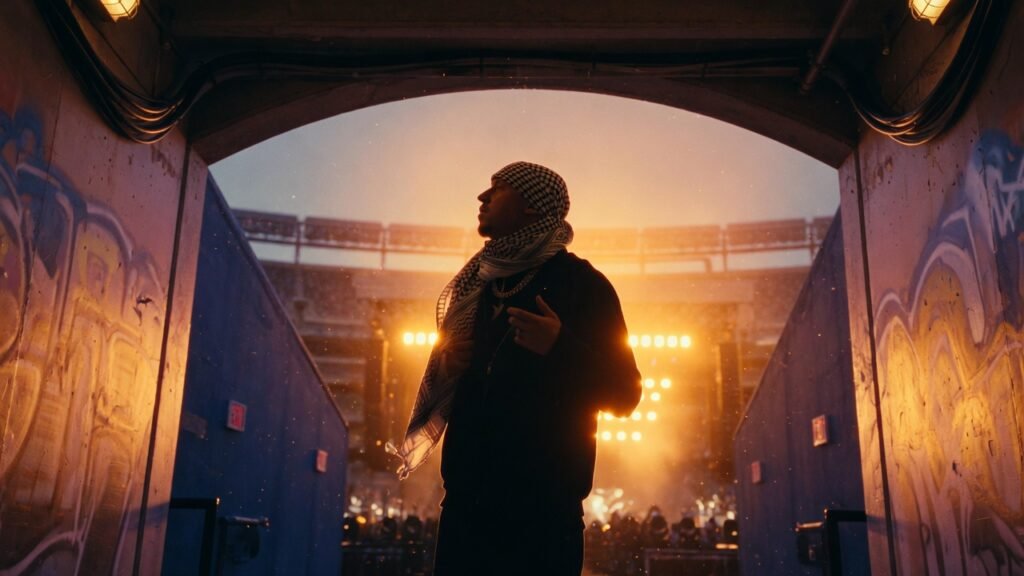
On September 4 and 5 he opened Sheeran’s U.S. run in East Rutherford wearing a keffiyeh, saying Free Palestine out loud, running Gaza and protest footage on the stadium screens, and performing “Hind’s Hall,” the 2024 track tied to the Columbia encampments and Hind Rajab. Crowds sat in the 80,000-plus range both nights. He named other crises too. The Israeli-American Council launched a petition. StopAntisemitism and the ADL objected. Pink amplified the pile-on. Within days the remaining buildings, including NFL venues, told the promoter they would not host the show with him on the bill.
Robert Kraft barred him from Gillette and, in Macklemore’s account of what Sheeran relayed, helped pull other owners into the same hard line. Keep Macklemore and lose the rooms. Messina Touring Group confirmed the venues would rather cancel than keep him. On September 14 he was removed from the eight remaining U.S. dates he had been scheduled to play. He refused the victim frame and moved the money instead. On September 16 he pledged the entire $1 million of his net Loop Tour earnings to six organizations: Palestine Children’s Relief Fund, HEAL Palestine, Gaza Soup Kitchen, Medical Aid for Palestinians, UNRWA USA, and Anera. He challenged Kraft to match it. Sheeran called Kraft and asked him to commit $2 million toward aid in the region. Kraft said yes.
The Empty Calendar Became the Marquee
“As you all know, my schedule freed up a bit,” Macklemore wrote on September 24. The shrug did the work of a press release. He said he had spent the week reaching artists who had already risked stages for Palestinian solidarity, “artists who understand that our platforms mean very little if we’re only willing to use them when it’s safe.” Supporting acts and U.S. dates still pending. The first three nights are locked: October 26 at Dublin’s 3Arena, October 29 at Paris’s Accor Arena, October 30 at London’s OVO Arena Wembley. Presale September 28. On-sale September 30. All proceeds to a longer list that now includes Anera, Glia, Gaza Soup Kitchen, Taawon, HEAL Palestine, Palestinian Youth Movement, Middle East Children’s Alliance, Jewish Voice for Peace, Medical Aid for Palestinians, Institute for Middle East Understanding, Palestine Children’s Relief Fund, and UNRWA USA.
That is the whole money trail. No mystery charity shell. No vague “awareness.” The ticket is the transfer.
Sheeran Held the Escape Hatch. The Openers Left Anyway.
Sheeran’s September 15 statement kept him inside the lane he has protected for years. The decision, he said, belonged to the promoter and the venues. Macklemore’s contract sat with the promoter. Venues signaled they would pull shows if Macklemore stayed. Sheeran described a week of calls, including with Kraft, trying to build bridges, then declined to risk fans, crew, and the other acts. He said he was appalled by suffering on both sides of the conflict and kept personal views private because his audience includes children who bought a night of unity and escape.
The rest of the bill disagreed with the math. Finneas, Aaron Rowe, Beoga, and Lukas Graham withdrew in solidarity with Macklemore and Palestine. The headliner stayed. The political cover around him walked.
Macklemore’s diagnosis runs the other direction. “If these last couple of weeks have shown us anything, it’s that something has shifted over the last three years,” he wrote. “It’s 2026. Being apolitical during a genocide doesn’t work anymore. People are asking artists to show up, educate themselves and be in community. To use the stage for more than entertainment. To push back when the call for a Free Palestine is met with attempts to silence it.”
Kraft’s public case was different. He cited the MetLife material and a longer record of what he called antisemitic rhetoric and imagery offensive to the Jewish community, said Gillette does not provide a platform for hate speech, insisted the ban did not diminish Palestinian suffering, and offered to meet. Two descriptions of one veto. The buildings closed. Three capital-city arenas opened on the other side of the Atlantic.
The Stage Was the Story the Whole Time
“What happened to me is bigger than one artist or one stage,” Macklemore wrote. “When the billionaire class can decide which voices are allowed on stage and which ones are too dangerous to hear, everyone should be paying attention.”
That line is the poster art. A pop-rap opener turned a Sheeran’s stadium slot into a protest document. The capital that owns the concrete removed him. He redirected seven figures, watched the other openers leave, and converted the vacancy into dated rooms in Dublin, Paris, and London with the cause printed on the ticket. The attempt to scrub the politics off the bill produced a tour whose entire identity is the politics.
Whether the guest list lands heavy or the U.S. leg materializes later is secondary. The sequence already did the cultural work. Stadium speech now carries a venue-owner veto, and the artist who absorbed that veto just sold the veto as the show. Presale starts next week. The first three addresses are already public. Macklemore lost the Loop Tour and kept the sentence that got him fired, only now it is the name of the run.