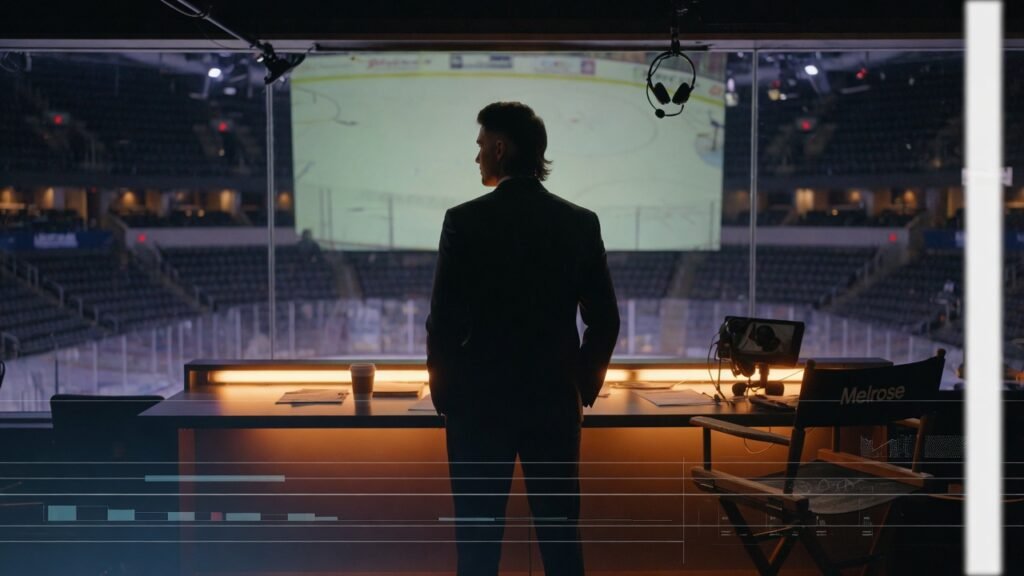
Barry Melrose never coached a single NCAA shift, and that still makes him one of the most important voices college hockey ever had. He died Wednesday at 70 after a Parkinson’s diagnosis in 2023 forced him off ESPN’s set, and the first thing I keep coming back to is not the mullet or the suits. It is the audience he built for a sport that needed every extra set of eyes it could get south of the border.
Gretzky said it cleanest when Melrose retired: “Hockey is more than a game, it’s a community — a finely tuned orchestra — and Barry was our conductor.” College programs sit in that orchestra now. Their March crowds, their TV windows, their ability to sell a kid from Minnesota or Massachusetts on staying four years instead of jumping, all ride the larger American hockey conversation Melrose spent nearly three decades amplifying. When that conversation got louder, every Frozen Four ticket got a little easier to move.
The Junior Titles Came First, the Translation Job Lasted Longer
Melrose’s coaching résumé starts where a lot of good college stories start: junior hockey that actually develops. He took the Medicine Hat Tigers to the Memorial Cup in 1987, then the Adirondack Red Wings to the Calder Cup in 1991. The NHL numbers that followed were honest rather than glossy. He played 300 regular-season games, put up 10 goals and 33 points with 728 penalty minutes, and as a head coach finished 84-108-29-4 across the Kings and a 16-game Lightning cameo. The 1992-93 Kings run to the Stanley Cup Final remains the highlight, a 39-35-10 club that lost to Montreal in five.
Rob Blake, who played for him in Los Angeles, cut straight to why the television pivot worked: “What he was teaching us about the game of hockey, he was teaching on TV.” That is the bridge. Melrose never dumbed the sport down. He just refused to hide it behind jargon. College coaches do the same job every fall with recruits who still need the game explained out loud. The difference is Melrose did it for millions who had never set foot in a college rink.
John Buccigross learned of the death while standing in a rink in Las Vegas preparing for the new season. “Chilling and fitting–the rink was Barry’s home,” he wrote. “A more beloved ESPN institution there has not been.” Steve Levy called him “the unquestioned face/voice of hockey in the United States” and “the kid from Kelvington who made it big but never forgot his roots.” Those roots matter in college hockey more than people admit. Saskatchewan farm-kid toughness translates cleanly to the physical, systems-driven game NCAA programs sell every October.
The Growth Chart Runs Through the Studio Desk
Luc Robitaille, now Kings president, put the national impact in plain language: “He played an important role in the growth of hockey and its popularity across the United States, and his influence on the game will not be forgotten.” I read that and immediately think about attendance curves and TV packages at the college level. The sport did not grow in a vacuum. It grew because somebody on national television kept making the case that hockey was worth caring about on a Tuesday night in February, not just when the Cup Final arrived.
Gary Bettman noted that Melrose “never failed to boost your love of the game.” Tony Granato said there was “no phoniness to him.” That combination, deep knowledge delivered without the corporate gloss, is exactly what college hockey still needs when it tries to hold casual fans through a 34-game conference slog. Melrose’s retirement statement in 2023 already sounded like a man who understood the handoff: “I’ve had over 50 extraordinary years playing, coaching and analyzing the world’s greatest game, hockey. It’s now time to hang up my skates and focus on my health, my family… Thanks for the incredible memories and I’ll now be cheering for you from the stands.”
The stands are fuller because of the work he did. College hockey’s current television footprint and the steady flow of American kids into the NHL draft both sit downstream of that expanded interest. Melrose did not invent the pipeline. He just refused to let it stay quiet.
Scott Van Pelt said the news made you catch your breath and that “nobody was cooler than Barry.” Cool does not grow a sport by itself. Clarity does. Melrose had both, and college rinks across the country are quieter for the loss even if his name never appeared on an NCAA lineup card. The conductor is gone. The orchestra he helped tune still has to play.