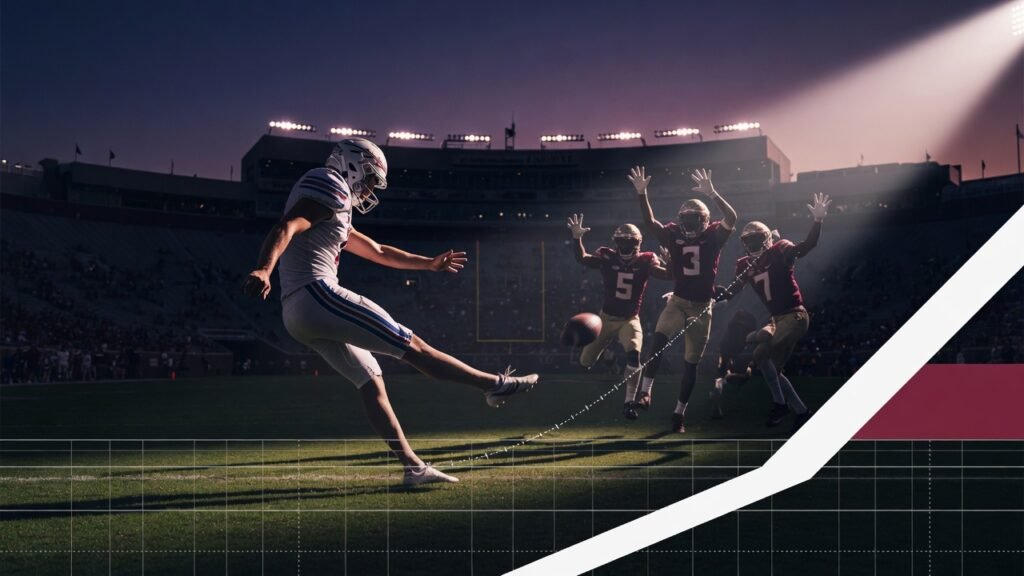
The lights died at Doak Campbell with 4:40 left on the pregame clock, and for a stretch it looked like the ACC’s Monday night opener might get shoved to Tuesday. What actually happened was stranger and more revealing: Florida State and No. 19 SMU kicked off at 9:15 p.m. under partial power, with the official clock living on the field, no coach-to-player helmet talk, no sideline iPads, and no PA. SMU still left Tallahassee with a 27-24 win on Nick Reed’s 20-yard field goal with 21 seconds left. The outage did not just delay a game. It ran a live stress test on how much modern college football actually needs its gadgets.
I kept coming back to the room that formed around 8:15 p.m. Roughly 30 people, including ACC commissioner Jim Phillips and both schools’ presidents, ADs, and head coaches, sat on what ESPN called their last option while electricians chased an electrical short in the main transformer that had taken out the west-side tower. Four generators got rolled into the equation. Safety stayed the only real veto. Phillips later put the standard clean: “Once it was determined the game could proceed safely — and with the full support of the presidents, athletic directors and head coaches from both schools — we agreed to move forward despite not having the usual technology available at the start of the game.” The Super Bowl blackout in 2013 lasted 34 minutes. This one ran nearly two hours and still produced a real ACC result.
Old-School Was Not a Slogan. It Was the Rulebook.
SMU athletic director Damon Evans cut through the noise in one line: “We’re just going to play old-school football.” That is exactly what the constraints forced. No helmet communication. No tablets. Clock on the grass. Scoreboard and PA dark for stretches. Instant replay living in a remote Charlotte command center with walkie-talkies feeding the crew on the field. Booth-to-sideline headsets still worked, which kept the game from turning into pure freestyle, but the play-call layer that every FBS staff now treats as oxygen was gone for the early stages.
Rhett Lashlee’s reaction told you more about SMU’s readiness than any spring practice report. “I told our guys, ‘We’re the last team in the country to get to play a game. What’s another hour and a half?’” He had the high-school scar tissue ready, too: sophomore year, lights out, national game of the year vibes, 70-64 after an hour-and-a-half delay with no scoreboard and no clock. “We adjust and move on. If you whine about how hard it is, you’re not going to solve the problem.” That is scheme talk dressed as toughness. The Mustangs had not practiced without coach-to-player communication in two years, per Lashlee’s own pregame admission to Taylor McGregor. They still dropped 585 yards of total offense and got 430 passing yards and three touchdowns from Kevin Jennings on 26-of-36 throwing, even with two interceptions mixed in.
Florida State’s side of the ledger looked like a team fighting the night as much as the opponent. Two-of-15 on third down. Roughly 330 yards of total offense against a road group that kept finding chunk plays. Ousmane Kromah ran for 116 on 22 carries, which kept FSU alive, but the Seminoles never solved the tempo problem once the game settled into its half-lit rhythm. Some of the missing tech came back by halftime or the second quarter. The early deficit in information and cadence never fully did.
The Delay Exposed the Dependency, Not the Product
College football sells itself as weatherproof and chaos-proof. Lightning delays are routine. This was different. Sunset hit at 7:52 p.m. The stadium message board blamed a short in the main transformer, while a failed reset had actually made the situation worse. Fans sat through the dark. Players went back to the locker room near 7:53, then came out for a truncated warmup around 9. The product that finally hit the field was stripped of the layers programs spend millions installing: the helmet chatter, the tablet scribbles, the video board cues, the polished PA rhythm that keeps a crowd locked in.
I watched the box score settle and kept thinking about what actually traveled. Jennings stayed in control. SMU converted 8-of-14 third downs. Four turnovers should have buried a ranked road team in Tallahassee; they did not. Reed’s kick with 21 seconds left closed it. Lashlee’s postgame read on his quarterback was simple and accurate: “I thought Kevin played awesome. He was in control. Threw it for 430, he ran it when he needed to. He’s a player.” That is the part the outage could not touch. The communication blackout and the dead scoreboard could slow the process. They could not erase a quarterback who already knew the answers.
Phillips emphasized the absence of friction in the decision room and the repeated safety check: fans, players, everyone. “Unequivocally, the answer was yes.” The ACC got the game in. SMU got the win that makes a 1-0 league start feel real. Florida State dropped to 0-1 in conference after beating New Mexico State and now has to sort whether the night’s weirdness was a one-off inconvenience or a reminder that Doak’s infrastructure needs a harder look before the next primetime slot.
The Mustangs waited longer than anyone in the country to open the season, then waited another hour and 45 minutes under dead lights, then still found the field goal. Old-school football, on a night the transformer quit, turned out to be enough.