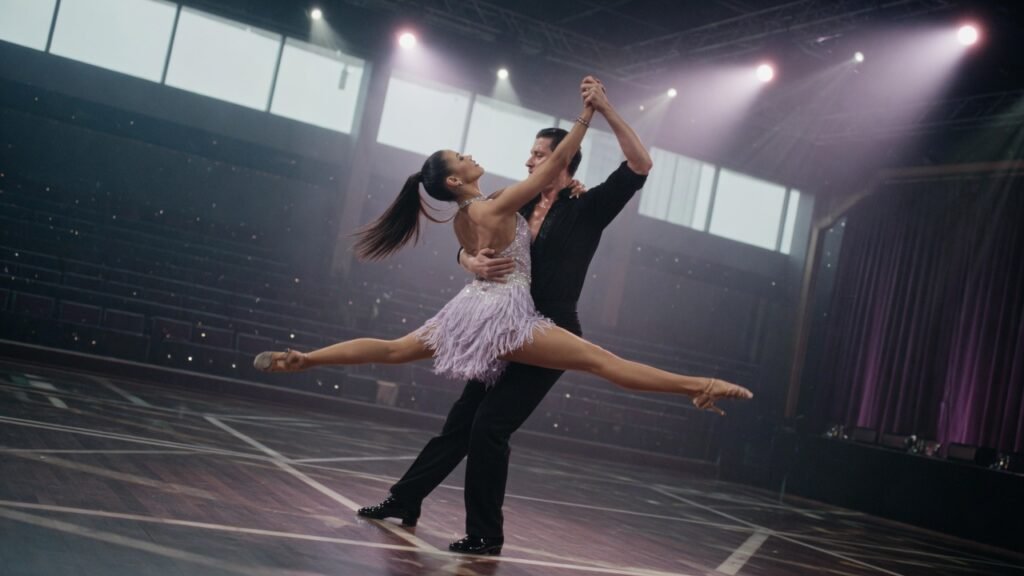
The internet discovered that Jenna Dewan can dance, and the annual DWTS purity panic started right on schedule. Season 35 cast drops, the Step Up lead gets paired with Val Chmerkovskiy, and half the timeline treats a 2006 dance movie like she walked in with the answers already written on her palm. Massive shock: a show built on celebrities learning choreography under hot lights cast someone who has already survived hot lights.
Look, I get it. The premise sells as fish-out-of-water theater. Pair the quarterback, the chef, the sitcom dad with a pro and watch them invent a body for eight weeks. When the fish arrives pre-trained, the fantasy wobbles. Dewan spent years as Janet Jackson’s backup and headlined a movie that made a generation think warehouse freestyle was a viable personality. Fans called it cheating. Fair enough as a vibe check. Terrible as an actual argument about what this show is.
Ballroom Does Not Care About Your Hip-Hop Resume
Dewan’s defense to Entertainment Weekly was cleaner than most of the outrage. “I do not know how to ballroom dance. Let’s be clear. It’s two different languages.” She kept going: training helps with learning choreography and performing, but the rest is unlearning. “It almost threw me off initially because I had to unlearn a lot of — I don’t want to say bad habits — but just habits of the style that I’m used to.”
Stay with me here. That is not spin. That is a working dancer describing a technical wall. Contemporary and commercial styles reward looseness, isolations, and attack. Ballroom rewards frame, partnership, and a kind of posture that looks like it was invented by a military school with better lighting. You do not transfer “I can nail an eight-count” into a clean foxtrot any more than a great freestyle basketball player automatically becomes a pure shooter from the corner. Different mechanics. Different muscle memory. Different failure modes.
She pushed the point further: “It’s not like you’re giving me a style that I’ve done — I can go out there and do that. It has its advantages, but it also has its challenges. But that was part of why I wanted to do it. I really wanted to challenge myself.” The background that supposedly hands her the season is also the thing making her “a little more nervous,” because the technique feels foreign. That tracks. When you already know how good you look doing the thing you know, the first ugly ballroom hold hits harder. Audience memory is unforgiving. The judges will not grade her on Janet Jackson nostalgia.
Val Chmerkovskiy, three-time Mirrorball winner across twenty seasons of this circus, said the quiet part without flinching. “First of all, it’s naive to think that this show is just about dance. It’s about the human experience and the human journey and how much you’re willing to reveal yourself. Dance is a vehicle for us to find out more about these people — and I think that’s our advantage.” Then the part that actually matters for handicapping: with great talent comes incredible expectation. That is his challenge. He wants to push her into something the audience has not seen from her yet. She cut in with the only honest footnote available: “Many years ago!”
The Advantage Discourse Is the Real Lazy Writing
Now, you might be thinking the fix is simple: only cast pure amateurs. Cute. The show has never run that way. Season 35 also rolled out Harry Shum Jr. and Julia Stiles, both of whom have dance credits thick enough to trigger the same Reddit threads. The franchise has always mixed ringers, athletes with body control, Broadway refugees, and people who move like furniture. There is no clean standard because the product is not a pure skill tournament. It is a weekly variety hour that uses dance as the delivery system for personality, backstory packages, and phone-in voting blocs.
If you want Olympic-level purity, you are watching the wrong network. If you want to see whether a forty-five-year-old woman with two decades of performance muscle can strip her instincts and rebuild them under a scoring system that has always been half politics, then Dewan’s casting is the interesting version of the show. The boring version is another celebrity who treats every foxtrot like a hostage situation and gets saved by a charity narrative in week four.
Chmerkovskiy’s framing is the adult read. The dancing is the vehicle. The vote is the referendum on whether the audience likes the person doing it. Dewan arrives with receipts and a thirteen-year-old daughter who is a fan of the show, which is the kind of human detail the edit will milk until the lights go out. She is also filming Season 9 of The Rookie at the same time, which means the schedule is already a negotiation. None of that is an automatic Mirrorball. It is a higher floor and a much louder ceiling of expectation. Miss a heel lead or look bored in a Viennese waltz and the same people screaming “unfair” will pivot to “overrated” without blinking.
The unlearning point is the one the backlash keeps skipping. Habits that made her bankable in commercial dance can fight the frame Val needs. Early weeks often punish the trained more than the blank slate, because the blank slate has nothing to unpick. Dewan has to sand down what already works. That is a real creative problem. It is also better television than watching someone discover their left foot for the third consecutive Monday.
September 15 Will Settle the Noise
The two-night premiere lands September 15 and 16 on ABC and Disney+. Sixteen couples. Val and Jenna in the middle of the noise they already answered. The show will do what it always does: package the journey, score the technique, and let America vote its feelings. If Dewan is technically clean and emotionally closed, she will feel the chill. If she lets the foreign technique look hard on her face while still selling the number, she will own the room the way trained performers sometimes do when they stop protecting their brand.
I walked into this casting news expecting the usual grievance cycle and found something rarer: a celebrity who named the actual craft problem instead of hiding behind “I’m just here for the experience.” Different languages. Unlearning. Expectation as the handicap. That is a sharper brief than half the scripts this franchise has run in the last decade.
The purity police can keep the whistle. I will take the woman who has to forget how she already knows how to move. Ballroom starts in less than two weeks. The only unfair advantage left is knowing the difference between a viral complaint and a dance that has to hold under the lights.