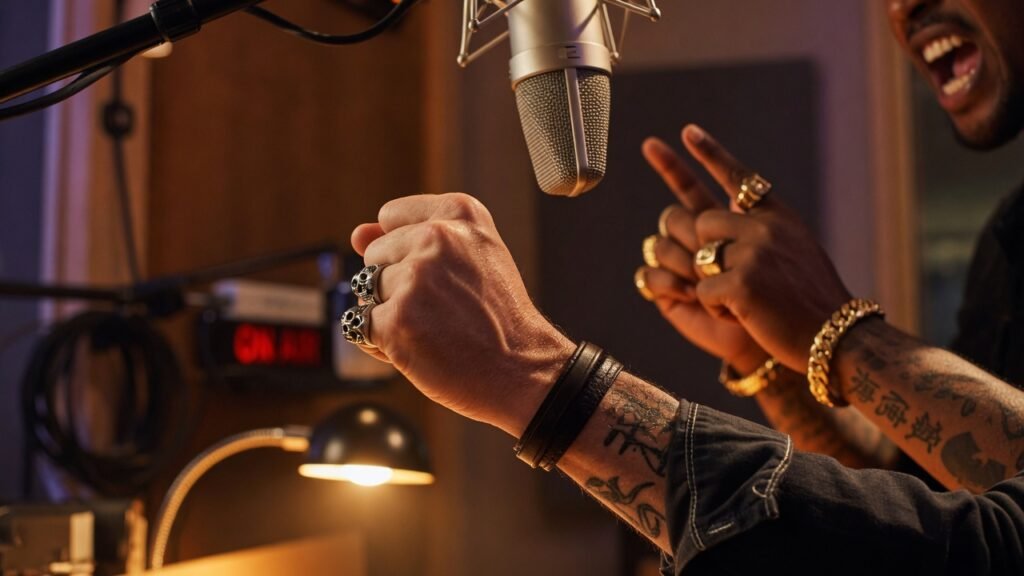
Tom Hardy just spent fifteen tracks proving the loudest thing in his career was never the mask. It was the notebook.
On August 28, 2026, the 48-year-old dropped *Czarface Meets Frankie Pulitzer*, a full collaborative album with the underground hip-hop unit built around Wu-Tang’s Inspectah Deck, 7L, and Esoteric. Fifteen songs. Roughly forty-seven minutes. Features from Busta Rhymes, Method Man, El-P, and Kendra Morris. He does the Bane voice on a Shakespeare monologue. He name-checks Doctor Doom, Cujo, Nicolas Cage in *Bringing Out the Dead*, Willem Dafoe’s Green Goblin, *Titanic*, and Kathy Bates in the same breath. The internet will reduce it to the meme. That is a failure of attention.
This is not a vanity drop. It is the character work finally getting its own runtime.
Hardy has been chasing this since he was a teenager. In 2011 he told BBC Newsbeat the plain version: “I started out rapping when I was 14 or 15.” Then the part that still lands: “Because I come from a nice middle-class neighbourhood it was a very hard sell. And I wasn’t very good!” He recorded with producers who had worked with Lauryn Hill and the Fugees. A 1999 mixtape under the name Tommy No. 1 eventually leaked. He kept saying the music would surface inside a role. “It’ll come out in a film one day, it’ll come out in a character somewhere.” He also left himself an exit hatch: “Maybe I’ll have an album when I’m 80.” He beat that prediction by thirty-two years and did it under the alias Frankie Pulitzer, the same handle he has been feeding Czarface tracks since the 2021 *Venom* cycle.
That continuity is the entire point. Frankie is not a costume he put on for press. It is the through-line that survived the blockbuster machine.
The Bane Monologue Is the Thesis, Not the Gag
Track six, “Grim-Visaged War,” has Hardy delivering the opening of *Richard III* in the Bane register. People will clip it for the joke. Listen again. The same man who built Venom’s voice by mixing “a little bit of Busta Rhymes, a little bit of Method and Redman, a little bit of James Brown, and ever so slightly an element of Richard Burton” is now closing the circuit. The gravel that sold a comic-book antihero is being returned to the MCs who helped invent it, on a record those MCs actually appear on. Method Man shows up on “Mad Technology.” Busta is on “Raw Forever.” The voice study becomes a conversation.
The lyric writing is pure Hardy density. On “Raw Forever” he opens by citing Scorsese’s *Bringing Out the Dead* and Cage’s Frank Pierce, pivots to Dafoe’s Goblin, then *Dog Day Afternoon*, then Doctor Doom. On “Mad Technology” he swings from Cujo to a deliberately ugly Kathy Bates line that would get any pure rapper canceled for the week and somehow reads, coming from him, like another costume change. “Gnawing at My Rhyme Like a Poisonous Rat” folds DiCaprio’s sketch scene from *Titanic* into a flex about figure and capture. These are not random flexes. They are the same referential overload he brings to every accent and physical transformation. He treats bars the way he treats prosthetics: load them until the person underneath almost disappears.
Czarface’s production keeps it in the right basement. This is not a glossy actor-raps-for-charity project. It sits next to *Czarmageddon!* and *Czartificial Intelligence*, the earlier records he already ghosted verses onto. Lead single “Brothers Grimm” arrived in late June with the blood-and-karambit imagery that would sound cartoonish from anyone else and sounds like a man who has played too many killers to flinch. Album of the Year users have it at a 78 across more than a hundred ratings, with the peaks (“Brothers Grimm,” “Mad Technology”) pushing into the low nineties. Spotify shows Frankie sitting around 146,000 monthly listeners. Those are not stadium numbers. They are the numbers of someone who never needed the stadium.
Actor-Rapper Rankings Need a New Shelf
Most actor-to-mic stories are either novelty (a one-off single that dies in a week) or rehabilitation arcs. Hardy skipped both. He built the alias in the margins of the *Venom* films, kept feeding the same collective for five years, then waited until the catalog was thick enough to justify a full meeting record. Compare that to the usual celebrity rap timeline and the difference is discipline. He treated Frankie the way he treats a role: research, repetition, no early victory lap.
The cultural timing helps. We are deep in the era of actors refusing to stay in their lane, but most of them still announce the pivot with a documentary crew and a brand partnership. Hardy released the thing on Silver Age, let the credits and the voice recognition do the talking, and barely spoke about it. That restraint is the flex. In 2026 the loudest move left is refusing to explain yourself.
Does every bar hit? No. Some of the pop-culture stacking tips into checklist energy, and the Kathy Bates line will age into a dare more than a punchline. A few tracks sit in the low sixties on user tallies for a reason. But the hit rate is high enough, and the concept is clean enough, that the misses feel like texture instead of collapse. The record works because it sounds like the man who has spent two decades turning himself into other people finally turning the process outward and keeping the receipts.
The larger claim is simple. Great screen acting and great underground rap share the same obsession: voice as architecture. Hardy has always built characters from the throat up. Frankie Pulitzer is what happens when that architecture gets its own album cover. The Shakespeare-in-Bane moment is not a stunt for the timeline. It is the thesis statement. The winter of our discontent, delivered by the man who already made audiences believe a man in a mask could rearrange a city’s air supply, now standing inside a cypher with the people who taught him how the mask should sound.
STREAM IT LOUD. Score: 8/10 — a fully earned character album from a star who treated the mic like another role he refused to phone in, and the collabs prove the homework was real.