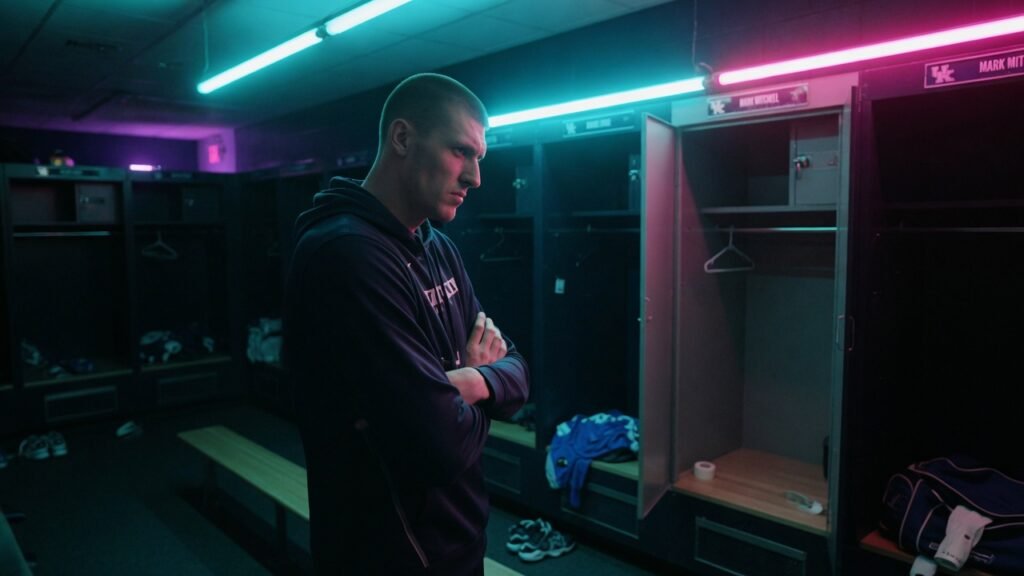
The SEC just told Mark Pope that the best frontcourt piece he landed all summer might cost him half a season on the sideline, half his basketball operating budget, and a chunk of Kentucky’s voting rights. All because Mark Mitchell entered the portal in August instead of April.
I have watched this league invent new ways to punish ambition for twenty years. This one is special. Mitchell averaged 18.3 points, 5.2 rebounds, and 3.6 assists last season at Missouri on 54.7 percent shooting. He dropped 32 on Kentucky in the SEC Tournament. He is 6-foot-9, 230 pounds, and one of the few isolation scorers left who can actually create his own shot at the high-major level. Pair him with Milan Momcilovic and Malachi Moreno and you have a trio that can stand up to Florida’s size without blinking. The SEC’s answer is a calendar technicality.
Mitchell finished his degree at Missouri under the old four-and-done rules. The NCAA’s five-for-five model arrived in June and left the 2022 high school class outside the grandfather gate. He went through the draft as an automatic senior, went undrafted, suited up for the Denver Nuggets in Summer League, and then joined the Jefferson County lawsuit seeking a fifth season. On Aug. 21 Judge Brian Edwards handed down a temporary restraining order. Mitchell hit the portal the same day, committed to Kentucky inside 24 hours, and suddenly Birmingham remembered it still owns an intra-conference transfer bylaw.
Players can only move from one SEC school to another if they enter during the sport’s regular portal window. For men’s basketball that was April 7-21. Mitchell had zero reason to enter then. He thought his college career was over. The conference reaffirmed the rule anyway after presidents and chancellors met this week. Football drove the conversation, with LSU chasing former Ole Miss players cut by NFL teams, but basketball sat in the same room. Mitchell is collateral and target at the same time.
The Pro Ban Cleared Him. The Calendar Did Not.
Craig Pinkerton, the SEC’s director of communications, drew a clean line on the Summer League question. “A player who played in the 2026 NBA Summer League still could be eligible to play in the SEC during the 2026-27 season if (1) he did not enter the 2026 NBA Draft as an early entrant (and instead was automatically eligible for the 2026 NBA Draft based on NCAA rules in effect at that time) and (2) he never signed any type of NBA contract, including an Exhibit 10 or Two-Way contract.”
Mitchell’s brother and agent, Brandon Mitchell, was just as direct: “He did not sign anything.” The pro-athlete crackdown that Sankey got authorized to enforce does not touch him. Only the April window does. That is the entire case the conference is hanging its hat on.
Kentucky saw this coming before the commitment, according to multiple reports. The program still took the player. Now Mitchell’s attorneys have amended the complaint to allege the SEC and Sankey are acting in concert with the NCAA on eligibility, and they want the restraining order expanded to cover the conference. A hearing is already on the books. Practices start in weeks. The season opener is Nov. 3 against Manhattan. This is not abstract governance. This is a roster that either has an elite scorer or a crater where one should be.
I already covered Kiffin turning NFL cuts into an LSU lawsuit pipeline. Same conference, same week of meetings, same impulse to stock a roster through a courtroom when the portal windows and the draft calendar refuse to line up with reality. The difference is Mitchell never pretended he was still a pro. He just wanted the fifth year the NCAA’s own new rule implied should exist for someone in his position.
Pope Either Fights Or Admits the Contender Talk Was Theater
The listed penalties are not gentle. Half-season suspension for the head coach. Fine equal to 50 percent of the sport’s operating budget. Revocation of SEC voting privileges. Greg Sankey gets discretion on top of that. If Kentucky rolls over, every other program in the league just learned that a rule written for a pre-NIL, pre-portal world still has teeth when it is convenient. If Kentucky takes the court fight and wins, the intra-conference transfer ban becomes another piece of paper the lawyers shred on the way to November.
I am not interested in the purity argument. The purity argument died the first time a booster wrote a seven-figure NIL check and the NCAA called it education. Mitchell played two years at Duke, two at Missouri, started 133 of 134 career games, and put up All-SEC numbers while finishing his degree. The only thing that changed is a June vote that failed to protect the exact class that needed protection most. He used the legal system available to him. Kentucky used the roster spot available to it. The SEC is the party insisting the old clock still governs.
Florida is sitting over there with a roster built to steamroll the league. Kentucky’s path to matching that physicality runs straight through Mitchell. Momcilovic stretches the floor. Moreno is already drawing first-round projections for 2027. Lose Mitchell and the frontcourt becomes ordinary overnight. That is the actual stake. Not some abstract commitment to “process.” A concrete group of players who can win games in March or a technicality that makes Birmingham feel in control for one more cycle.
Kentucky has the look of a contender with him. Without him it has the look of a program that blinked. I know which version I would rather watch. The TRO already exists. The amended complaint already names the conference. Pope and the administration either back the player they just landed or they hand Sankey the win and spend the rest of the year explaining why the three-headed monster never got to play together. The hearing is coming. The practices are coming. The only open question left is whether Kentucky still remembers how to fight its own league.