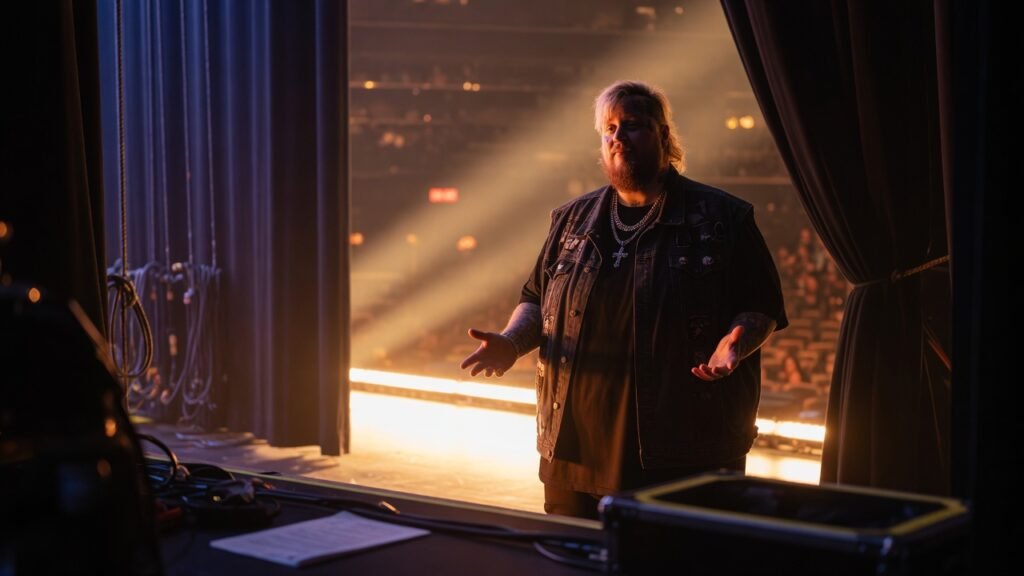
Jelly Roll spent eighteen minutes on Thursday night doing the one thing American pop culture keeps insisting is impossible: telling the truth without picking a jersey.
He had just finished a week of guest-hosting Jimmy Kimmel Live, and the internet had already drafted him twice. First as the MAGA country boy who once shook Donald Trump’s hand at a UFC event. Then, after a run of monologue jabs about Trump’s weight, the Freedom 250 IndyCar circus, and the Canada trade spat, as a “liberal snowflake” who had sold out to the late-night machine. By the time the final show rolled around, fans were threatening to delete his songs and Florida officials were telling him he was unwelcome in the Panhandle. So the 41-year-old Grammy winner did what almost nobody with a platform still does. He explained himself without groveling.
“But let’s be real about this, y’all. Do you think I would take orders from some sweaty little dork named Josh? No, I was just telling it like it is. And for some reason, that seemed to freak a lot of people out.”
That line is the whole story. The jokes were his. The risk was his. The freak-out belonged to everyone who needs artists pre-sorted into tribes so the outrage economy can keep running on schedule.
He Knew the Storm and Walked Into It Anyway
Jelly Roll has said he understood exactly what kind of mess guest-hosting would create. He did it anyway because he had already lived the version of himself that stayed quiet. At the 2026 Grammys, where he took home three awards including Best Contemporary Country Album for Beautifully Broken, he dodged a politics question. He later called that dodge a regret. Scared, hurting people were looking for someone to speak, and he chose safety. The Kimmel week was the correction.
He roasted Trump the way late night has roasted presidents for decades: physical comedy, absurdist bits, a fake weight-loss drug ad called “Donjaro.” He compared his own three-hundred-pound weight loss to “losing an entire Donald Trump.” From one fat pig to another, he said. The bits were broad, sometimes crude, and entirely standard for the format. What was not standard was the speed with which a chunk of his audience treated punchlines as a loyalty test.
On Thursday he met that test head-on. “It is funny that before this week everybody thought I was MAGA. And now they think I’m some sort of liberal snowflake. Hosting Jimmy Kimmel’s show doesn’t mean I have all of Jimmy Kimmel’s politics. Sure, I lean left on some things, but like most folks I’m pretty down the middle.”
Then he listed the actual inventory: Christian. Country music singer. Farmer. Bow hunter. Most of what he eats, he prefers to get with a stick and a string. He spent the week inside a building full of “chihuahua-hugging, oat-milk-latte-loving lefties” and had a blast. He also made clear that watching a UFC fight at the White House does not equal a blank check for an administration, any more than hosting Kimmel makes him a pure vessel for Kimmel’s worldview. Grown-ups used to understand this. The monologue felt like a public reminder.
The Handshake Was About a Marine, Not a Movement
The part that will travel longest is the father. Jelly Roll’s dad, a Marine Corps veteran, died in 2019. When Trump asked for a handshake at that November 2024 UFC event, the singer took it. “This might be a hot take, but out of respect for him and everybody who has ever served and continues to serve this country, I will always shake the hand of the sitting president of the United States when asked,” he said. “My father would have been disappointed had I done anything other than that.”
He was proud of the handshake. He was equally proud that he lives in a country where he can turn around and joke about the man on national television. That double pride is the actual American inheritance, and it has become nearly unspeakable. One side hears the handshake and screams traitor. The other hears the jokes and screams traitor. Jelly Roll stood in the middle of both reactions and refused the script.
He also noted that his voting rights were restored only in March of this year after a felony-related ban. He plans to use them in the November midterms. He wants to be a voice for the voiceless. He cited Jesus on loving God and neighbor with no party or border exemptions. He got emotional. An eighteen-minute monologue on a talk show is supposed to be disposable. This one had the shape of a short film: setup, pressure, confession, release.
Country Music Keeps Trying to Kill Its Own Best Instinct
Here is the part the culture-war machinery cannot metabolize. Jelly Roll’s entire artistic brand is second chances. Addiction, prison, obesity, redemption, faith that does not require a voter guide. Of course a man built on that material lands “pretty down the middle.” Country music once specialized in exactly these complicated humans. Somewhere along the way the genre decided political purity was safer than moral messiness. The same fans who stream songs about broken people now demand unbroken partisan loyalty from the singer. That demand is the real soft bigotry of low expectations.
Late night has its own disease. The format still runs on the assumption that every guest host will deliver the approved roasting package, then disappear. Jelly Roll delivered the package and then spent eighteen minutes explaining why the package did not own him. He turned a summer hiatus fill-in into the clearest recent statement we have heard from a mainstream artist about the exhaustion of forced sides. The writers did not force him. The audience’s categories could not contain him. The only people truly threatened by that are the ones whose business model requires containment.
I walked away from the clip more hopeful about American storytelling than I have felt in months. Not because Jelly Roll solved polarization. Because he modeled what it looks like when a public figure treats the audience like adults capable of holding more than one idea. The jokes landed. The tears landed. The stick-and-string self-portrait landed. The refusal to apologize for either the handshake or the roast landed hardest of all.
Watch the full Thursday monologue, not the clipped outrage versions. Let the eighteen minutes play without a comment section open. Then decide whether you still need him filed under one label. Most of the country is already living where he just stood. The industry is simply late to the map.
VERDICT: WATCH the Aug. 27 monologue straight through. Cultural courage score: 9/10 — he turned a guest-host gig into the rarest primetime act left: an unbranded human being.