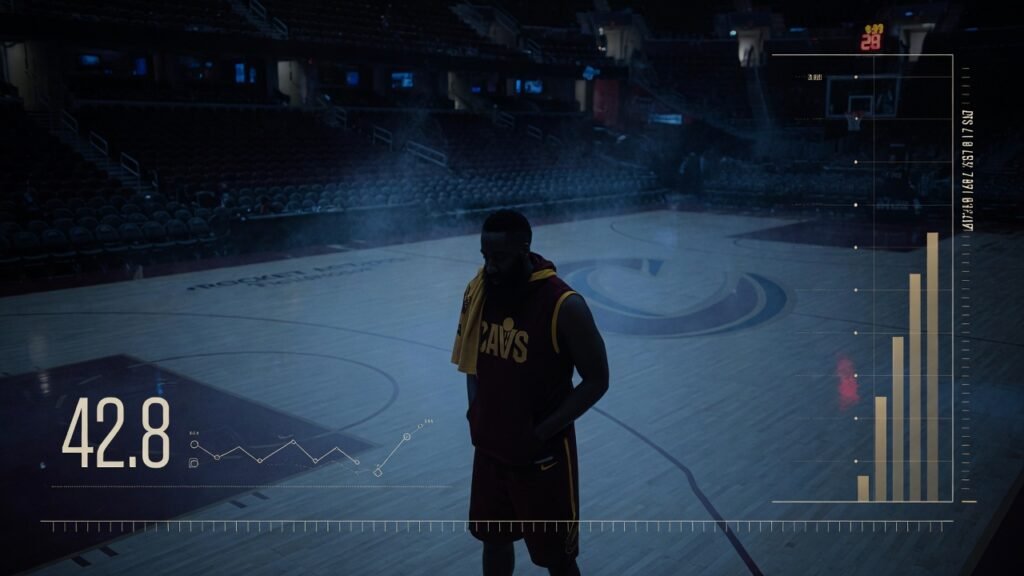
James Harden just took $10 million a year off the table so Cleveland could finish building a roster around him. That is the entire story. The three-year, $97 million deal he agreed to Thursday, player option in year three and a 15 percent trade kicker attached, is not a victory lap for a fading superstar. It is a salary-cap instrument that let Koby Altman add Peyton Watson, clear both aprons, and lock Donovan Mitchell into a maximum extension through 2030-31 without detonating the books.
Harden declined his $42.3 million player option in June knowing exactly what he was doing. He sat through free agency while the Cavaliers missed on LeBron James, flipped Dennis Schröder, and finally executed the five-team sign-and-trade that brought Watson in on four years and $88 million. Harden recruited the 23-year-old himself. The resulting starting five of Harden, Mitchell, Watson, Evan Mobley, and Jarrett Allen is the product of that patience, not a coincidence.
The $97 Million Is the Discount That Bought the Apron
Cleveland needed the lower annual number. A two-year deal at higher AAV would have kept them trapped above the first apron and hard-capped their ability to move. The three-year structure at roughly $32.3 million per season gave Altman the breathing room to complete the Watson acquisition one day before Harden’s agreement became public. That sequence is the real transaction. Everything else is window dressing.
Harden will finish the contract with career earnings of $511 million, the fourth player in league history past $500 million after LeBron, Kevin Durant, and Stephen Curry. He becomes only the second player, after LeBron, to sign more than $90 million guaranteed at age 37 or older. Those milestones matter for the ledger. They matter less for the half-court.
What matters on the floor is the usage he still commands. After the February trade from the Clippers, Harden averaged 20.5 points, 7.7 assists, and 4.8 rebounds in 26 regular-season games for Cleveland. The Cavs went 21-9 once he debuted. He led the league in isolations and ranked second in made step-back threes. That is not nostalgia. That is still a functional offensive engine next to Mitchell.
In the playoffs the scoring held at 19.2 points across 18 games, but the three-point percentage cratered to 29.9 percent and the Knicks swept them in the Eastern Conference finals. Harden’s own postmortem was blunt: “I think we found something. It’s tough not ending how we wanted to, but I think we found something.” I believe him on the first half. The second half is why the player option exists.
Mitchell Needs the Second Creator More Than the Narrative Needs a Savior
The Mitchell-Harden backcourt is the scheme bet. Cleveland’s offense after the trade ran through two high-usage guards who can both create off the bounce and both punish a switched big with a step-back. Mobley and Allen become finishers and short-roll threats instead of primary initiators. Watson’s length and vertical spacing give them a weak-side athlete who can punish the help that Harden’s isolations inevitably draw.
That is a coherent half-court identity. It is also a bet that a 37-year-old’s legs hold through another 80-game slog and a deeper playoff run than the one that ended in a sweep against New York. The regular-season efficiency after the trade (43.5 percent from three in some splits) suggests the shot is still there when the legs are fresh. The playoff drop-off is the warning label printed on the contract.
I keep coming back to the mechanism Altman used. He let Harden wait. He used the time to acquire a 23-year-old wing on a team-friendly deal. He kept Mitchell. He stayed out of the second apron. The $97 million is the price of that flexibility, paid by the player who still wants one more clean crack at the East.
Harden is entering Year 18. This deal can carry him into a 20th season. The Cavaliers are not paying him to be the 2018 MVP. They are paying him to be the second creator who lets Mitchell attack downhill and gives Mobley the spacing he has never consistently had. If the three-point percentage recovers even halfway toward his career norms, the apron math looks brilliant. If it stays at playoff levels, the player option in 2028-29 becomes the exit ramp everyone already priced in.
The Knicks own the recent sample. Cleveland just bought two more years of the counter-sample. That is the wager.