James Harden has not signed his next deal with Cleveland, and treating that as suspense is a category error. The Cavs are not waiting on a decision. They are using the unfinished paperwork as a roster construction tool, and everyone inside the building is already penciling him in as a Cavalier.
Chris Fedor put it without hedge on the Wine and Gold Talk podcast: “There’s no benefit right now to the Cavs getting something locked in with James Harden. And there’s nothing that is preventative for the Cavs to wait. And there’s nothing preventative for James Harden to wait.” That is not spin. That is apron arithmetic. Harden declined his $42.3 million player option on June 29, the last year of the two-year, $81.5 million Clippers structure. A fresh multiyear deal at a lower annual number gives Cleveland room to breathe under the first apron (~$209M) and second apron (~$222M) while it still hunts an impact wing. Locking him in early would freeze the sheet and kill the non-taxpayer MLE access they still want.
The organization is not talking about a free agent. Fedor again: everybody inside is talking about “James Harden, the Cleveland Cavalier. Not James Harden, the free agent.” They have planned around him since the February trade that sent Darius Garland and a second-rounder to the Clippers. That framing is the entire story.
The Delay Is the Cap Space
I keep coming back to the mechanism. Harden’s next contract is expected to top out at no more than two fully guaranteed years, with the first-year number fluid enough to leave MLE room or create matching salary for a sign-and-trade. Ramona Shelburne reported the wait was specifically to let the front office poke around restricted free agent Peyton Watson, with secondary looks at Jonathan Kuminga and other wings after the LeBron pursuit died and Mario Hezonja landed instead. Watson’s 2025-26 line (14.6 points, 4.9 rebounds, 1.1 blocks on 49.1 percent shooting and 41.1 percent from three in 54 games) is exactly the defensive length Cleveland lacked when the Knicks swept them in the Eastern Conference Finals.
Harden understands the tether. Fedor noted that “everybody understands how James and what contract he ultimately signs with the Cavs is tied to the kind of activity that the Cavs can make this off season and the kind of improvements that they can make as a team.” That is not loyalty theater. It is a 36-year-old (he turns 37 on August 26) who just posted 20.5 points, 7.7 assists and 4.8 rebounds on 43.5 percent from three across 26 regular-season games in Cleveland, helping the team go 19-7 after the trade, deciding the long-term money is safer if the supporting cast improves now. The playoff drop (19.2 points, 5.5 assists, 29.9 percent from three in 18 games) is real, but the regular-season fit was not a mirage.
Jake Fischer’s reporting tracks the same logic: Harden and the Cavs remain “in lockstep” while the front office keeps shopping. There is no competing offer driving a wedge. There is no reported bad blood. The misdemeanor gun charge from the June 13 Houston traffic stop was dismissed August 7 after an alternative resolution program. That cloud is gone. What remains is CBA chess.
Nineteen Wins Already Paid the Deposit
The on-court sample is why the patience holds. Full-season Harden still averaged 23.6 points and 8.0 assists across 70 games. In the wine-and-gold stretch he tightened the shot diet, hit threes at an elite clip, and ran pick-and-roll actions that finally gave Donovan Mitchell a secondary creator who does not need the ball glued to his hands. Cleveland’s half-court offense stopped dying on the vine whenever Mitchell sat. That is the version they are building around, not the volume-chasing Clippers edition.
Compare it to other aging creators who restructured for contenders. The pattern is the same: take less annual cash, get more years or more certainty, and give the front office one last window to add a two-way wing before the second apron locks everything down. Harden’s camp (Mike Silverman, Troy Payne, Brandon Grier) is not inventing leverage. They are simply refusing to close the window early.
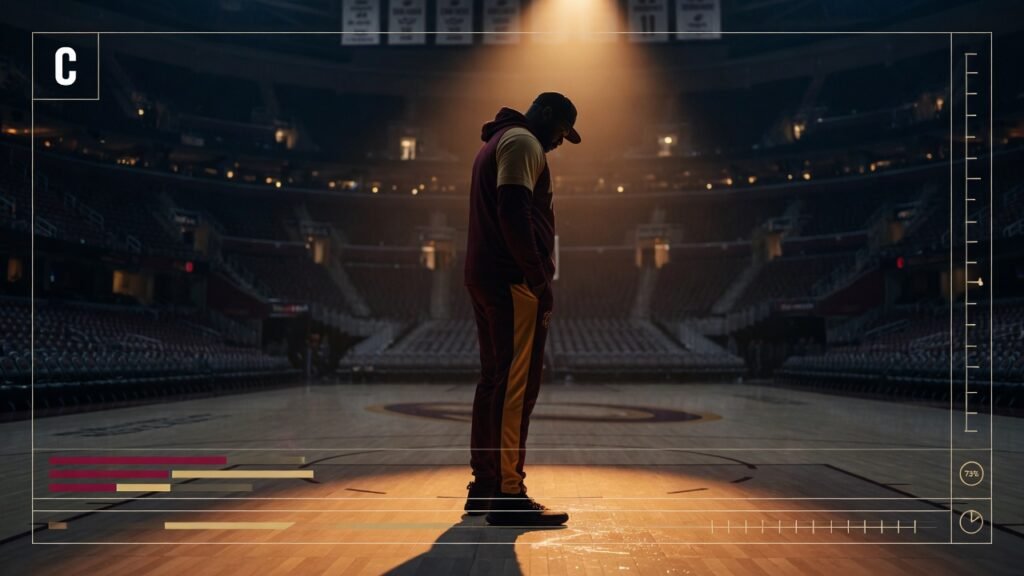
Fedor floated the visual that stuck with me: it would not be surprising to see Harden in Cavs gear at workouts right now “because everybody expects him to be a member of the Cavs, and they’re planning for him to be a member of the Cavs. Just like they have been since they traded for him in February.” That is the opposite of a standoff. That is a shared calendar.
I do not see talks collapsing. I see a deal landing once the Watson/Kuminga market clarifies, probably in the two-year range with a first-year number closer to the high $20Ms or low $30Ms if they need the flexibility, or closer to a $60-64 million total if the wing addition never materializes. The frustration some outsiders are projecting onto Harden is noise. The people actually in the room are treating the re-sign as settled and the delay as the smartest money they can still spend.
Cleveland already paid for Harden once in February. The unsigned contract is just the second installment of the same bet. They expect him back because the basketball and the math both still point the same direction. Anyone waiting for drama is watching the wrong film.