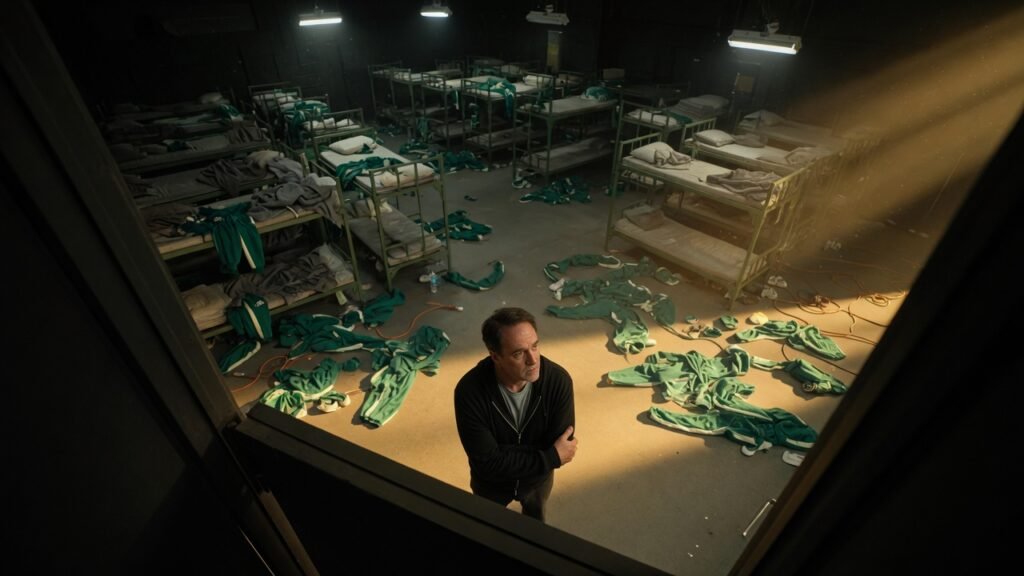
Netflix just killed David Fincher’s American Squid Game spin-off, and the loudest sound in the room should be relief. Not nostalgia. Not another round of “what could have been.” Relief. The most expensive instinct in modern television just got a hard no, and for once the platform that greenlit every half-baked franchise extension in its vault actually walked away from the one that would have embarrassed it most.
This was never a show. It was a thesis statement with a director attached. Take the Korean phenomenon that conquered the planet on the strength of its specificity, strip the cultural voltage that made it dangerous, hand the carcass to one of the great American stylists, and pray the brand equity does the rest. That is not development. That is cosplay with a prestige budget.
The Original Never Asked for a Passport
Squid Game worked because it was violently particular. The debt crisis, the childhood games turned lethal, the class rage humming under every bright tracksuit: those were not generic “eat the rich” stickers you could peel off and slap onto an Ohio warehouse. They were Korean. The series became a global event precisely because it refused to sand itself down for export. Viewers did not need subtitles explained to them. They needed the world on screen to feel lived-in and hostile in ways Hollywood’s default settings almost never allow.
An American version was always going to answer the wrong question. Instead of “what does this story still have left to say,” it asked “how do we own this IP in English.” Fincher’s name was supposed to launder that transaction. The man who turned serial killers and tech billionaires into cold poetry would, the thinking went, elevate a remake into something cooler than a remake. Cool was never the problem. Hollow was.
The reports call the project officially dead. Good. Prestige directors are not magic erasers. They cannot invent stakes a story no longer possesses. Fincher at his best is a surgeon of systems: the machine, the code, the institution that grinds people down. Squid Game already had that machine, and it ran on a fuel Hollywood keeps trying to dilute. Transplanting it was never going to produce a sharper cut. It was going to produce a handsome autopsy.
Netflix Is Still Addicted to the Wrong High
Look at the pattern. Every time a non-English series detonates, the corporate reflex is the same: localize, franchise, Americanize, rinse the foreignness until the thing is safe enough for a dual-language press tour. Sometimes you get a decent companion piece. More often you get a ghost that spends its entire runtime apologizing for not being the original. The American Squid Game was lining up to be the purest version of that failure mode, because the original’s power was inseparable from the society that produced it.
This cancellation lands at a moment when the streamer is still trying to figure out what “event television” even means after the binge era peaked. Reality formats are eating prestige’s lunch in raw minutes watched. International originals keep proving that audiences will cross language barriers for something that feels necessary. And yet the development machinery keeps defaulting to the same move: find the hit, build the English mirror, hire the brand-name filmmaker, announce it like a victory lap. Fincher’s exit from this particular lap is not a tragedy. It is a data point the company should frame.
There is a version of expanding the Squid Game universe that could have been genuinely unsettling: new games, new debtors, same pitiless architecture, still rooted in the world Hwang Dong-hyuk built. That is not what an “American spin-off” signals. American spin-off signals boardrooms asking how to make the next season easier to promote at the Emmys. It signals fear that the original’s success was a fluke of timing rather than a hard-earned artistic win.
I have watched this industry treat Love Island-level cultural capture like a cute seasonal glitch while throwing real money at prestige brand extensions that nobody asked to see translated. The Fincher project sat right in the middle of that confusion. Kill the confusion. Keep the original’s teeth.
Let the Games Stay Dangerous
What happens next matters more than the obituary. Netflix still owns the mothership. The smart play is to protect the thing that actually broke through instead of cloning it for markets that already watched the Korean version in record numbers. The audience already proved it would show up for the real article. Manufacturing a safer cousin was always a solution in search of a problem.
Fincher will be fine. He will find another system to dissect, another set of beautiful surfaces hiding rot. The loss here is not his. The loss would have been ours if this thing had staggered onto the service looking expensive and empty, another reminder that Hollywood still believes every story is improved by making it more familiar. Some stories get worse the second they learn English as a first language.
Squid Game did not need a translator with final cut. It needed executives willing to admit that the version the world already fell in love with was enough. For one clean afternoon, Netflix admitted it. That is not a cancellation. That is the first intelligent creative decision this franchise has seen from the American side of the ledger. Protect the original. Stop trying to naturalize it. The games were always more terrifying when we were the ones who did not fully understand the rules.
WATCH the Korean original again if you need a fix. SKIP whatever English-language consolation prize they eventually try to float in its place. 9/10 for the cancellation itself: the rare studio flinch that actually serves the audience.